

Wuying-Browser-Agent-27B, posted to arXiv on 19 August 2026 by Alibaba Cloud's AI team, scores 65.1% on a new 350-task benchmark where the average task takes 37.9 steps S¹P². Most browser agents ace short demos then fall apart on real websites, and the field has lacked a benchmark long enough to prove it. This paper claims to fix both problems at once. Whether 65% is a floor or a ceiling is the question the paper itself leaves hanging.
My read: The 37.9-step average is the number that matters most here. Wuying's answer is to train explicitly on recovery trajectories, rather than success paths alone. That is the right instinct. I don't buy the "open-source state of the art" framing yet, because the paper doesn't specify licensing or weight availability, and the results are self-reported on a self-built benchmark. But the benchmark design, 350 bilingual tasks averaging nearly 38 steps, is the kind of test this field has been missing.
Why 37.9 steps breaks everything
The paper's core argument is simple: browser agents do fine on short, tidy demos. Real deployment is different. Agents must hold together dozens of decisions on live sites, recover from their own mistakes, and handle interfaces they have never seen S¹. Most benchmarks in this field are too short to surface the failures that only appear after many steps S¹.
Think of it like cooking. A five-step benchmark tests whether you can chop an onion. A 38-step benchmark tests whether you can cook the entire meal and adjust when you burn the sauce so you still serve something edible. The first is a demo. The second is a job.
The researchers' new benchmark, BrowserBench, consists of 350 bilingual tasks with an average length of 37.9 steps S¹. That length is the point. At 38 steps, a model needs to remember what it did 20 steps ago, recover when a page loads differently than expected, and deal with UI elements it has never encountered. Short benchmarks hide all of that.
The four-layer fix
To close the gap between demonstrations and actual deployment, the researchers contend that every pipeline layer, execution, supervision, optimization, and evaluation, must be aligned, instead of merely increasing model size S¹. Wuying-Browser-Agent operates as an integrated framework addressing all these components S¹.
For execution, the system uses a structured browser setup that provides dependable methods for the agent to interact with web pages and controls what data is retained in context at every step S¹. In plain terms: the agent gets a stable set of tools for clicking and typing on pages and reading their contents, plus a system that keeps the right details in view at each step.
The supervision and optimization layers are where it gets interesting. The RUIC-SFT training approach exposes the model to difficult interface scenarios and sequences where it must fail and then recover S¹. Translation: the model practices failing and fixing itself, rather than succeeding alone. Additionally, the DAO-GRPO reinforcement learning technique isolates the exact step in a lengthy sequence that caused a breakdown, applying step-level weighting and reward shaping to better allocate credit S¹. That matters because in a 38-step task, knowing whether step 4 or step 31 broke the run is the difference between learning and guessing.
What the numbers actually say
Wuying-Browser-Agent-27B scores 80.6% on WebVoyager, 66.7% on Online-Mind2Web, and 65.1% on BrowserBench S¹. The decline from 80.6% to 65.1% tells its own story: as benchmarks get longer and messier, the success rate drops. Even with a framework built for long-horizon tasks, a 27-billion-parameter model still fails on roughly one in three BrowserBench tasks.
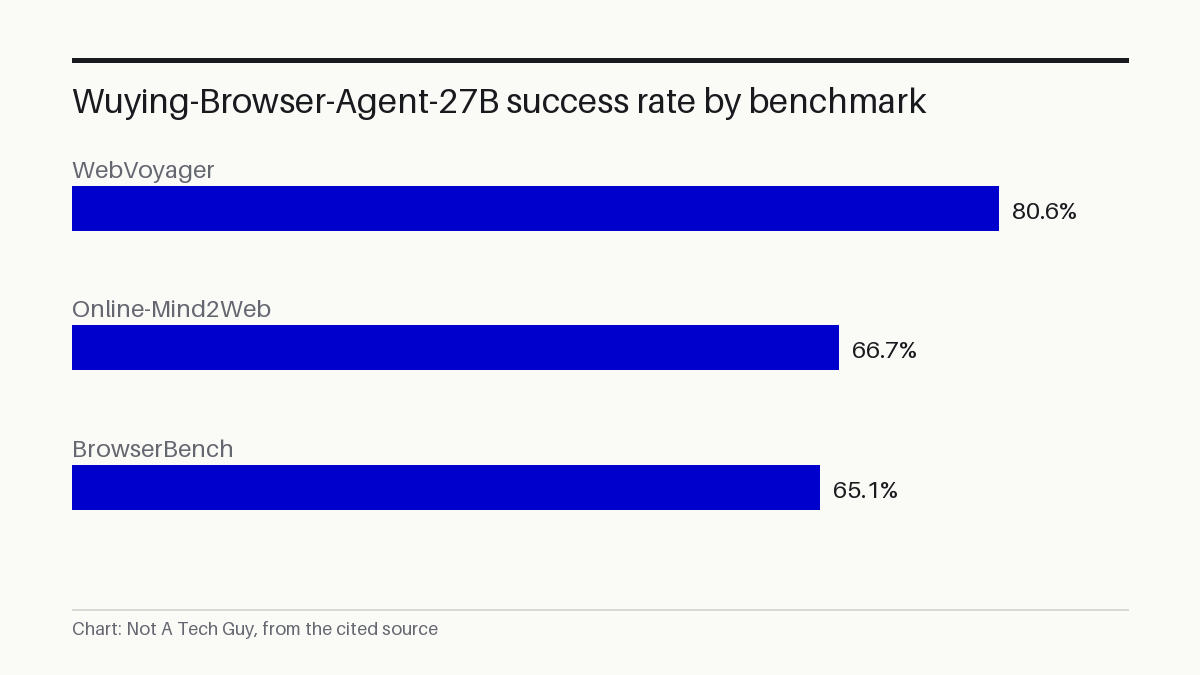
The authors claim these results set a new open-source record on browser-use benchmarks S¹. That claim comes with caveats: the results are self-reported and the paper is not peer-reviewed, with the abstract not specifying whether model weights or code are publicly available under an open license.
Beyond the browser
Wuying's training methodology extends beyond web browsing, achieving a 73.8 average across three general agent benchmarks: Tau2-Bench, Claw-Eval, and BFCL-v4 S¹. These are not web-specific tests. They measure whether an agent can handle multi-step tool use across different domains.
The aggregation method for that 73.8 average across three distinct benchmarks is not detailed in the abstract, so the number should be treated as a directional signal rather than a precise comparison.
Meanwhile, Microsoft's separate Webwright initiative approaches the issue differently, equipping the model with a terminal to launch and freely explore browser sessions rather than predicting individual clicks P⁴. Both projects are chasing the same gap between demo and deployment, but from opposite directions. Wuying trains the model to recover from mistakes inside the browser. Webwright gives the model tools to bypass the browser entirely.
What to do about it
If you build agent systems, the practical signal here is about training data, not model size. The Wuying team's key bet is that recovery trajectories matter more than clean success paths. A team building a browser agent for, say, an insurance claims processor that needs to log into a carrier portal, work through a multi-page form, upload documents, and handle session timeouts would get more from training on failure-and-recovery sequences than from another round of clean demonstrations.
The BrowserBench design is also worth copying internally. Build your own evaluation set with tasks that average 30-plus steps on real websites, not sanitized test pages. If your agent scores 90% on a five-step benchmark and 40% on a 35-step one, you have your answer about deployment readiness.
One thing to check this week: the Wuying AgentBay SDK on GitHub (agentbay-ai/wuying-agentbay-sdk) is public under Apache 2.0 with over 1,100 stars P³. Whether the model weights themselves are available is a separate question the paper does not answer.
What we don't know yet
The paper is an arXiv preprint. It has not been peer-reviewed, and the benchmark results have not been independently reproduced S¹. The "open-source state of the art" claim lacks specifics on licensing and weight availability in the abstract. The 73.8 cross-benchmark average is reported without a detailed aggregation method. And there are no direct comparisons to proprietary systems from OpenAI, Anthropic, or Google on the same benchmarks.
The next signal: whether Alibaba Cloud releases the Wuying-Browser-Agent-27B weights and the BrowserBench task set publicly. Without those, the "open-source" claim is a label, not a verifiable fact. We'll check the GitHub repository and arXiv updates for release artifacts. If you want to follow that thread with us, subscribe and we'll flag it the moment it lands.
Sources: S1 — Wuying-Browser-Agent: Real-World Centric Fundamental Long-Horizon Brow · P2 — Wuying-Browser-Agent: Real-World Centric Fundamental Long-Horizon Brow · P3 — agentbay-ai/wuying-agentbay-sdk · P4 — Webwright: A Terminal Is All You Need For Web Agents - Microsoft Resea · P5 — GitHub - microsoft/Webwright: A simple SWE style browser agent framewo
More from Not A Tech Guy
- Agent memory boosts gpt-oss 16 points but does nothing for GLM-5
- OpenAI adds safeguards to pace frontier AI model development
- Hugging Face adds multi-vector retrieval to sentence-transformers
Generated from an audited evidence pack with primary-source research. Social-media items are discussion signals, not verified facts. Nothing here is financial, legal or medical advice.


