

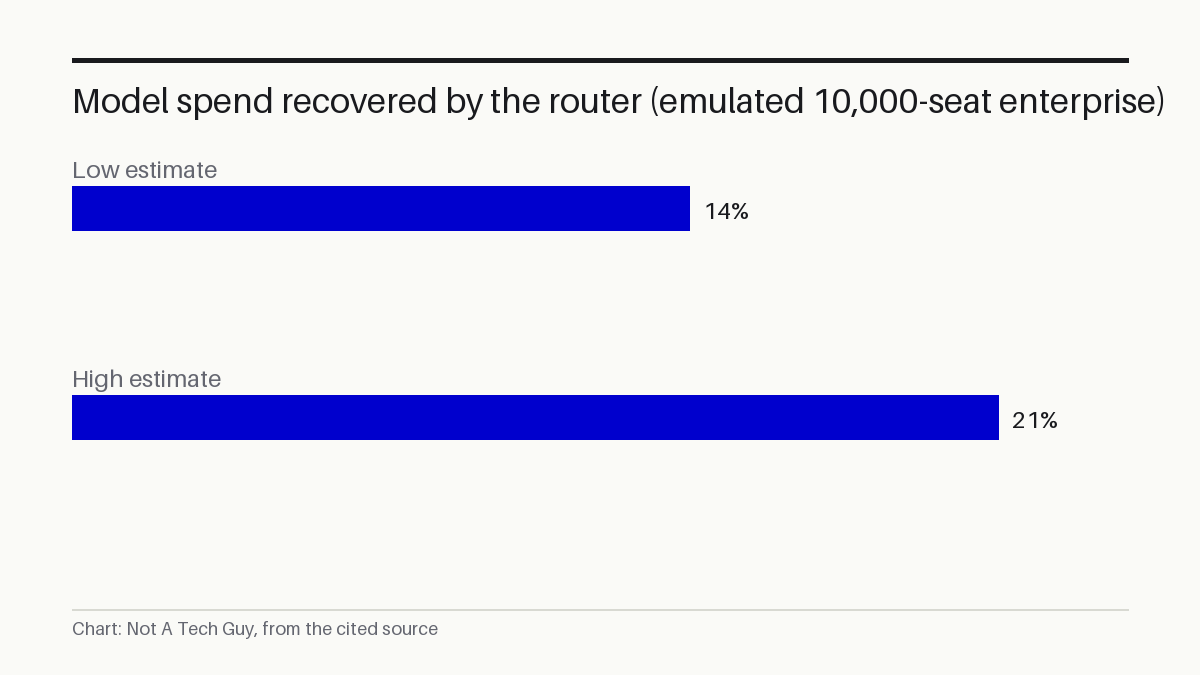
Anthropic's Claude Code and OpenAI's Codex are scaling from pilot deployments to tens of thousands of enterprise seats, and most buyers leave the defaults alone, inheriting the vendor's bill S¹. A router described in a 25 September preprint recovers 14 to 21 per cent of that spend, up to $5 million a year for a 10,000-seat firm, by classifying each prompt and routing the easy ones to cheaper models S¹ (no error bars reported, no code released, savings derived from emulation rather than live deployment). On long, tool-heavy sessions, the most expensive model can actually cost less than the next tier down, because it finishes the task in fewer steps S¹.
My read: This is the first paper I have seen that treats the AI coding agent harness as a cost-control surface rather than just a developer tool. The savings figure is derived from emulation, not a live deployment, and the pricing uses Anthropic's list prices dated 21 September 2026, which appear to be hypothetical. I would want to see the router tested against a real enterprise's actual usage patterns before trusting the dollar figures. But the core insight, that the harness decides which model answers and therefore sets the bill, is sound and immediately actionable for any engineering leader buying Claude Code or Codex at scale.
How the harness sets the bill
A harness is the product that runs an AI coding agent. Most enterprises buy one from a large vendor rather than building their own, with Anthropic's Claude Code and OpenAI's Codex as common examples S¹. The harness decides which model answers each prompt, what context the model reads, how the prompt cache is used, and which subagents spin up S¹. Each of those decisions picks a line on the vendor's price sheet and sets the volume bought at that rate S¹. Leave the harness at its defaults and you inherit every choice the vendor made, along with the bill S¹.
This matters because the harness is becoming the primary interface between enterprises and frontier models. The vendor optimises for quality and speed, not for your cost per ticket.
The router and where it moves work
The researchers constructed a router driven by a classifier they call Jev, which outputs calibrated probability scores, letting each enterprise tag prompts against its own custom taxonomy of agentic request types S¹ (Jev is not commercially available, per the paper).
The router then directs each prompt to the model that fits the task and the budget.
The binding design constraint is cache. A running conversation accumulates a prompt cache — stored context that keeps follow-up queries inexpensive. Switching models mid-conversation invalidates that cache and forces a rebuild, costing more than it saves. So the router only relocates work at three moments: session start, side lanes, and subagent launch S¹, points where no running conversation needs to rebuild its cache.
The counterintuitive crossover
One finding flips the obvious assumption about model pricing. On long, tool-heavy sessions, the highest-priced model can cost less than the next tier down S¹. The authors derived this by repricing roughly 10,000 real sessions drawn from public datasets S¹ (no error bars reported, no released code for the repricing pipeline). A stronger model finishes the task in fewer steps, and each step burns tokens. A cheaper model that takes twice as many tool calls can end up costing more, even at a lower per-token rate.
Engineering leaders are already rethinking how their teams work with AI. The instinct to default everything to the cheapest model can backfire on complex tasks.
The simulated savings
In an emulated enterprise of 10,000 seats, with user behaviour drawn from public datasets, the router recovers 14 to 21 per cent of model spend at Anthropic's list prices of 21 September 2026 S¹ (no error bars reported, no released code, figures based on the vendor's own list prices rather than negotiated enterprise rates). That translates to $3.3 million to $5.0 million per year S¹.
These numbers come from emulation, not a live deployment. The preprint has not undergone peer review. The savings analysis covers only Anthropic's rate card, not multiple vendors, and Jev, the classifier at the heart of the router, is not commercially available S¹. The paper also maps risks across twenty harnesses and prices the cost of depending on a single vendor's models S¹, but the risk mapping is described rather than quantified in the available evidence.
First steps for platform teams
The paper proposes a control plane that enterprises can run internally, starting now, with a ladder for deciding later whether to own the harness outright S¹. For a platform engineering team at a 10,000-seat firm, the practical first step is to instrument the existing harness: log which model answers each prompt, how many tokens each session consumes, and where the prompt cache is being rebuilt. That data tells you whether a router would help before you build one. For a FinOps analyst at the same firm, the weekly cloud-cost reconciliation shifts from a single aggregate API spend line to a per-session breakdown of model mix and token volume — the same data the harness instrumentation produces S¹.
Harness engineering is becoming a research field in its own right. Jiahang Lin and colleagues at Fudan University and Peking University published a separate preprint, "Agentic Harness Engineering," exploring observability-driven automatic evolution of coding-agent harnesses P². The harness concept is spreading beyond coding into physical control.
The preprint is available on arXiv at 2609.28919. As of its 25 September publication, the 14 to 21 per cent figure remains a well-reasoned estimate, not a measured result.
Sources: S1 — Control the Harness, Control the Cost: Routing and Governing AI Coding · P2 — Agentic Harness Engineering: Observability-Driven Automatic Evolution · P3 — Enterprise Deep Research: Steerable Multi-Agent Deep Research for Ente · P4 — relore - repository memory for coding agents
Written from 4 sourced items, 3 of them primary.