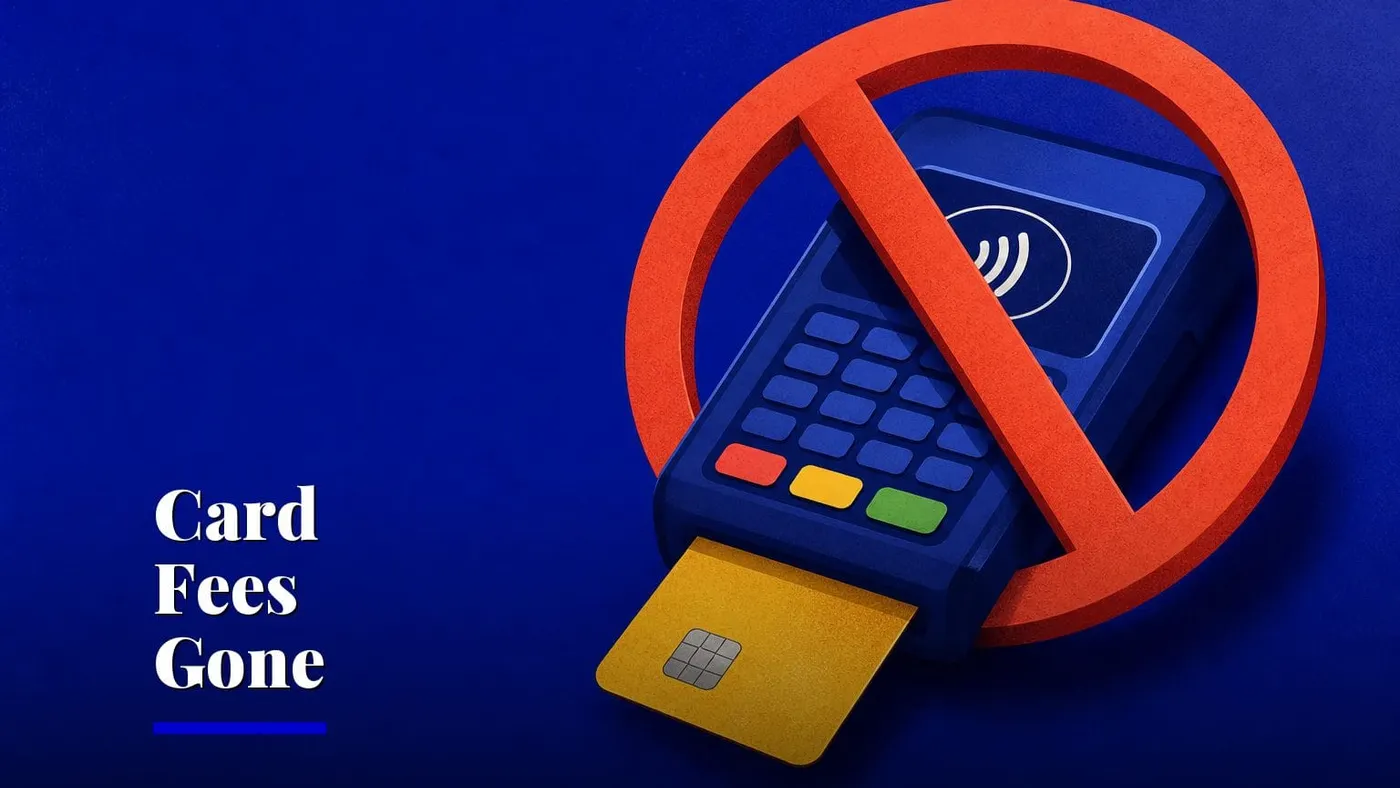
The Reserve Bank of Australia will strip card surcharges from checkout receipts starting October 1, closing a payment practice it authorized in 2003 [S1, P3]. Roughly 16% of Australian businesses — among them Aldi, cafes and some tradespeople, will lose the ability to add that extra line to the receipt S¹. The rest already absorb the cost.
The shift ranks among the most significant changes to Australian retail payments in two decades. The RBA's FAQ page P³ and March Conclusions Paper P⁵ lock in the October 1, 2026 start date. The Australian Restaurant and Cafe Association reports that many small businesses are unprepared S¹, and a cafe that currently passes a 1% Visa fee to the customer must either absorb that cost or reprice every item on the menu by October 1. The RBA's 0.1% inflation estimate assumes every surcharging merchant builds the full cost into sticker prices — a specific scenario, not a forecast. That estimate has not been independently tested.
The rule change reverses a 2003 RBA decision that permitted merchants to pass card acceptance costs directly to customers S¹. When the central bank started tracking payment habits in 2007, cash dominated at 69% of transactions while cards accounted for roughly 25% S¹. That share has since flipped. Cards now represent nearly three-quarters of all payments — debit cards alone handle 49% of transactions in 2025, with credit cards at another 23% S¹. Cash has dropped to about 15% of consumer payments, though it still appears in nearly one in four purchases under $10 S¹.
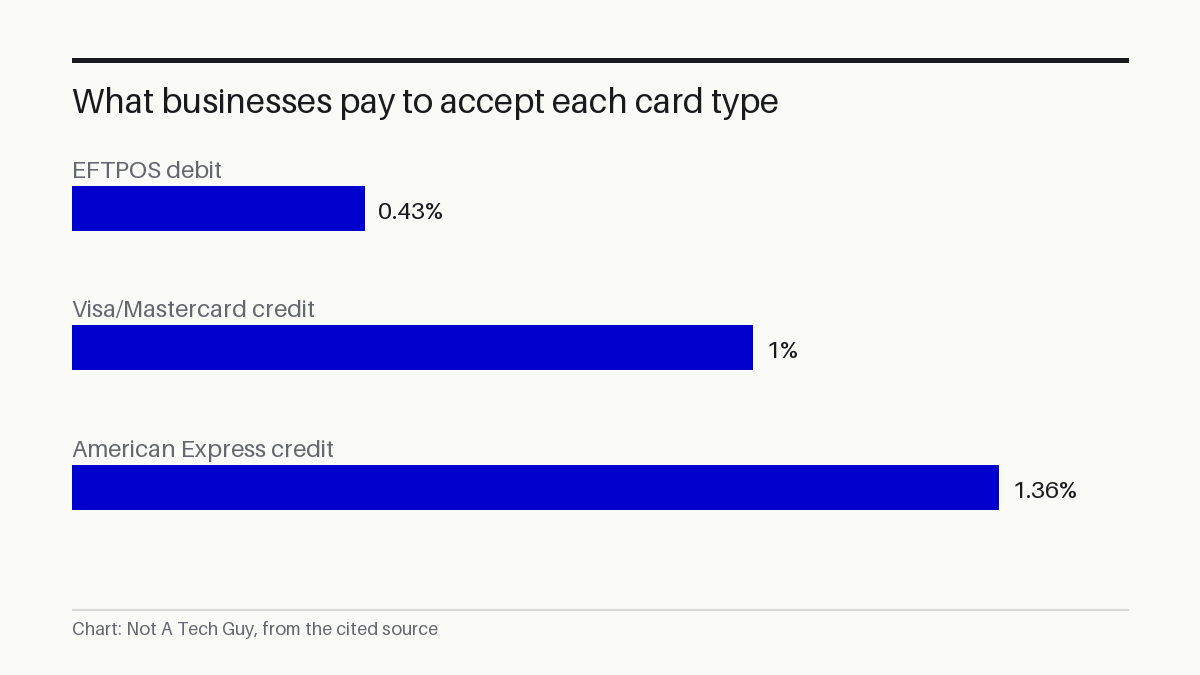
EFTPOS debit runs about 0.43%, Visa credit closer to 1%
Merchant costs differ widely depending on the card network. EFTPOS debit runs businesses about 0.43% of the transaction value, Visa or Mastercard credit cards around 1%, and American Express credit cards up to 1.36% S¹. A cafe selling a $5 coffee pays roughly 2 cents when a customer taps an EFTPOS debit card, or about 5 cents on a Visa credit card. A cafe owner processing 300 card transactions a day at those rates will need to fold the cumulative fee burden into menu prices or accept thinner margins S¹.
Most large retailers — Woolworths, Coles and JB Hi-Fi among them, already absorb these costs and do not surcharge S¹. The 16% that do include Aldi supermarkets, local grocers, cafes, restaurants, some tradespeople and some online stores S¹. The RBA has acknowledged that acceptance costs will persist after October 1 and can be reflected in overall pricing S¹.
Surcharging merchants must absorb or reprice
A business owner faces two options: absorb the remaining cost, or fold it into slightly higher prices S¹. The RBA has estimated that if all surcharge costs were built into sticker prices, it could add about 0.1% as a one-off impact on measured inflation S¹. That figure is conditional, not a forecast, and it matters because card surcharges were never included in the Consumer Price Index S¹. A price rise built into the sticker price would show up in inflation data where the surcharge never did.
For consumers who already shop at non-surcharging businesses, nothing changes. For those who shop at the 16% that do, the total amount paid will be similar, just distributed through the sticker price rather than a separate surcharge line S¹.
Flexischools, a platform used by more than 2,100 schools for canteen orders, notified parents this week of changes coming from October S¹. The precise pricing adjustment has not been detailed in the available reporting.
The ban takes effect on 1 October 2026 P³.
Sources: S1 — Card surcharges are banned from October 1. What’s changing at the chec · P2 — Payments System Board Update: February 2024 Meeting | Media Releases | · P3 — Frequently Asked Questions – Removal of payment surcharges from 1 Octo · P4 — CAFE: A Compound-AI Factorial Evaluation Framework · P5 — Review of Merchant Card Payment Costs and Surcharging – Conclusions Pa · P6 — huggingface/open-r1
Written from 6 sourced items, 5 of them primary.