Researchers testing seven commercial vision-language models found that a car spanning just 20 pixels in an 8,000 by 6,000 drone photograph gets compressed to roughly 6 pixels by the time Claude processes it S¹. OpenAI's default configuration refused to accept the same image at all S¹. The models are not seeing what users send them, and the study, an arXiv preprint posted on 17 November 2026 that has not been peer-reviewed S¹, is the first systematic attempt to measure how much detail survives the trip.
My read: The pixel-shrinking finding is the kind of thing that should have been measured two years ago, and the 20-to-6 compression for Claude is concrete enough to trust as a directional finding. I am skeptical of the "GPT-6.1 Sol" model name, which does not match any known public model and may be a typo or placeholder in the source. The two-step zoom result, matching tiled accuracy at 40% of the token cost, is the number I would watch if anyone reproduces this independently.
A car shrinks to six pixels before the model looks
The authors devised a visual acuity test using printed codes and 601 questions about small objects in real photographs, running it across seven models from four vendors S¹. Vision-language models, which combine image understanding with text generation, have grown capable enough to read documents and describe scenes. But the services that host them resize or reject large images before the model processes them. A related paper from Junzhe Shi at UC Berkeley examined the same problem from a theoretical angle P², and the HuggingFace VLM guide notes that most models process images at fixed resolutions regardless of the input size P⁵.
The study reports that the smallest text a model identifies correctly 50% of the time rises from 6 pixels or fewer on a small image to an estimated 10 to 13 pixels on a 7,680 by 4,320 photograph under default settings S¹. No error bars or confidence intervals are reported for these figures.
That means a licence plate or serial number legible in the original file becomes unreadable by the time the model sees it.
Splitting photos into tiles recovers what resizing destroys
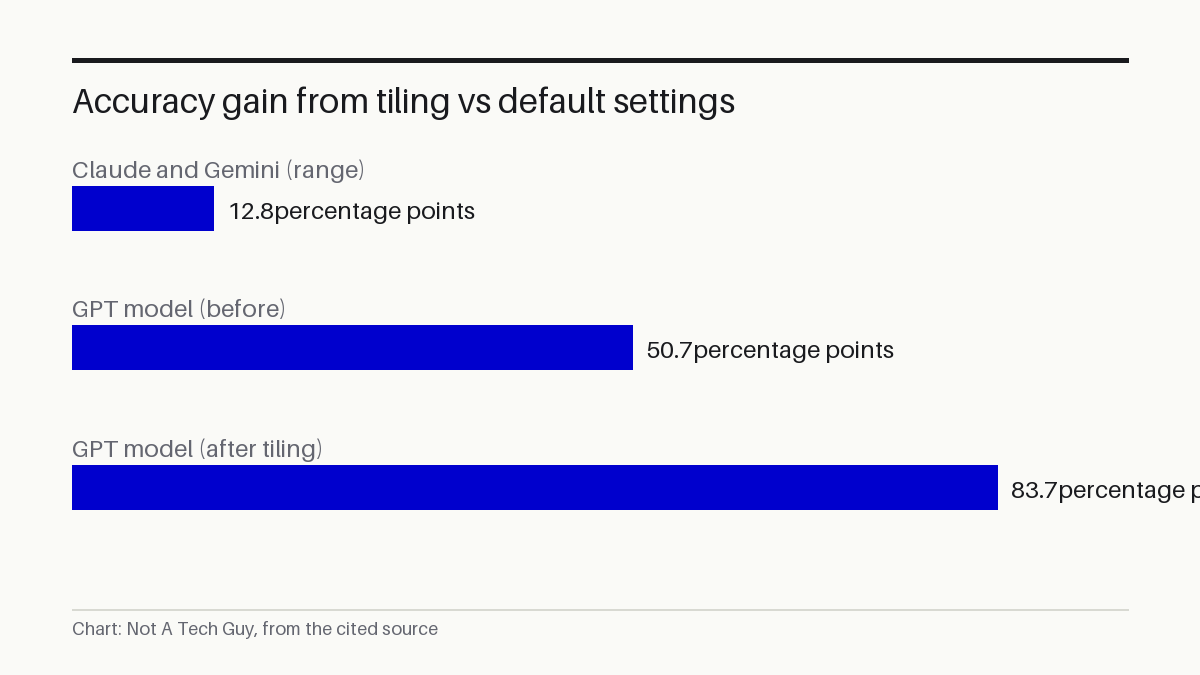
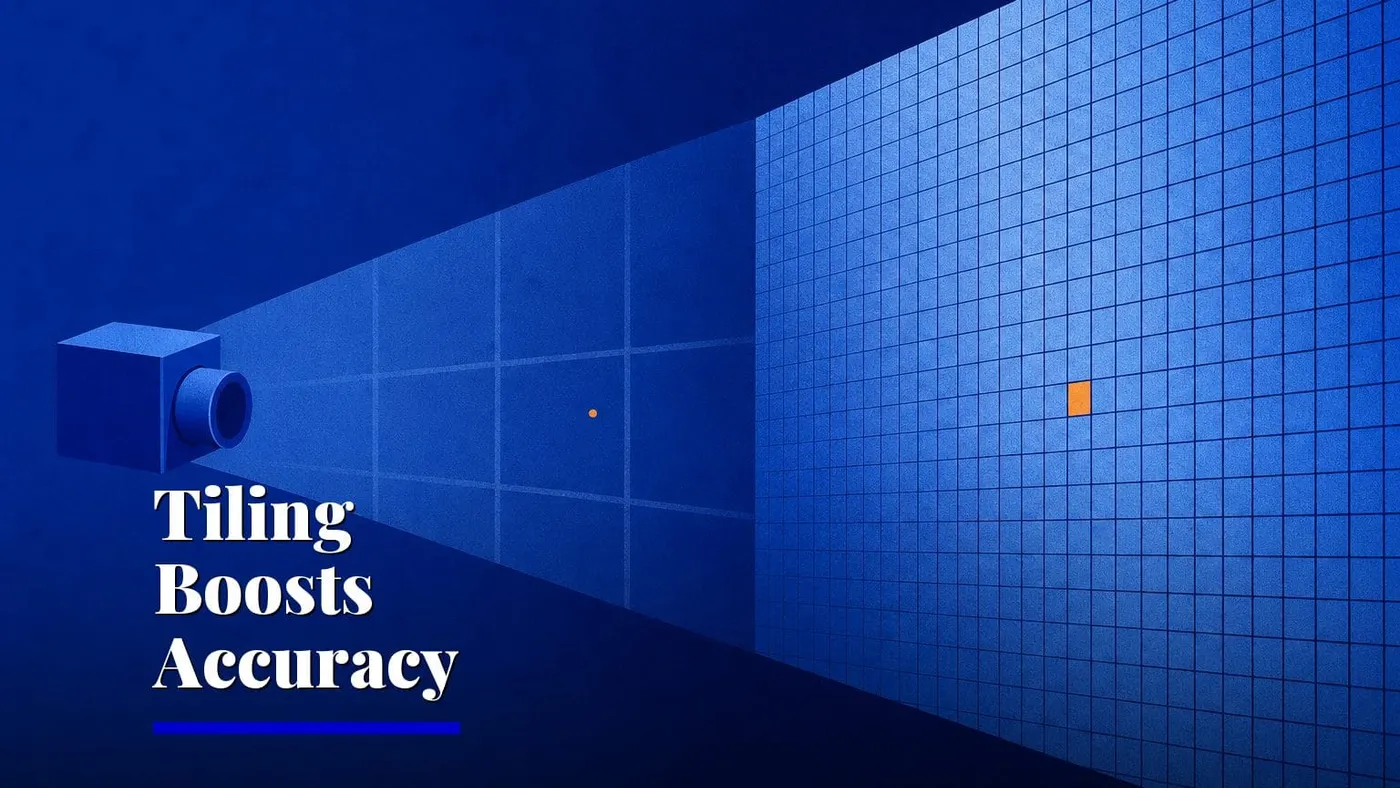
The simplest fix the authors tested was tiling: cutting each photo into up to nine pieces and sending them separately. This improved accuracy by 11.1 to 14.5 percentage points for Claude and Gemini S¹. For one model the paper labels "GPT-6.1 Sol", a name that does not match any recognised public model and may be a placeholder, tiling lifted accuracy from 50.7% to 83.7% by avoiding the service's outright rejection of large images S¹.
A more efficient approach, which the authors call two-step zoom, has the model first identify the region it needs, then crops to that region for a second pass. This matched or exceeded tiling on Gemini and came within 2.5 points on Claude, while consuming about 40% of the image tokens S¹.
A cheaper variant, tiling only after the model gives an unsure reply, came within 1.4 points of always tiling while using 62% to 70% of the tokens S¹. A pre-call detail-size check, run before the model sees anything, missed most of the tiling gain on both Claude and Gemini S¹.
For a drone-survey operator who submits 8,000-pixel-wide imagery to count vehicles, tiling means their workflow now requires up to nine API calls per photo instead of one, with a corresponding rise in token costs, but the accuracy gain means vehicles that were previously invisible to the model become countable.
When the model can't see, it guesses or stays quiet
When detail was lost, Claude and Gemini both said they could not tell about half the time S¹. In the remaining cases, Gemini gave a confident wrong answer in 43% to 48% of cases, while Claude did so in only 5% to 9% S¹.
A model that says "I can't tell" is less dangerous than one that invents an answer. For a drone operator counting vehicles or a pathologist reading a slide, a confident wrong answer is worse than no answer at all.
The authors distilled their findings into five rules for when an agent should zoom, and released the eye exam dataset, every model answer, and their code at siddvoh.com/know-when-to-zoom S¹. The dataset lets anyone with an API key check whether their specific workflow loses detail at default settings, which is the first thing a team processing large images should test before trusting a model's output. Nobody outside the authors has reproduced these results, and vendor image-handling policies may have changed since the preprint was posted.
Sources: S1 — Know When to Zoom: How Small Is Too Small for Vision-Language Models? · P2 — Why VLMs Miss Small Objects,and When Zooming In Is Safe · P3 — jimmyjames177414/knowwhen · P4 — Look Before You Zoom: Adaptive Routing for the Resolution-Context Trad · P5 — vlms.md
Written from 5 sourced items, 4 of them primary.