

Francesco Cerasuolo, Gabriele Mangiacapre and Antonio Pescapè catalogued 234 cybersecurity network-traffic datasets and found a field expanding fast but unevenly, with thin coverage in 5G, drone and vehicle-to-everything networks S¹. Their work, posted to arXiv on 16 November 2026 as a preprint that has not been peer-reviewed, tackles a problem that has quietly undermined AI security research: the collections used to train intrusion and malware detectors are scattered across personal lab pages, version-control platforms and aggregation hubs, where they can be silently edited or vanish without notice S¹.
Earlier review efforts tend to freeze the landscape at the moment of writing, so their listings lose relevance quickly as new data appears S¹. The Cybersecurity Dataset Observatory, as the authors call their catalog, is built to avoid that fate. The team plans to incorporate newly discovered or community-submitted datasets over time, revisit each entry against its primary source on a rolling basis, and log every alteration in a transparent revision history S¹. Rather than storing the data itself, the observatory points users to where each dataset resides S¹.
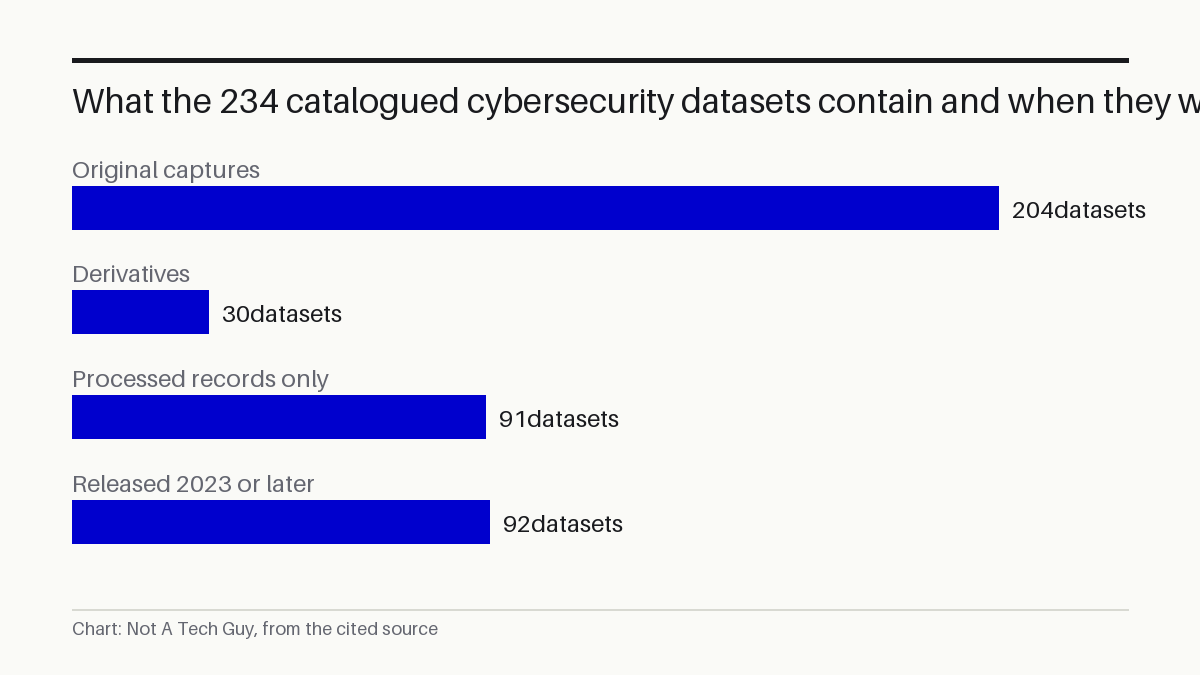
My read: The number I would watch is the 91 datasets that distribute only processed records. If nearly 40 percent of the catalog offers no raw packet captures, researchers training AI models on this data are trusting someone else's preprocessing pipeline with no way to audit it. That is a serious integrity question for any security model built on these datasets. I am also skeptical of the "continuously updated" claim. The paper describes the intention but provides no evidence of update frequency or how long the catalog will be maintained. A living catalog is only as good as its next update.
Network-traffic data is growing fast but concentrated in a few labs
The first release defines a scope centred on network traffic and a taxonomy built on seven axes, reviewing 234 datasets across 14 domains S¹. Of those, 204 are original captures and 30 are derivatives S¹. 92 of 234 were released in 2023 or later, a measure of how recent the surge in AI-for-security research is S¹.
But the growth is lopsided.
A handful of research groups account for a disproportionate share of the catalog's contents S¹. UAV and wireless networks, plus V2X, the connective tissue of drones and connected cars as well as industrial IoT, have little public evidence S¹. And 5G, despite its rollout across major economies, has few real captures S¹.
91 of the 234 datasets distribute only processed records S¹. Anyone training an AI model on them cannot inspect the raw network packets, only the features someone else chose to extract. For a security model, where subtle attack signatures can live in packet timing or header anomalies, that is a real limitation.
Dataset freshness directly shapes model reliability
Security teams are turning to machine learning for tasks like spotting intrusions and classifying malware across corporate, factory, automotive and cellular environments S¹. The performance of those systems hinges almost entirely on the representativeness and cleanliness of their training data. As Cisco and OpenAI teamed up on AI cybersecurity defence earlier this month, the pipeline from dataset to deployed model is getting shorter, and the cost of training on bad or stale data is rising.
The same data-quality problem surfaces when AI agents ground themselves in enterprise data, as NVIDIA's Agent Toolkit demonstrated in October. A model is only as reliable as the data flowing into it, whether that data is enterprise records or network packets.
The authors tie their catalog to standard AI research workflows, sketch a procedure for selecting appropriate datasets, and highlight recurring benchmark pitfalls and under-covered areas S¹. They do not claim the catalog is complete or endorsed by any industry or government body. All statistics are self-reported by the authors and have not been independently verified S¹.
For a security team evaluating whether to train or fine-tune a model on public network-traffic data, the practical first step is straightforward.
Check whether the dataset offers raw captures or only processed records, and verify the original source link still resolves. The observatory's change log, which the authors say records every modification, is the place to see whether a dataset has been corrected or withdrawn since publication.
The next checkpoint is whether the catalog's update cadence holds. The authors have committed to continuous updates and public change logging S¹, but the preprint provides no schedule or maintenance plan. The observatory's value depends on whether it is still being re-checked six months from now.
Sources: S1 — The Cybersecurity Dataset Observatory: Which Data for AI in Cybersecur · P2 — The Cybersecurity Dataset Observatory: Which Data for AI in Cybersecur · P3 — huggingface/datasets · P4 — The Cybersecurity Dataset Observatory: Which Data for AI in Cybersecur · P5 — about.md · FrontierAICybersecurity/Cybersecurity_leaderboard at refs/p
Written from 5 sourced items, 4 of them primary.