
NVIDIA on October 21 broadened its open-source Agent Toolkit with a knowledge foundation designed to let agents reason over company data in place, securing commitments from 14 enterprise partners S¹. The approach departs from the typical enterprise AI pattern, which requires copying proprietary data into an external model or re-engineering pipelines around it.
My read: This is the first agent toolkit I've seen that frames data sovereignty as a design constraint rather than a limitation to work around. The promise that agents can work "without moving data, rebuilding existing workflows or changing governance controls" S¹ is exactly what risk-averse enterprises want to hear. I'm skeptical of the partner performance numbers NVIDIA quotes — no methodology is disclosed and NVIDIA is the one reporting them; these figures have not been independently verified, with no published error bars, no baseline comparisons and no released code to reproduce. What I'd watch is whether the Auto-Ontology library actually maps messy real-world schemas as cleanly as the blog implies, or whether that translation layer becomes the new integration tax.
The centerpiece is the NVIDIA Agent Knowledge Foundation. It bundles CUDA-X libraries (cuDF, cuGraph, cuML, cuOpt and cuVS) with a new Auto-Ontology library that converts raw company data into familiar business concepts like customers, products and orders, then charts how those concepts relate S¹. On top of that sit two families of open models: Nemotron Retriever for search and retrieval, and the Kumo family (Tabular, Relational, Time Series and Forecast) for structured-data prediction S¹. The toolkit also includes OpenShell, a secure runtime boundary that lets enterprises set boundaries on what agents can access and do, and NemoClaw blueprints providing reference designs for specialised agents, with a newest blueprint focused on agent optimisation S¹. The GitHub repository, NVIDIA/NeMo-Agent-Toolkit, carries an Apache 2.0 licence with 2,661 stars and 799 forks P⁵.
Partner integrations announced but unproven at scale
NVIDIA's own supply chain organisation is using Agent Knowledge Foundation through Palantir Foundry, Ontology and AIP to deploy specialised agents and predict outcomes S¹. Databricks pairs NVIDIA Kumo Anomaly with its Genie Ontology to power context-aware agents, and Snowflake is enabling customers to use the Kumo Engine and Kumo Relational models inside Snowflake Notebooks S¹. All three are announced integrations. Deployment scale and commercial availability are unspecified.
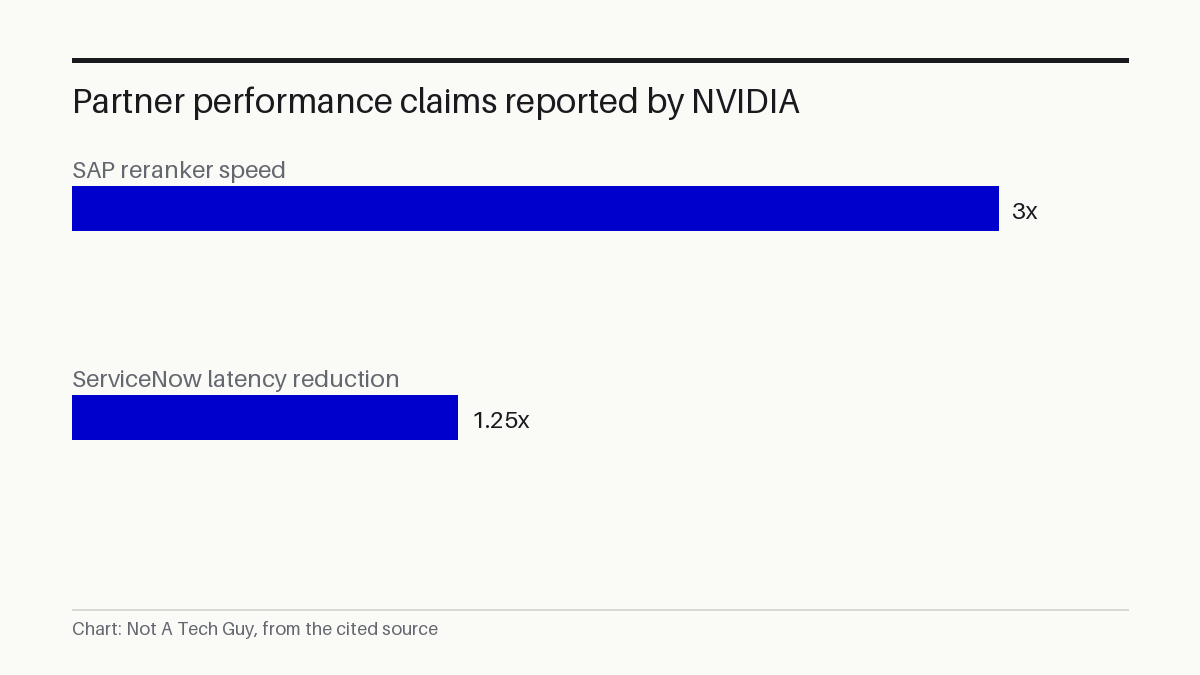
The performance numbers NVIDIA cites from partners are the least verified part of the story. SAP's fine-tuned reranker "ran nearly 3x faster" and ServiceNow "cut latency by nearly a quarter," both reported by NVIDIA with no disclosed benchmark methodology or baseline comparison S¹ — these are vendor-supplied figures with no independent confirmation, no published error bars and no released code to reproduce. Amazon OpenSearch Service reports improved search relevance with fewer steps and "virtually no added latency" using Nemotron Retriever S¹. Zoom is using Nemotron Retriever models for document understanding and search relevance in Zoom AI Services S¹. A broader roster including AWS, Dell, IBM, Oracle, Perplexity and VAST Data is described as "building on" the foundation S¹, which signals intent more than shipping product.
For a data engineering team evaluating this, the practical question is whether Auto-Ontology can map an existing schema — say a retailer's product catalogue spread across a Postgres inventory table, a Salesforce CRM export and a Snowflake warehouse, into the unified concept graph the toolkit expects, without a multi-month data modelling project. The open-source licence and the NeMo Agent Toolkit's 2,661-star GitHub following P⁵ mean a team can clone the repo and test that mapping on a single table before committing. For a platform engineer at a retailer, the immediate change is that instead of writing custom ETL to pipe a product catalogue into a vector database, they can clone the NeMo Agent Toolkit repo P⁵, point Auto-Ontology at an existing Snowflake table S¹, and test whether the concept mapping holds on a single column before scaling up. NVIDIA's own product page confirms the toolkit is positioned around building agents that "operate within boundaries you define" P².
This is NVIDIA's second toolkit expansion in 2026. In July, the company added Omniverse libraries for building simulation-ready 3D worlds P³. The October release shifts the focus from agents that build virtual environments to agents that understand the messy, structured reality of enterprise data — the problem that has kept most company-specific AI agents stuck at the demo stage.
NVIDIA's broader infrastructure ambitions, including the 2 GW of AI factory capacity it targets in Australia by 2027, depend on enterprises actually deploying agents at scale. The Agent Knowledge Foundation is NVIDIA's bet that the bottleneck is not compute but data access.
The toolkit is available now on GitHub under Apache 2.0 P⁵, with documentation at NVIDIA's developer site P².
Sources: S1 — NVIDIA Agent Toolkit Expands, Grounding Enterprise Agents in Company D · P2 — Agentic AI Solutions | Transform Your Business With NVIDIA Agentic AI · P3 — NVIDIA Agent Toolkit Expands With New Omniverse Libraries, Putting AI · P4 — ServiceNow/GroundCUA · P5 — NVIDIA/NeMo-Agent-Toolkit
Written from 5 sourced items, 5 of them primary.