
NVIDIA revealed on 10 September a collaboration with eight Australian data centre and cloud firms to construct as much as 2 gigawatts of AI factory capacity by 2027 S¹. Two gigawatts is roughly the output of two large nuclear reactors, pointed at a single task: training and running AI models. The listed firms, which include NEXTDC, AirTrunk, and CDC, will own and run the facilities, whereas NVIDIA provides the DSX platform, chips, networking, and software S¹. Why NVIDIA is choosing to sell the picks and shovels rather than dig the gold itself tells you where the real lock-in lives.
My read: This is the first Australia-specific AI infrastructure announcement I've seen with a gigawatt-scale target, and I'm skeptical of the "up to" framing. "Up to 2 gigawatts by 2027" could mean 500 megawatts or 2,000. The number that matters is how much capacity is contracted, financed and grid-connected today, and the press release does not say. What I do buy is the structural choice: NVIDIA supplies the stack, local operators carry the capital risk on land, power and buildings. That is the same model NVIDIA has pushed globally, and it keeps CUDA at the centre of every workload without NVIDIA owning a single square metre of Australian real estate.
What 2 gigawatts actually means
The goal, framed as a maximum 2-gigawatt expansion by 2027, represents a ceiling rather than a binding agreement S¹. NVIDIA's press release does not reveal financial investments, employment figures, or the proportion of capacity that is secured versus hoped for. What it does reveal is the scale: land, power, and structural capacity intended to support several iterations of NVIDIA DSX AI factories S¹.
DSX represents NVIDIA's comprehensive AI factory platform. It encompasses the physical site, computing hardware, networking, software, and reference designs S¹. Raj Mirpuri, NVIDIA's vice president of global AI clouds and infrastructure ecosystem, characterized AI factories as a means of converting power into intelligence and noted DSX's compatibility with the CUDA ecosystem S¹. CUDA is NVIDIA's proprietary software layer that virtually all serious AI workloads currently run on. Compatibility with CUDA means any model trained elsewhere on NVIDIA hardware can run here without rewriting code.
The platform receives software improvements throughout its operational lifespan S¹, which means NVIDIA can push updates that improve performance on existing hardware. That is the recurring revenue play: you buy the chips once, but the software layer keeps you tied to NVIDIA's roadmap for the life of the facility.
Who builds, who runs, who benefits
The eight partners fall into two groups. On the infrastructure side: NEXTDC, CDC, AirTrunk, Megaport are data centre and network operators with existing Australian footprints. On the AI cloud side: Firmus, Sharon AI, IREN, ResetData are NVIDIA Cloud Partners, companies that buy NVIDIA hardware and sell AI compute to end users S¹.
The partners manage the factories. NVIDIA supplies the DSX platform, accelerated computing, networking, software, and ecosystem assistance S¹. NVIDIA neither owns nor runs the sites. No government body is identified as a partner or financial backer S¹.
The expected beneficiaries include Australian startups, universities, researchers, enterprises, and AI-native firms S¹. Two mentioned customers, Heidi and Atlassian, are identified as organizations that will utilize the increased compute access and NVIDIA Nemotron open models to develop regional AI models, applications, and agents S¹. These are enablement goals, not confirmed deployments.
The CUDA lock-in question
NVIDIA's DSX platform works with the CUDA ecosystem S¹. In practice, that means the AI factories will run NVIDIA's software stack end to end. For Australian researchers and companies, that is both the appeal and the trade-off.
The appeal: CUDA is the lingua franca of AI computing. Models trained on NVIDIA hardware anywhere in the world can be deployed here without modification. The trade-off is that choosing DSX means choosing NVIDIA's roadmap for the life of the infrastructure, which could be a decade or more.
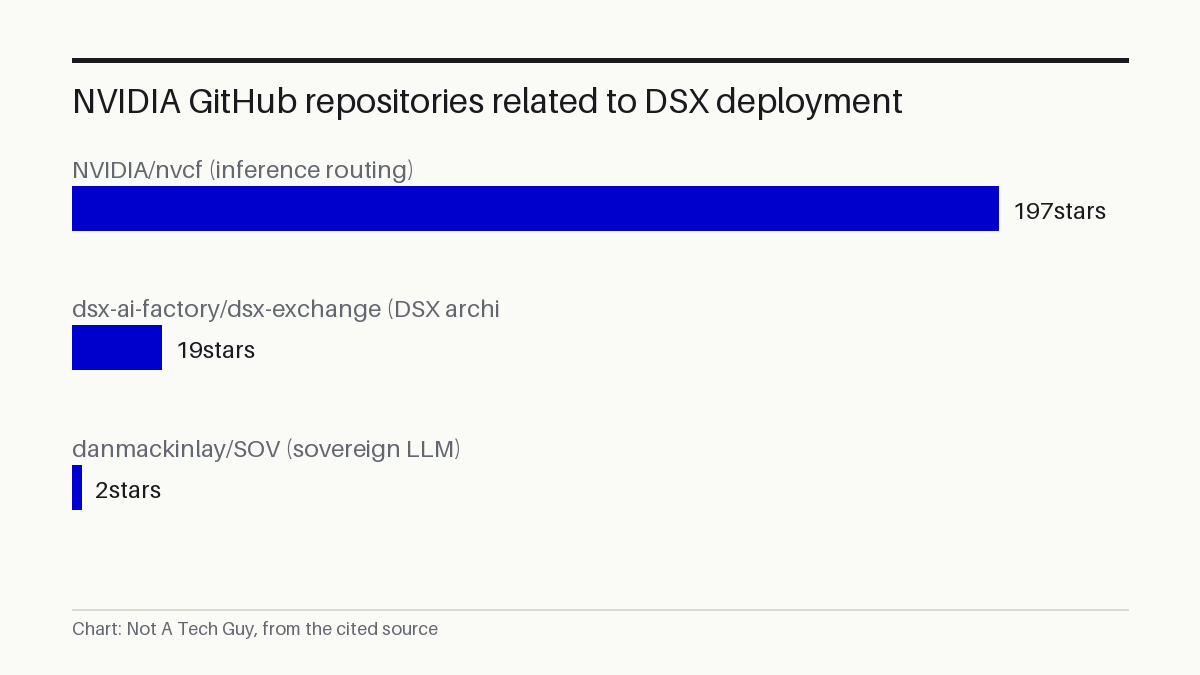
On GitHub, two NVIDIA repositories shed light on the software layer. NVIDIA's nvcf repository, featuring 197 stars and an Apache 2.0 license, is characterized as a system for deploying and routing GPU-accelerated inference, streaming, and batch workloads at scale P⁴. The dsx-exchange repository, with 19 stars, seems to be a recent project centered on DSX architecture, established in May 2026 P³. Both are open source under Apache 2.0, meaning the deployment tools are available, even though the underlying CUDA layer is not.
A separate signal: danmackinlay/SOV, an Australian sovereign-LLM cooperative on GitHub with 2 stars, states it is developing openly toward sovereign AI models P⁵. That project has negligible traction, but it is the counter-current: the idea that Australia should control its own AI infrastructure and models, not rent them from a US vendor's ecosystem.
The Australia announcement extends the same pattern: NVIDIA positions itself as the infrastructure partner of choice for nations wanting domestic AI capacity, without owning the physical assets.
What to do about it
For an Australian AI startup or research lab, the practical impact is more local GPU capacity, potentially reducing the cost and latency of running models compared with renting compute from US-based cloud providers. A Brisbane medical imaging company that currently sends scans to a US-hosted API for model inference could run the same model on DSX infrastructure locally, cutting round-trip latency from hundreds of milliseconds to single digits and keeping patient data onshore.
For larger enterprises like Atlassian, the appeal is building regionally tuned models using Nemotron open models on local infrastructure, rather than depending on US-hosted APIs for every inference call S¹.
The one thing to check this week: whether any of the named partners, particularly NEXTDC or AirTrunk, have separately disclosed contracted capacity or construction timelines in their own investor materials. NVIDIA's press release sets a target. The partners' filings will tell you how real it is.
What we don't know yet
The 2-gigawatt figure is a target ceiling, not a contracted commitment S¹. No dollar investment, construction timeline or staged rollout plan has been disclosed. The press release does not specify which sites are involved, how much power is already secured from the grid, or what generation mix will supply the facilities.
The named customers, Heidi and Atlassian, are described as organisations that will be enabled to build on the platform, not as confirmed tenants with signed contracts S¹. Whether they, or other Australian companies, actually deploy workloads on DSX infrastructure depends on pricing, availability, performance, none of which are detailed in the announcement.
The entire story rests on a single NVIDIA press release S¹. No independent corroboration from the named partners has been identified in the evidence reviewed.
The next signal: watch for NEXTDC, AirTrunk or CDC to disclose specific DSX-related capacity in their upcoming quarterly or annual filings. If the 2-gigawatt target is real, at least one partner will need to show grid connection agreements and construction milestones within the next two quarters. We will check their filings against this claim.
If you want this kind of analysis in your inbox every week, subscribe below.
Sources: S1 — NVIDIA Expands AI Infrastructure Capacity in Partnership With Australi · S2 — NVIDIA Expands AI Infrastructure Capacity in Partnership With Australi · P3 — dsx-ai-factory/dsx-exchange · P4 — NVIDIA/nvcf · P5 — danmackinlay/SOV
More from Not A Tech Guy
- SAREF ontology maps distributed AI across edge-fog-cloud continuum
- OpenAI claims AI solved Navier-Stokes problem
- OpenAI $5M grant funds research on AI and teens
Generated from an audited evidence pack with primary-source research. Social-media items are discussion signals, not verified facts. Nothing here is financial, legal or medical advice.