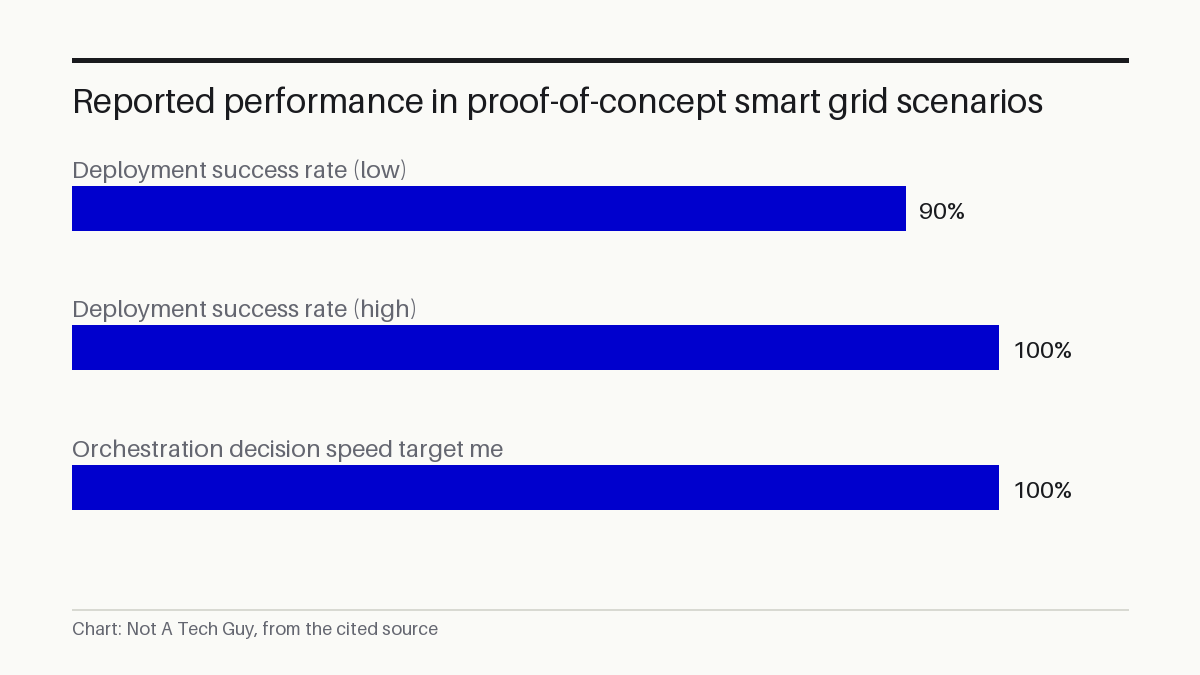

On 28 August 2026, a preprint appeared on arXiv proposing a SAREF-compliant ontology that gives distributed AI workflows a shared vocabulary across the edge-fog-cloud continuum S¹. The authors report deployment success rates of 90 to 100 percent and orchestration decisions in under 80 milliseconds, but those numbers come from proof-of-concept smart grid scenarios, not production systems S¹. Whether this shared language actually helps when the edge device is a wind turbine controller and the cloud is three time zones away is the question the preprint opens but cannot yet close.
My read: This is the first attempt I've seen to bolt AI workflow concepts onto the ETSI SAREF ecosystem, and the choice of SAREF4SYST as the base makes sense because it already describes systems and their interconnections. What I'm skeptical of is the performance framing. A 90 to 100 percent deployment success rate in a proof-of-concept tells you the ontology is internally consistent, not that it survives contact with real infrastructure. The sub-80ms orchestration decision time is interesting but unbenchmarked against any existing orchestrator. I'd watch for whether ETSI picks this up as a working group item, because without standardisation backing it, this stays an academic exercise.
Why a shared vocabulary for distributed AI is hard
Running AI across edge, fog and cloud means splitting a pipeline into pieces that execute in different places. A camera on a factory floor might run object detection locally, send results to a fog node for aggregation, and trigger a cloud model for long-term analysis. Each piece has different hardware, latency budgets, and communication constraints.
The authors argue that current semantic models provide limited support for representing these distributed AI workflows and their execution across heterogeneous environments S¹. That claim is author framing, not an established industry consensus, but it points to a real gap: if you cannot describe a workflow in a machine-readable way, you cannot automate where its pieces run.
SAREF, the Smart Applications REFerence ontology maintained by ETSI, already provides a framework for describing smart applications and their interactions. SAREF4SYST, one of its extensions, covers systems and their interconnections. A GitHub repository mapping this data model has existed since 2023 P⁴. The new preprint builds on that foundation by adding AI-specific concepts: what a pipeline is, what a job needs to execute, what resources are available, what constraints govern deployment, and how components communicate S¹.
What the proof-of-concept actually tested
The authors evaluated their ontology using smart grid energy services orchestration scenarios S¹. They defined a set of competency questions, the kind of queries a real orchestrator would need to answer, and validated all of them using SPARQL querying and semantic reasoning S¹.
SPARQL is the query language for data stored in the Resource Description Framework format. In plain terms, the researchers wrote questions like "which devices can run this job given these constraints?" and showed their ontology could answer them through standard semantic web tools.
The reported numbers: deployment success rates of 90 to 100 percent and average orchestration decision times below 80 milliseconds across heterogeneous edge-fog-cloud environments S¹. Both figures are self-reported by the authors and come from proof-of-concept scenarios only. The preprint has not undergone peer review, and the paper does not include a comparative benchmark against existing orchestration methods.
The wider current: edge AI tooling is moving fast
This preprint lands amid active development in distributed and edge AI tooling. On GitHub, a project called DistribAI, created in August 2026, claims to distribute AI training across consumer devices under an Apache 2.0 licence, though it has just 8 stars and lists Batchfile and CSS among its primary languages P². Another project, EdgeAI-Continuum, created in 2025, claims to reduce edge device memory by 80 percent by offloading PyTorch and scikit-learn workloads to cloud storage, with no code changes needed P³. That project has 5 stars and links to the EU-funded ICOS project P³.
These are early-stage tools, but they signal where the field is heading: AI workloads are spreading across devices, and the tooling to manage that spread is being built now. An ontology that gives those tools a common way to describe what runs where could matter, if it gains adoption.
What to do about it
If you build systems that run AI across multiple locations, the practical takeaway is that a standard vocabulary for describing distributed AI workflows now exists in preprint form. It is not ratified, not peer reviewed, and not production-tested, but it is a reference point.
Consider a regional electricity distributor that runs fault-detection models on substation sensors at the edge, aggregates anomalies at a local control room server in the fog layer, and runs predictive maintenance models in a national data centre in the cloud. Today, the team managing that pipeline likely uses custom scripts and ad hoc documentation to track which model runs where and what each piece needs. A SAREF-compliant ontology would let them describe the entire pipeline in a machine-readable format that any compatible orchestrator could query.
The concrete step this week: read the SAREF4SYST data model on GitHub P⁴ and check whether your existing workflow descriptions could map to its system-and-connection structure. If they can, the AI-specific extensions in this preprint are a natural next layer.
What we don't know yet
The preprint does not tell us whether this ontology works outside smart grid scenarios. The proof-of-concept covers energy services orchestration, but distributed AI workflows in manufacturing, healthcare, or autonomous vehicles may introduce constraints the current model does not capture.
We also do not know whether ETSI will adopt any of these extensions into the official SAREF standard. The paper states the ontology remains aligned with the ETSI SAREF ecosystem S¹, but alignment is not endorsement. No ETSI working group has picked up this work, as far as the evidence shows.
The performance claims need external validation. A 90 to 100 percent deployment success rate and sub-80ms decision times are promising, but without a comparison against existing orchestration tools like Kubernetes-based schedulers or edge-specific platforms, we cannot judge whether the ontology actually improves outcomes or simply adds a description layer on top of an already-working system.
The next signal: whether ETSI lists a new work item referencing AI workflow ontologies in its next SAREF committee cycle. We will check the ETSI portal for that filing. If you want to follow along, subscribe and we will flag it the moment it appears.
Sources: S1 — SAREF-based Ontology for Distributed AI Workflows across the Edge-Fog- · P2 — naxium-oss/DistribAI · P3 — sebasmos/EdgeAI-Continuum · P4 — smart-data-models/dataModel.S4SYST
Related reading
- AI generates synthetic health data across multiple tables — our technology desk, 2026-08-17
- MMJailBench: prompt framing is top jailbreak risk across 16 AI models — our technology desk, 2026-09-01
Generated from an audited evidence pack with primary-source research. Social-media items are discussion signals, not verified facts. Nothing here is financial, legal or medical advice.