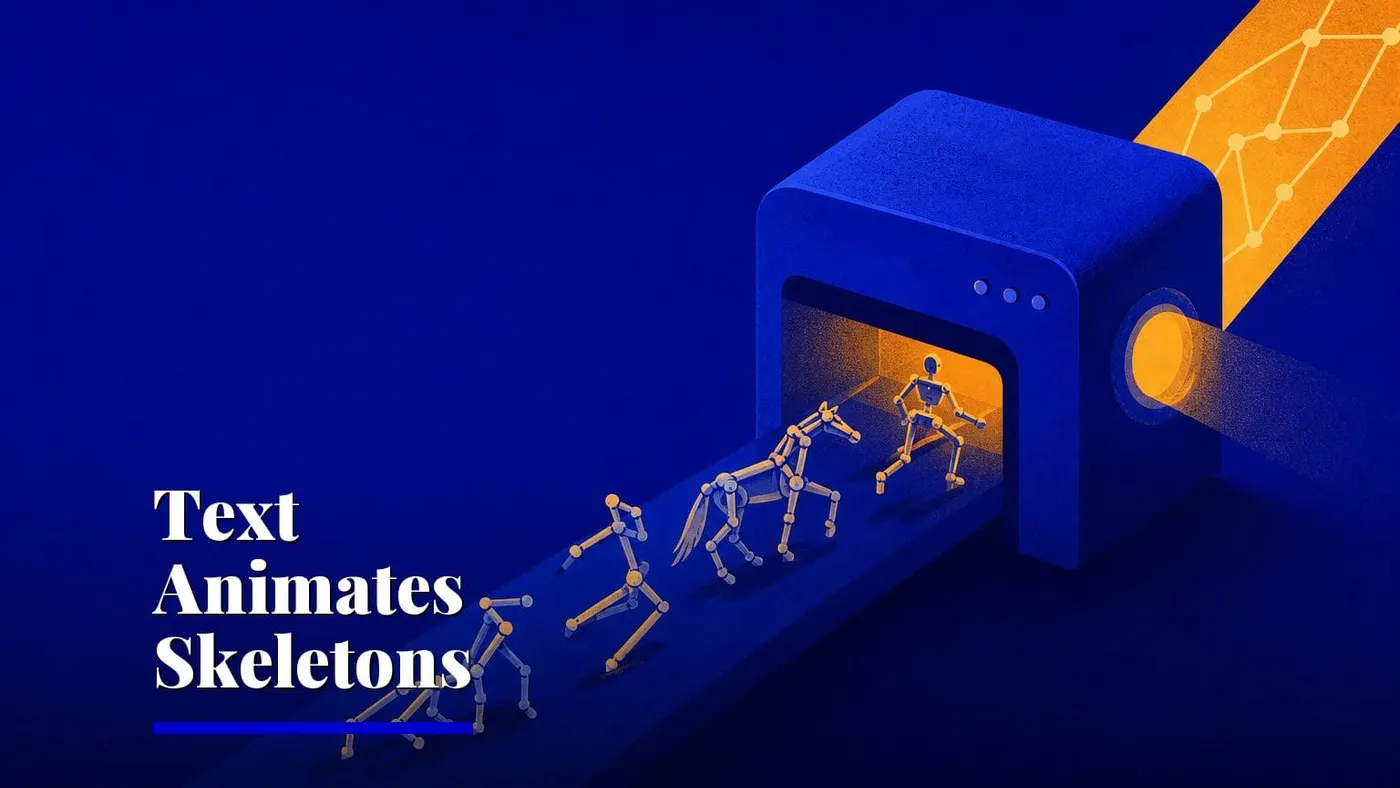
Linzhan Mou, a Princeton computer science student, and six collaborators from Princeton, UC Berkeley, MIT and NTU built a single AI model that animates skeletons ranging from humans to snakes to crabs from text prompts S¹. Their project, UniMate, landed on GitHub's trending list on 20 October with 128 new stars in a day, bringing its total to 2,036 S¹. The claim challenges a basic assumption in character animation: that each skeleton type needs its own dedicated model.
My read: This is the first text-to-motion model I've seen that explicitly handles seven skeletal topologies in one architecture, and the "bring your own rig" feature added on 5 October S¹ is what makes it practically useful rather than just a research demo. I don't buy the SIGGRAPH Asia 2026 acceptance claim at face value because it is self-reported in the README with no independent conference program confirmation, and the Truebones ZOO component being commercially licensed means the full training data is not freely redistributable S¹. What I would watch is whether anyone outside the team can load a custom rig and get usable motion without extensive tuning.
What the model actually does
UniMate is a text-conditioned flow-matching model, a generative technique in the same family as diffusion, that produces motion sequences for skeletons of any topology P⁴. You type a description, and the model generates joint rotations across a skeleton it may have never seen before.
The team trained it on UniML3D, a dataset of 13,769 text-paired motion clips spanning 7,430 distinct skeletons S¹. Those skeletons cover seven categories: bipedal, quadrupedal, avian, marine, insectoid, serpentine, and articulated rigid objects S¹. The raw source assets come from three collections on Hugging Face: Mixamo animations and characters, Objaverse-XL rigged animated objects, and Truebones ZOO animal annotations S¹. The Truebones ZOO motions are a commercial asset pack whose licence forbids redistribution, so the full dataset is not open-source S¹.
The processed version is available as UniML3D on Hugging Face S¹.
A steady rollout since August
The team has been releasing components in stages. An interactive demo went live on 1 August 2026 S¹. The UniML3D dataset and its data-processing pipeline followed on 30 August S¹. Training and inference code landed on 6 September S¹, and preview checkpoints appeared on Hugging Face on 27 September S¹.
The most recent addition, on 5 October, was a "bring your own rig" feature that lets users feed in their own skeleton structure rather than choosing from the dataset's pre-built options S¹. The Hugging Face model page lists multiple checkpoint variants with different architectures and parameter counts P⁴, and choosing among them is the same trade-off enterprise teams face when routing coding tasks to the cheapest capable model. There are 8 training configurations in total: 4 data combinations across 2 model variants, all trained at 60 frames per clip S¹.
What is verified and what is not
The arXiv page for the paper lists it under SIGGRAPH Asia 2026 Conference Papers, scheduled for 1 to 4 December in Kuala Lumpur, with an assigned DOI P².
The conference has not yet taken place.
The README's acceptance announcement is self-reported, and no independent conference program listing has been confirmed S¹. No third party has benchmarked UniMate against existing animation methods. The claims about the model's performance and dataset scale all originate from the maintainers' own README and Hugging Face descriptions [S1, P4]. Picking the right model without overpaying for capability, as an AI tutor showed by choosing an 8B model over bigger rivals, only works when someone has independently tested the options. The GitHub star count is a point-in-time metric that changes daily S¹. The push toward models that run efficiently, as an 8 MB model demonstrated on microcontrollers, is reaching animation tooling, but UniMate's inference cost and hardware requirements have not been independently reported.
For a game studio technical artist evaluating this, the practical first step is to load one of the preview checkpoints from Hugging Face P⁴, try the "bring your own rig" feature with a production skeleton, and check whether the generated motion is clean enough to use as a starting pass rather than a finished animation. The paper is scheduled for presentation at SIGGRAPH Asia 2026 in Kuala Lumpur from 1 December P².
Sources: S1 — Friedrich-M/UniMate: [SIGGRAPH Asia 2026] UniMate: One Unified Model t · P2 — UniMate: One Unified Model to Animate Diverse Skeletons · P3 — Tencent-Hunyuan/UniCom · P4 — Linzhan/UniMate · Hugging Face · P5 — Linzhan Mou
Related reading
- CourseChat AI tutor picks 8B model over bigger rivals — our technology desk, 2026-10-05
- AI coding agent router cuts enterprise model spend 21% — our technology desk, 2026-09-25
- Needle: 8 MB AI model runs on phones and microcontrollers — our technology desk, 2026-09-20
Written from 5 sourced items, 4 of them primary.