
Cactus Compute built Needle, an AI model that packs tool-call capability into 8-29 MB, and the project just landed on GitHub's trending list with +234 stars and 11,736 total S¹P². The maintainers claim it outperforms models 10 times larger on mobile tool calls, but they name no competitors and publish no independent benchmarks S¹ — the 10x figure is the vendor's own, with no error bars and no released training code S¹.
My read: This is the most aggressive size-to-capability ratio I have seen for an on-device model. The architecture details, the "engram n-gram memory" and "Monarch Hadamard MLP," read like real engineering rather than a wrapper repo. But the "beats models 10x its size" claim cites relative sizes, not named models, and the only sources are the maintainers' own GitHub page S¹ and Hugging Face listing P². I would want to see exact-match accuracy numbers against a named model like Phi-3 or Gemma before I took the 10x claim seriously. The star velocity, 234 in a day, tells you developers are curious, not that the benchmarks hold.
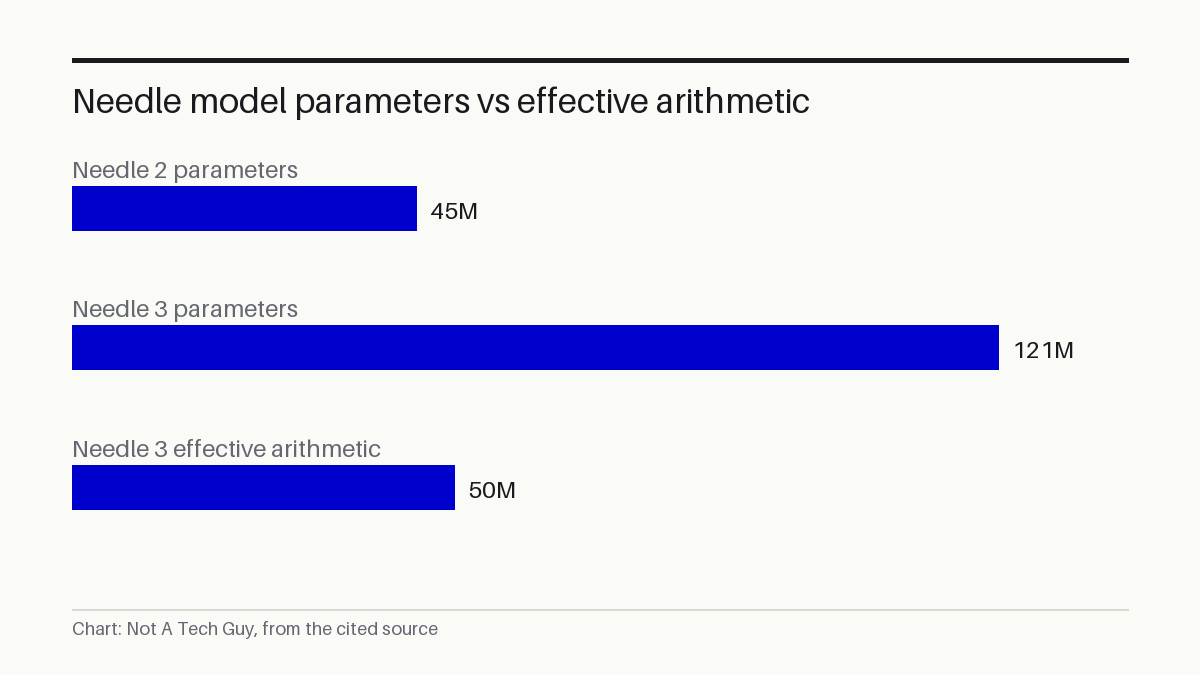
The previous version, Needle 2, was a 45-million-parameter model in a 14 MB binary that ran in about 28 MB of RAM P⁴. The current Needle 3 stretches the range from 8 to 29 MB depending on configuration, with 121 million parameters S¹.
The maintainers say most of those parameters sit in an "engram" n-gram memory bank that is looked up rather than multiplied, so the 121M model does the arithmetic of a 50-million-parameter network S¹.
Monarch Hadamard MLP and grammar-constrained outputs
Needle 3 swaps the conventional feed-forward network for a Monarch Hadamard MLP and pairs grouped-query attention with causal convolution taps S¹. Each layer depth from 2 to 20 functions as a standalone deployable model, letting a developer cut the network short to trade accuracy for speed without retraining S¹. A byte-level grammar compiled from the user's own schemas constrains every output, so a tool call in JSON should be syntactically valid by construction S¹. Each response also carries a calibrated confidence score from a learned head, allowing an app to fall back to a cloud model when the on-device result is uncertain S¹.
None of this has been peer-reviewed, no error bars are reported, and no training code has been released — the capability figures are the vendor's own S¹.
The benchmarks are described as exact-match accuracy for tool calling and field micro-F1 for extraction on full test splits S¹, but no external party has run them. No phone, car, or wearable manufacturer has confirmed deployment.
Smart-home and embedded developers get a local tool-call option
A developer building a smart-home app that parses voice commands into thermostat actions without sending audio to the cloud could test Needle today. The schema-constrained generation would keep the output valid, and the confidence score would gate when to escalate to a server-side model. The model targets phones, wearables, smart homes, robots, cars, and microcontrollers S¹P², though the microcontroller claim, 8 MB on a device with 28 MB of RAM, puts it in the range of higher-end embedded chips rather than the smallest Arduino-class boards.
For an embedded firmware engineer who currently ships a hand-maintained rule-based parser on a Cortex-M7 board, Needle would replace that state machine with a model that generates structured tool calls in roughly 28 MB of RAM, trading deterministic logic for probabilistic output that needs confidence-score gating S¹P⁴.
This fits a broader compression trend. But pushing AI onto microcontrollers also expands the attack surface. An on-device model that makes tool calls could act on the device it runs on if compromised.
The Hugging Face model page P² and the GitHub repository S¹ are the places to check for benchmark tables and code. The maintainers have not announced a date for independently audited results.
Sources: S1 — cactus-compute/needle: Automation foundation model for tiny devices: 2 · P2 — Cactus-Compute/needle3 · Hugging Face · P3 — mariklolik/vibe · P4 — README.md · P5 — MokshithRao/ai-research-assistant
Written from 5 sourced items, 4 of them primary.