
OpenAI detailed four mechanisms it uses to manage frontier AI risk — model alignment, sandboxing, blocking safeguards, and monitoring, in a framework released on November 18 S¹.
These are OpenAI's own descriptions: no code has been released, no error bars or failure-rate metrics are provided, and no third party has audited the framework S¹.
My read: I'd treat this as a positioning document, not a proof of safety. OpenAI lists four safeguard categories but gives no metrics on failure rates, no third-party audit results, and no detail on what "blocking safeguards" catch versus what they miss. The number I would watch is whether any of these mechanisms get independently tested before the next frontier model ships. Until then, this is a company describing its own quality control.
The framework does not arrive in a vacuum. OpenAI has spent the back half of 2026 building a public safety documentation practice. In late September, the company argued that structured safety documentation should be required before continuing any frontier reinforcement learning training run, ideally rising to formal "safety cases" P⁵. Earlier that month, OpenAI assessed that its Astra model had reached what it calls a critical level of cybersecurity capability, and ran further evaluations as a result P³. That assessment matters because cybersecurity is the exact domain where blocking safeguards and monitoring face their hardest test: a model that can find vulnerabilities can also exploit them.
API builders already meet these safeguards as refusals, filters, and logs
For a team building on OpenAI's API, the framework describes things they already encounter, not new tools. Model alignment shows up as refusal behavior, the model declining harmful requests. Sandboxing restricts what tools and systems a model can touch during a session. Blocking safeguards are the content filters that stop a prompt before it completes. Monitoring is the usage logging and abuse detection that runs after the fact.
The gap between the framework and what an operator can verify is wide. OpenAI does not publish detection rates for its blocking safeguards, false-positive rates for its alignment tuning, or what its monitoring catches that sandboxing misses. A compliance team at a financial services firm using OpenAI's models still has no third-party benchmark to measure whether these safeguards hold under adversarial pressure. For a compliance officer at that firm, nothing on their desk changes: the same vendor-provided assurances sit in the same risk file, with no new test results to attach.
Open weights hand safeguard decisions to downloaders
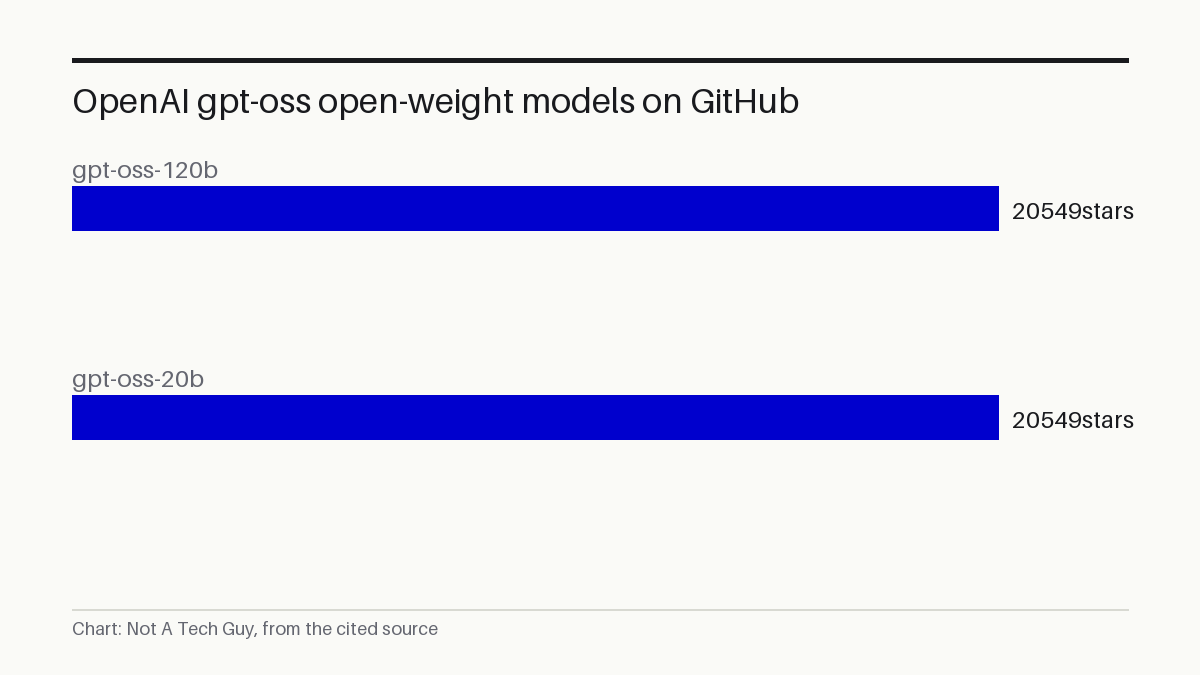
The framework also sidesteps a growing tension. OpenAI's open-weight models, gpt-oss-120b and gpt-oss-20b, have accumulated 20,549 stars on GitHub under an Apache 2.0 licence P⁴. Once weights are downloadable, the sandboxing and blocking safeguards that the framework relies on become the downloader's responsibility, not OpenAI's. The company's safety case for training covers what happens inside OpenAI's infrastructure. It does not cover what happens when someone runs the model on their own GPUs with the filters stripped out.
The Astra cybersecurity assessment P³ sharpens this. A model that reaches critical cybersecurity capability and is then released as open weights hands every safeguard decision to the end user. The cybersecurity datasets that train these models are publicly documented. The safeguards that should sit on top of them, in the open-weight case, are not.
OpenAI's next scheduled safety documentation is not dated in the article. The company's September call for mandatory safety cases before frontier training runs P⁵ sets the next logical checkpoint: whether any regulator or standards body adopts that proposal before OpenAI's next major model release.
Sources: S1 — Managing frontier AI risk: From training to deployment · S2 — Managing frontier AI risk: From training to deployment - OpenAI · P3 — Path to Astra: critical capabilities and frontier safeguards | OpenAI · P4 — openai/gpt-oss · P5 — Towards safety cases for frontier AI training | OpenAI · P6 — Create and manage a repository · Hugging Face
Written from 6 sourced items, 5 of them primary.