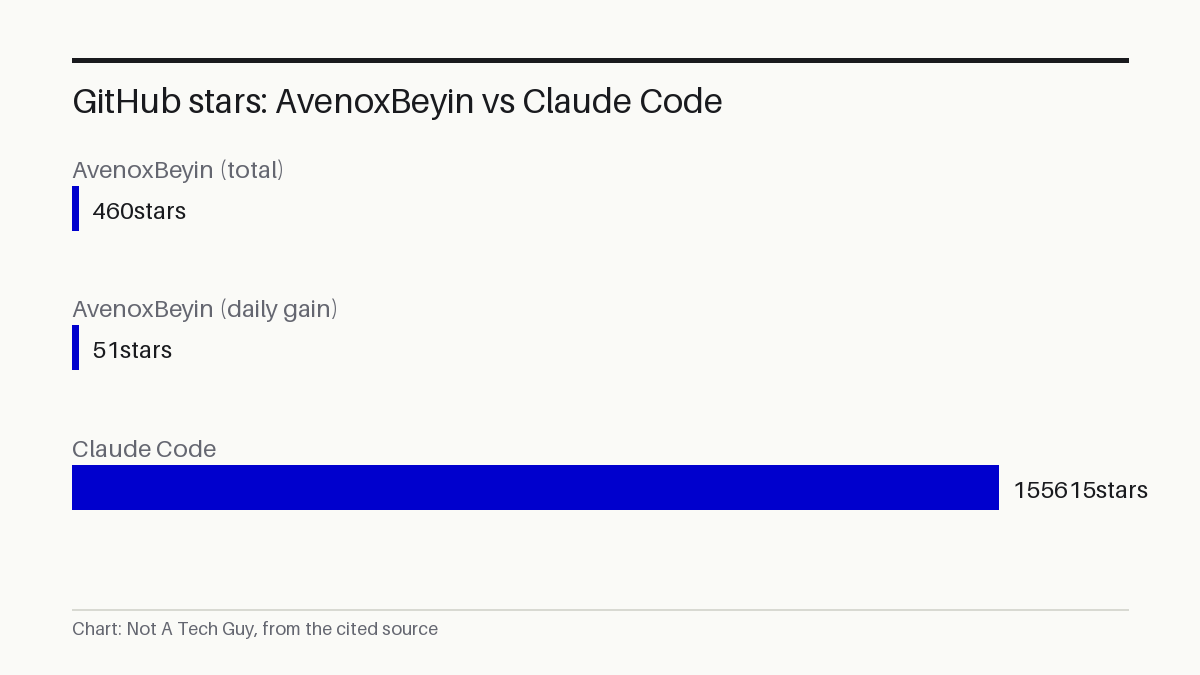

Avenox shipped version 3.13.0 of AvenoxBeyin on November 12, adding Word document reading and an OpenCode bridge to its open-source system that gives Claude Code persistent memory across sessions P². The repo landed on GitHub Trending the same week, picking up 51 stars in a single day to reach roughly 460 total S¹.
My read: The pitch is appealing: tell your AI coding agent to read one URL, and it sets up a local Markdown-based memory system that survives across sessions. But the recommended install method, having an AI client fetch and execute instructions from an external URL, is exactly the kind of pattern security teams warn about. I would want to see the contents of that .md file audited before pointing any agent at it. The star count is modest, and every functionality claim comes from the maintainers' own README — no benchmark, no error bars, no third-party test has been published S¹.
Claude Code, Anthropic's terminal-based coding agent, has accumulated 155,615 stars on GitHub P³. A growing ecosystem of templates and extensions has built up around it. AvenoxBeyin sits in that same ecosystem, but targets a specific gap: Claude Code, like most AI coding tools, starts each session with no memory of what you discussed yesterday.
Avenox, the account behind the project, describes itself as building "AI x Web3 x token infra" and joined GitHub in November 2024 with 25 public repositories and 1,302 followers P⁴. The project is released under an MIT licence and requires Python 3.11 or higher S¹.
Notes live in Markdown files the user curates
Rather than dumping full chat transcripts into storage, the tool lets users pick what matters and tell the agent to save it as a Markdown note S¹. Obsidian, the note-taking app, is optional S¹. Setup avoids dependencies on Git, pip, Mem0 accounts, additional API keys, or an always-on server process S¹.
Version 3.13.0, released via GitHub Actions on November 12 P², adds the ability to read Word (.docx) documents, an optional pipeline for submitting tasks to Claude or Codex agents, a Pi connection, an OpenCode global bridge, a local web view, and workspace tools S¹. The release bundles fixes from a November 12 maintenance pass P². These feature descriptions are the maintainer's own; no independent review has confirmed them S¹.
The one-command install pulls instructions from a remote URL
The recommended installation is to tell a supported AI client to read https://avenox.io/beyin.md and set up the system in a chosen folder S¹. A manual alternative involves downloading a zip file and verifying its SHA-256 checksum against an accompanying .sha256 file S¹.
The one-command install is the headline feature, but it is also the part that should give any developer pause. Pointing an AI agent at a remote URL and asking it to execute whatever instructions it finds there is a pattern that depends entirely on trusting the source. The project is open-source under MIT, which means the code is inspectable, but the install flow asks the agent to act before the user has necessarily read anything.
No one outside the project has independently reviewed or verified the functionality claims S¹. The README is the maintainers' own description, not a third-party assessment S¹. Star counts and trending status are ephemeral and can shift within hours.
For a developer who already uses Claude Code and wants a lightweight memory layer without standing up a database or a server, the manual zip install with checksum verification is the safer entry point. A solo developer working across daily sessions on a single repository would gain a local Markdown file the agent reads on startup, replacing the routine of re-explaining yesterday's decisions each morning. Version 3.13.0 landed on the project's GitHub release page on November 12 P².
Sources: S1 — avenoxai/avenoxbeyin: Your AI second brain in one command — open-sourc · P2 — Releases · avenoxai/avenoxbeyin · GitHub · P3 — anthropics/claude-code · P4 — Avenox · P5 — arosboro/your_ai
Written from 5 sourced items, 4 of them primary.