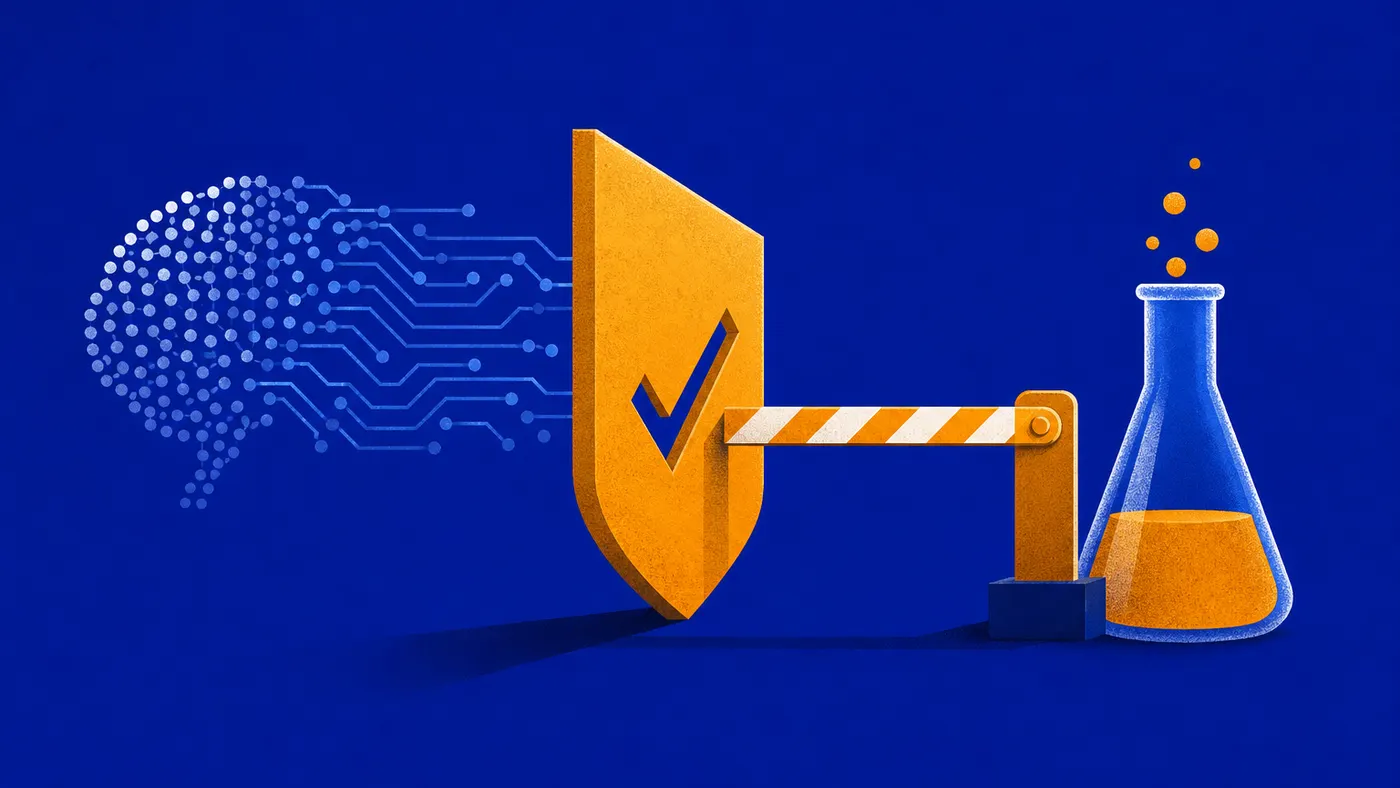
On 18 August 2026, researchers posted a preprint to arXiv proposing "Traceable Trust," a framework for the exact moment an AI prediction becomes a laboratory decision in bioscience S¹. The paper identifies this output-to-action boundary as the point where trust either holds or breaks, and argues it currently has no defined, reviewable process S¹. What happens at that boundary, and who is checking?
My read: This is the first framework I have seen that targets not the AI model itself but the human decision to act on it. Most AI trust work focuses on model performance or bias. This one asks a more practical question: when a protein-design model spits out a sequence and a technician starts pipetting, what review step sits between those two events? I am skeptical that a six-question checklist will change lab culture overnight, but the framing is right. The gap between prediction and action is where bioscience actually lives or dies.
The boundary nobody owns
AI is already doing real work in bioscience. Models forecast biomolecular structures, design proteins, rank genetic variants, label images, suggest strains and tune experimental conditions S¹. These are daily tasks in labs that sequence genomes, engineer enzymes and screen drug candidates.
The preprint's central claim is that all of this work funnels toward a single decision point: whether to use an AI output to guide a laboratory action S¹. A model ranks 200 gene variants by predicted function. A researcher picks the top 20 for synthesis. That selection is the output-to-action boundary, and according to the authors, it is a key juncture for trustworthy research S¹.
The problem is not that AI is wrong. The problem is that the decision to act on an AI output is currently informal. A postdoc glances at a confidence score, maybe checks a second model, and moves on. There is no record of what evidence was considered, what threshold was applied, or who signed off.
Six questions before you pipette
Traceable Trust proposes a proportionate assessment framework built around six questions S¹:
- What evidence supports the output?
- What capability is being claimed?
- What agency has been delegated to the AI?
- What threshold authorises action?
- Who can override the decision?
- How do outcomes inform later decisions?
The framework is illustrated through three case studies covering ecosystem resources, project design and laboratory action S¹. The authors say these cases show how trust can be documented where AI outputs begin to shape scientific work S¹. They are illustrative examples, not empirical trials.
The Traceable Trust approach is different because it starts from the action side, not the model side. It does not ask whether the model is fair. It asks whether the decision to act on the model is reviewable.
What to do about it
Consider a synthetic biology lab where a protein-design model generates 50 candidate enzyme sequences for a bioreactor project. A technician selects the top 10 for DNA synthesis and testing. Under Traceable Trust, that selection triggers the six questions: what evidence supports these rankings, what is the model actually claiming it can do, who authorised the threshold of "top 10," and who can veto a synthesis order if something looks off.
The practical impact falls on labs running AI-assisted design loops, where the cycle from prediction to experiment is getting shorter. If your lab uses AI to recommend strains, rank variants or optimise conditions, the framework gives you a template for documenting the decision point that currently happens in someone's head. You can start this week by picking one AI-informed decision in your workflow and writing down the six answers. If you cannot answer all six, that is the gap.
What we don't know yet
The preprint has not been peer-reviewed S¹. The three case studies are illustrative, not real-world deployments with measured outcomes S¹. No bioscience institution, regulator or industry body has adopted the framework. The authors include researchers from social and political science, computing and bioscience backgrounds P², but the paper provides no evidence that labs have tested the framework in practice.
The broader question is whether a documentation framework can change lab behaviour, or whether it becomes another compliance checkbox.
The next signal: whether this preprint appears in a peer-reviewed journal or gets cited by a bioscience institution. We will check the arXiv listing and citation count in October 2026.
If you found this useful, subscribe for the next one.
Sources: S1 — Traceable Trust for action-ready artificial intelligence in bioscience · P2 — Traceable Trust for action-ready artificial intelligence in bioscience · P3 — declare-lab/trust-align
More from Not A Tech Guy
- BERT-LER: explainable AI reads 75 million health records
- LLM corrections usually die with each session, arXiv preprint says
- n8n hits 201k GitHub stars but isn't open source
Generated from an audited evidence pack with primary-source research. Social-media items are discussion signals, not verified facts. Nothing here is financial, legal or medical advice.