
n8n, a workflow automation platform with native AI features, appeared on GitHub's daily trending list on 22 August with 201,563 total stars after gaining 193 that day S¹. Those stars put it alongside projects most developers would assume are open source. The license tells a different story, and an academic audit published this year suggests the gap between appearance and reality is wider than anyone has measured.
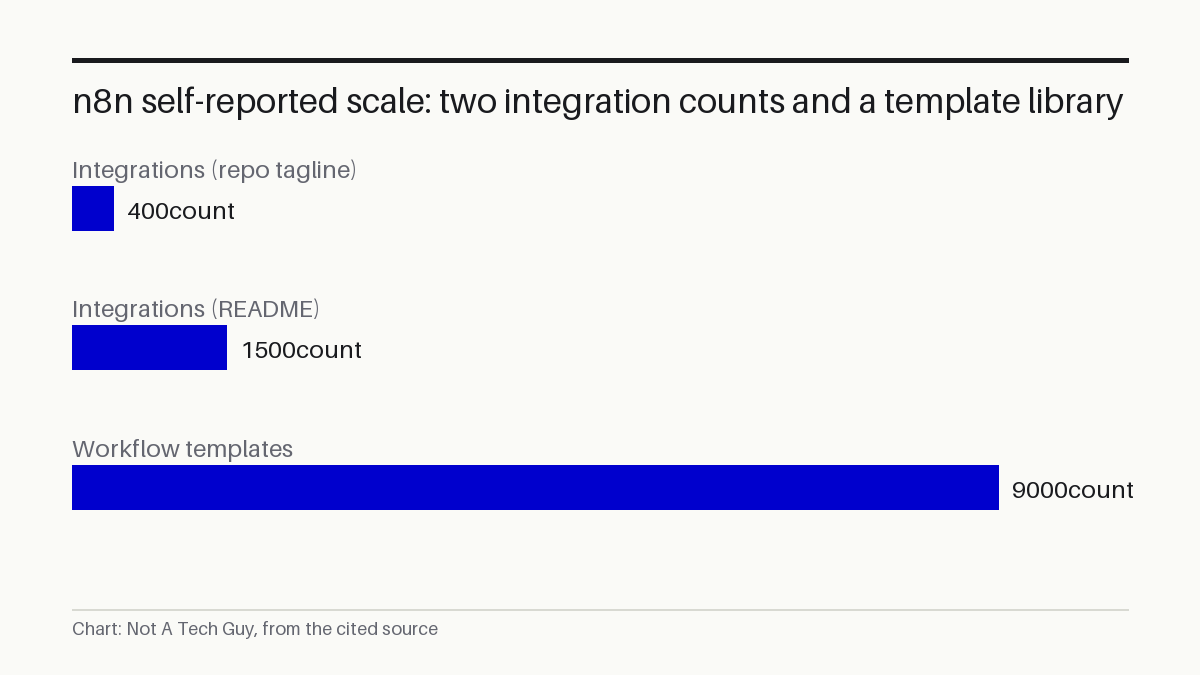
My read: This is the first workflow tool I've seen that markets itself as "fair-code" while pulling star counts usually reserved for genuinely open projects. I don't buy the "400+ integrations" figure in the repo tagline when the README claims 1,500+ S¹. One of those numbers is stale, and neither is independently verified. What interests me more is the license. The Sustainable Use License is a deliberate choice that restricts certain commercial use. An arXiv audit published in February P⁴ flags this pattern as a growing problem in the AI supply chain: tools that look open without being open.
What n8n actually does
n8n, pronounced "n-eight-n" and short for "nodemation" according to founder and CEO Jan Oberhauser S¹, lets users build automation workflows by dragging nodes together on a visual canvas. When a node is not enough, you can drop in JavaScript, Python, or npm packages S¹. The project is written in TypeScript S¹ and can be self-hosted or run in n8n's cloud S¹.
The maintainers claim 9,000+ workflow templates and either 400+ or 1,500+ integrations, depending on which part of the repository you read S¹. The repo tagline says 400+. The README says 1,500+. GitHub's own metadata page lists the license simply as "Other" P⁵.
Why "fair-code" is not open source
In March 2022, n8n's maintainers changed the project's license from Apache 2.0 with Commons Clause to a custom Sustainable Use License P². The stated goal was clarity: to make it obvious which uses are restricted P². The result is a license that allows most uses, including internal and personal projects, but restricts others, particularly competitive commercial offerings.
This puts n8n in a growing category of software that looks and feels open source but is not. The Sustainable Use License, shared by projects like Sealos P³, is not approved by the Open Source Initiative. An arXiv paper published in February 2026, "Permissive-Washing in the Open AI Supply Chain: A Large-Scale Audit of License Integrity," audited this phenomenon at scale P⁴. The paper, co-authored by Bram Adams and Ahmed E. Hassan, sits in the ethics and social impacts of AI category P⁴.
The software supply chain is only as trustworthy as its licences. n8n's 201,000 stargazers are betting on a platform whose terms can shift.
What to do about it
A small marketing agency building client dashboards might pick n8n for the visual builder and the AI nodes, deploy it self-hosted, and never read past the word "fair-code" on the GitHub page. That agency could be fine. But if the same agency wanted to package n8n as part of a product they sell to other businesses, the Sustainable Use License might block them, and the Enterprise License would apply instead.
The practical step this week: before adding n8n to any production stack, read the actual licence text on the repository, not the tagline. The distinction between "fair-code" and "open source" is not semantic. It determines whether you can build a product on top of this tool without paying for an enterprise licence.
What we don't know yet
All capability claims, from the integration count to the AI features, come from n8n's own README S¹. No independent benchmark or security audit exists in the evidence. The conflicting integration numbers, 400+ versus 1,500+, have not been reconciled by the maintainers. The arXiv audit P⁴ has zero citations as of publication, so its findings about permissive-washing are early-stage academic work, not settled consensus.
The next signal: n8n's next release or licence change on the GitHub repository. We'll check the integration count and licence terms against it. Subscribe and we'll send you the follow-up when it lands.
Sources: S1 — n8n-io/n8n: Fair-code workflow automation platform with native AI capa · P2 — [Announcement] A new license for n8n · P3 — heads/main/LICENSE.md · P4 — Permissive-Washing in the Open AI Supply Chain: A Large-Scale Audit of · P5 — n8n-io/n8n
More from Not A Tech Guy
- Nakama AI agent platform trends on GitHub at 259 stars
- Tencent AI-Infra-Guard: 5,200-star AI red team tool trends
- Neurosymbolic world model transfers tasks without retraining
Generated from an audited evidence pack with primary-source research. Social-media items are discussion signals, not verified facts. Nothing here is financial, legal or medical advice.


