

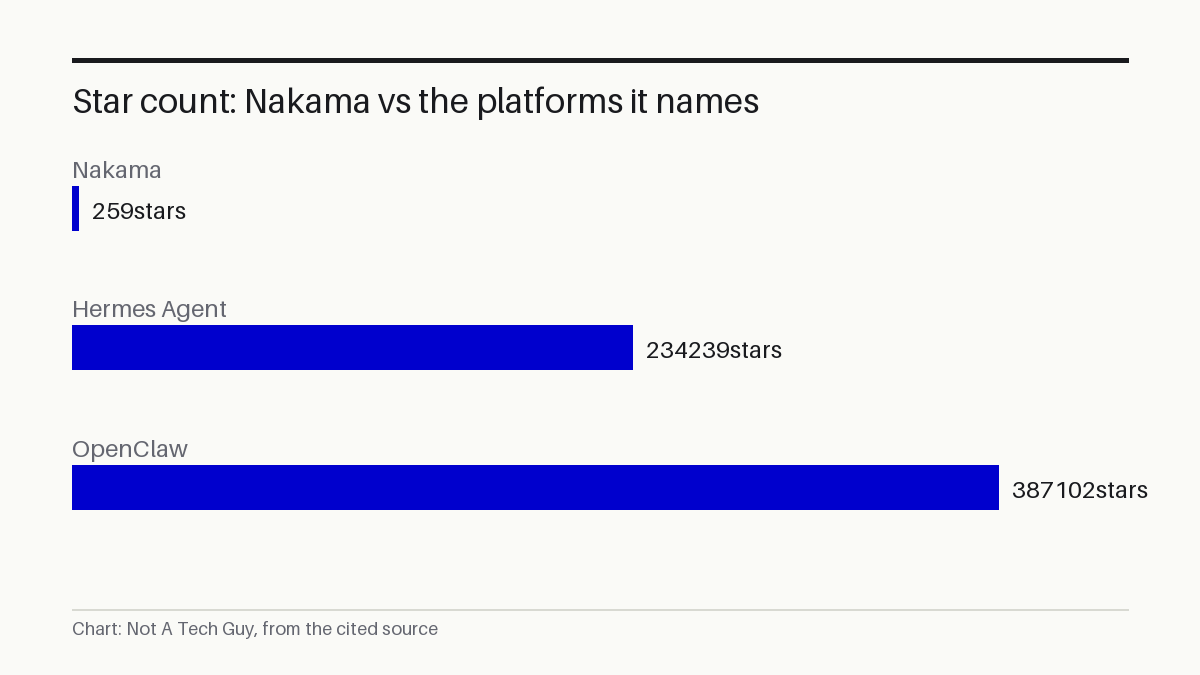
A TypeScript project called Nakama, with 259 total stars, appeared on GitHub's daily trending list on 22 August S¹. Its maintainers call it "like Hermes Agent & OpenClaw but designed to work nicely with teams" S¹, a claim that pits a 259-star repository against platforms with hundreds of thousands of stars. The gap between the ambition and the traction is the story, but so is the design choice that got it trending in the first place.
My read: This is the first agent platform I've seen that leads with multi-tenancy rather than single-user power. The pitch makes sense: most open-source agent tools are built for one person at one terminal, and teams need organisations, roles, and isolation. But I don't buy the comparison to Hermes Agent and OpenClaw yet. Those projects have 234,000 and 387,000 stars respectively P³P⁵; Nakama has 259 S¹. The team-first design is the interesting part. The competitive positioning is aspirational.
What Nakama claims to do
Nakama is an open-source AI agent platform written in TypeScript S¹. The README pitches a ChatGPT-style dashboard where teams interact with agents that carry distinct identities, permission sets, tools, skills, and memory S¹. Each agent can connect to channels including Telegram, WhatsApp, and Discord S¹.
The architecture is built around multi-tenancy from the start. One server supports many organisations, with invite and role management, and agents kept isolated from each other S¹. That is the specific gap the maintainers say they are filling: the same class of capability as OpenClaw or Hermes Agent, but without what they call "the setup maze," and not limited to one operator on one machine S¹.
The project runs locally with Bun or via a prebuilt Docker image S¹. It integrates with Composio, which the README says connects to more than 1,000 external apps S¹. It is released under the MIT licence S¹. A live demo is available, and managed hosting is offered through Nakama Cloud S¹.
The scale gap it is climbing into
The projects Nakama names as comparisons are orders of magnitude larger. Hermes Agent, by NousResearch, has 234,239 stars and was created in July 2025 P³. OpenClaw has 387,102 stars and was created in November 2025 P⁵. Nakama was created in May 2026 and had 156 stars as recently as the deep-research snapshot, before climbing to 259 P⁴S¹.
All of Nakama's capability and comparative claims come from the maintainers' own README S¹. No independent benchmarks, security audits, or third-party reviews are cited. The comparison to Hermes Agent and OpenClaw is self-reported positioning, not corroborated by either project.
Why the team-first angle matters
Agent memory, which Nakama lists as a per-agent feature S¹, has been a live research question. The per-agent memory and permissions model Nakama describes would need to handle model-level variance at scale.
The isolation claim is the other piece worth watching. Nakama's agent isolation is architectural, not behavioural S¹. The permissions model it describes would need guardrails to work in a shared server where multiple organisations run agents on the same instance.
What to do about it
A small dev shop that wants to experiment with shared AI agents across a team of five could try Nakama this week. The Docker image is prebuilt, the MIT licence places no restrictions on commercial use, and the live demo lets you poke at the dashboard before installing anything S¹. For a team that has been running individual copies of an agent tool on separate laptops and wants a shared server with role-based access, the pitch addresses a real friction point.
The practical step: pull the Docker image, point it at a test organisation, and check whether the multi-tenant isolation actually holds when two agents from different orgs share the same server. That is the claim most worth verifying, and it is the one the README cannot prove on its own.
What we don't know yet
No independent testing has confirmed that Nakama's multi-tenant isolation holds under load, or that the per-agent permissions model works as described across the Telegram, WhatsApp, and Discord channels it claims to support S¹. The project had 10 open issues in an earlier snapshot P⁴, which puts it at a stage where bugs and breaking changes should be expected.
The comparison to Hermes Agent and OpenClaw is unverified. Those projects have vastly larger communities, more languages, and longer release histories P³P⁵. Whether Nakama's team-first design is enough to close that gap, or whether the larger projects will add multi-tenancy themselves, is an open question.
The next signal: watch whether Nakama's star count sustains above the trending threshold over the next two weeks, and whether either Hermes Agent or OpenClaw ships a multi-tenant update in response. We'll check the star history and release notes against this claim. If you want that follow-up in your inbox, subscribe now.
Sources: S1 — ahmadrosid/nakama: It's like Hermes Agent & OpenClaw but designed to w · P2 — NousResearch/hermes-agent · P3 — NousResearch/hermes-agent · P4 — ahmadrosid/nakama · P5 — openclaw/openclaw
More from Not A Tech Guy
- Tencent AI-Infra-Guard: 5,200-star AI red team tool trends
- Neurosymbolic world model transfers tasks without retraining
- Claude Code v2.1.239 adds cost tracking, hits 142k stars
Generated from an audited evidence pack with primary-source research. Social-media items are discussion signals, not verified facts. Nothing here is financial, legal or medical advice.


