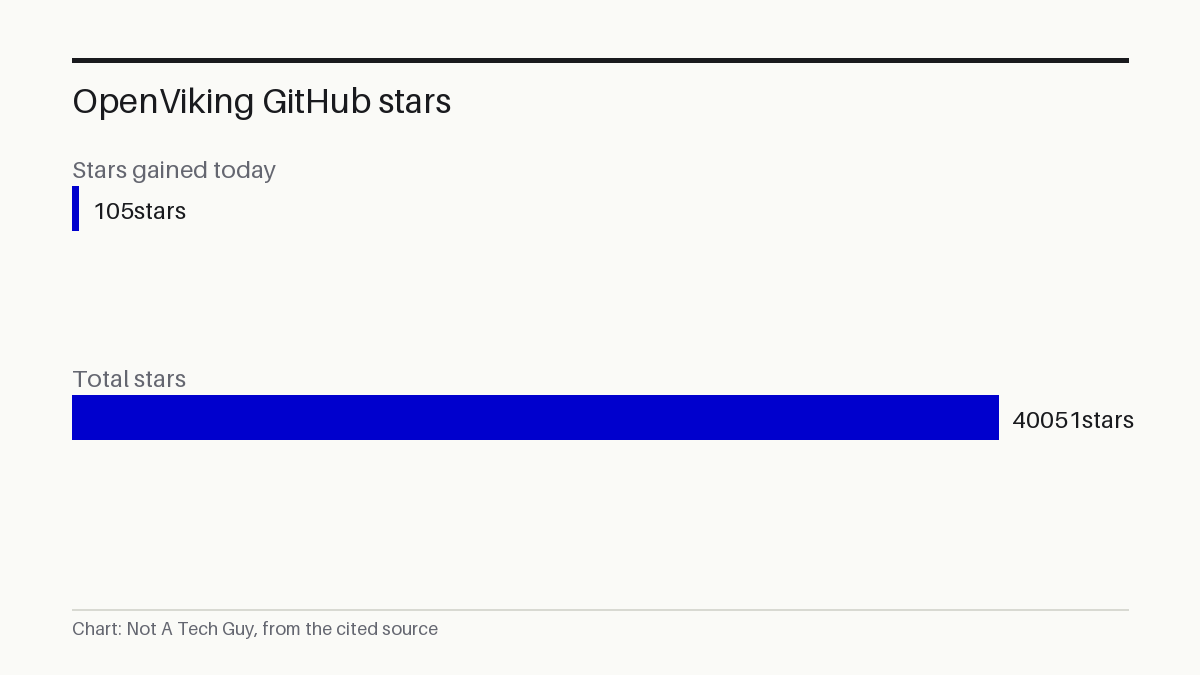

ByteDance's Volcengine team published OpenViking, an open-source context database that treats everything an AI agent knows as files under a viking:// filesystem, and the project crossed 40,000 stars on GitHub this week after gaining 105 stars in a single day on the platform's trending list S¹.
The approach challenges how most agent builders work today: stitching together separate systems for retrieval-augmented generation (the standard method for feeding documents into a model), conversation memory, and tool or skill management. OpenViking collapses all three into one virtual filesystem that an agent can browse and read on demand P²P⁴.
My read: This is the first agent-memory project I've seen that refuses to separate knowledge from memory from skills at the storage layer. Most teams I watch are still gluing a vector database to a chat-history buffer and calling it done. The filesystem metaphor is elegant, but the benchmark numbers are entirely self-reported and nobody outside the Volcengine team has verified them. I'd want to see independent tau2-bench results before believing the performance claims, and the 40,000-star count tells me about GitHub momentum, not production readiness.
One filesystem, three context types
The Viking team, part of ByteDance's cloud infrastructure arm Volcengine, organises context into three types: resources for reference material, memories for information retained from interactions, and skills for task procedures P⁴. Each piece of context loads in three tiers: L0, a one-sentence abstract; L1, a core overview; and L2, the full original data S¹. An agent scans the L0 summaries to decide what it needs, then drills down to L2 only for relevant items, which keeps token consumption down.
When a conversation session ends, OpenViking commits and archives it as Markdown files that a developer can read and edit by hand S¹. Memories sit in readable text, not a binary store, which makes debugging and correction straightforward.
Agent memory has become one of the most active corners of open-source AI this year. A memory repository called Hindsight gained 1,668 stars in a single day last month, as we found when the Hindsight agent memory repo surged. LoopX added durable memory to Claude Code and Codex agents in early September. And agent skill scanners were shown to miss 97% of attacks by Huawei researchers earlier this month, a reminder that the skill-management layer OpenViking handles is also a security surface.
The benchmarks nobody has checked
The project reports evaluation results on two benchmarks: LoCoMo, which tests long-conversation user memory, and tau2-bench, which tests multi-turn agent tasks S¹. Version 0.3.22 used Doubao 2.0 Pro, Volcengine's own vision-language model, for the memory evaluation S¹. These results are self-reported. The repository does not include peer-reviewed or third-party-audited benchmark data, and the README is the maintainers' description of their own work, not an independent review.
A developer who wants to try the system without committing to an install can use OpenViking Studio, a browser-based demo that requires no setup S¹.
The repository is written primarily in Python and carries the volcengine organisation label on GitHub, though the about page confirms the team sits inside ByteDance's Volcengine unit P².
Until an independent team reproduces the LoCoMo or tau2-bench results, the 40,000-star count measures interest, not proof.
Sources: S1 — volcengine/OpenViking: Self-evolving Context Database for AI Agents. U · P2 — docs/en/about/01-about-us.md · P3 — VectifyAI/ConDB · P4 — docs/en/concepts/02-context-types.md · P5 — lyonzin/knowledge-rag
Related reading
- Hindsight agent memory repo gains 1,668 stars in a day — our technology desk, 2026-09-25
- LoopX adds durable memory to Claude Code and Codex agents — our technology desk, 2026-09-05
- AI agent skill scanners evaded 97% by Huawei researchers — our technology desk, 2026-10-02
Written from 5 sourced items, 4 of them primary.