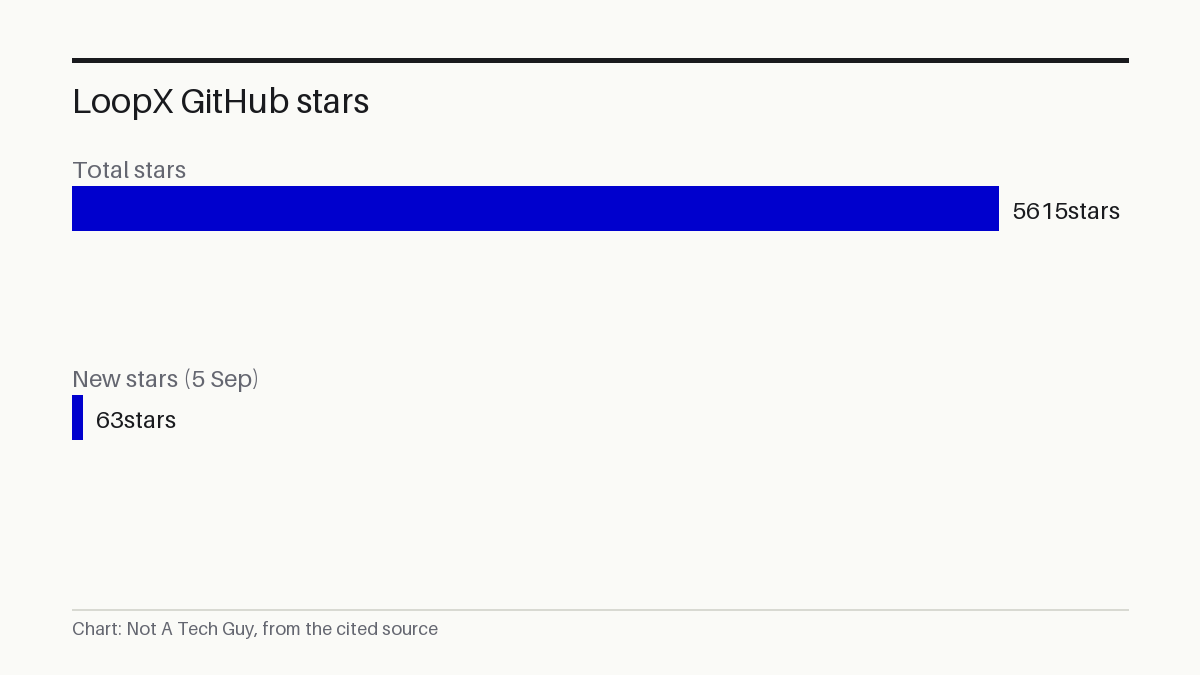
A Python project called LoopX landed on GitHub's daily trending list on 5 September with 5,615 stars and 63 new ones that day S¹. Its pitch, in the maintainers' own words, is a "long-horizon agent control plane" that sits on top of Codex, Claude Code, Cursor and other AI coding tools, giving them something they lack: durable memory across days, restarts and harness switches S¹. The question is whether a thin state kernel can actually hold an agent's attention when a task spans a week, or whether this is another orchestration layer that sounds good in a README and falls over on contact with a real codebase.
My read: This is the third agent-infrastructure project I've seen trend in as many weeks, and the pattern is clear: the bottleneck has moved from model capability to agent reliability over time. LoopX is attacking the same problem from a different angle. Instead of making the agent smarter, it wants to make the agent's workspace persistent. I'm skeptical of the "governance" claim because governance implies enforcement, and a local-first tool can only enforce what the underlying harness allows. But the durability angle, the idea that your agent picks up exactly where it left off after a restart, is the right problem to be working on. The v0.4.1 release on 4 August P⁴ is still early. I'd watch whether anyone builds a real multi-day workflow on this and reports back.
What LoopX actually claims to do
The maintainers describe LoopX as "open and provider-neutral" and a "local-first control plane for loop engineering" S¹. In plain terms: it does not replace your AI coding agent. It wraps it.
You keep using Codex, Claude Code, Cursor, or a custom harness. LoopX runs alongside, maintaining what the maintainers call a "Personal Agent Workspace" where goals, conversations, tasks, files, schedules and recovery state stay durable across sessions and restarts S¹. The Chinese tagline in the README translates roughly to: turn agents that can work into manageable, reviewable, continuously improving digital employees S¹.
The latest release, v0.4.1 from 4 August, is described as "a focused control-plane release for longer-running agent work" P⁴. The release improves how the system picks which work to persist, carries goals across host restarts, adds limits on scheduling, scopes recall to individual agents, and keeps provider-neutral operations, while requiring explicit permission before any action that touches the outside world P⁴. That last point matters. It suggests the agent cannot take actions outside its sandbox without permission, which is the governance claim.
The project offers a browser or PWA dashboard as its main entry point, with an experimental Tauri desktop shell for those who want a native app S¹.
The problem it is trying to fix
AI coding agents have a memory problem, and it is not the kind you fix with a bigger context window.
When you use Claude Code or Codex, the agent works within a session. It reads your codebase, makes changes, runs tests. But when the session ends, the agent's understanding of its task and its planned next steps evaporates. Start a new session and you are briefing a new hire from scratch.
This is fine for a one-hour task. It breaks down for anything that spans days. A multi-step migration, a refactoring across a dozen files, a bug investigation that requires running tests and reading logs over a week. The agent forgets, contradicts itself and redoes work it already finished.
LoopX takes a different approach: instead of loading memory into the agent, it maintains the workspace around the agent.
Why "control plane" is the right framing
A control plane, in networking, is the layer that decides where traffic goes. It does not carry the traffic. LoopX applies the same logic to agents. The agent (Claude Code, Codex, Cursor) does the actual coding work. LoopX decides what the agent should work on next, keeps the state between sessions and enforces rules about what the agent is allowed to do.
The maintainers claim this includes "semantic decisions about what happens next, governance, recovery, and human-agent collaboration" S¹. In practice, that means LoopX holds the task list, the conversation history, the file state and the recovery checkpoints, then hands the appropriate slice to whichever harness you are using.
The provider-neutral claim is important here. If LoopX works as described, you could start a task with Claude Code, switch to Codex mid-stream and pick up where you left off. Whether that actually works in practice, with different agents having different tool-use formats and system prompts, is an open question.
What to do about it
If you are running a team that uses AI coding agents for anything beyond quick fixes, the durability problem is real and you have probably hit it. An agent that forgets its plan overnight is an agent you have to manage like an amnesiac intern.
Consider a small dev shop that uses Claude Code for a client project spanning two weeks. Each morning, the lead developer opens a fresh session and spends 15 minutes re-explaining the codebase, the decisions made yesterday and the remaining tasks. Over two weeks, that is hours of lost time. LoopX's pitch is that the workspace persists, so the agent starts each session already knowing where it is.
The practical step: clone the repository, read the v0.4.1 release notes P⁴ and try running a single multi-day task through the browser dashboard. Do not bet a production workflow on it yet. The project has 5,615 stars and one listed maintainer S¹. The Tauri desktop shell is explicitly experimental S¹. Treat it as a promising prototype, not infrastructure.
What we don't know yet
Every functional claim in this story comes from the maintainers' own README and release notes S¹ P⁴. No independent review, benchmark or user report confirms that LoopX actually delivers durable state across harness switches, that governance enforcement works as described, or that recovery from a mid-task failure is reliable.
The 63 daily stars S¹ are a snapshot. The project could sustain that growth or it could be a one-day spike driven by a social media post. We do not know.
The provider-neutral claim, in particular, is unverified. Claude Code, Codex and Cursor have different tool-use protocols and context management. Whether LoopX's state kernel can genuinely abstract over those differences, or whether it works well with one harness and poorly with others, is not clear from the README.
The next signal: the LoopX release page, where a v0.5 tag would appear. Given the 4 August v0.4.1 release P⁴, watch for the next tag by early October. We will check the provider-neutral claim against it.
If this kind of reporting is useful, subscribe to get the next one in your inbox.
Sources: S1 — huangruiteng/loopx: Long-horizon agent control plane for durable, gove · P2 — Releases · huangruiteng/loopx · GitHub · P3 — ruvnet/open-claude-code · P4 — LoopX v0.4.1 · P5 — princeton-nlp/ProLong
More from Not A Tech Guy
- GPT-6 Astra: OpenAI's first model to hit Critical cyber level
- Google Fairwind Program: AI writes verified patches in minutes
- Environment evolution for terminal agents: 18-point gain
Generated from an audited evidence pack with primary-source research. Social-media items are discussion signals, not verified facts. Nothing here is financial, legal or medical advice.