

An arXiv preprint posted on 3 September reports that two Qwen language models improved their scores on a terminal-agent benchmark by 14.4 and 18.0 percentage points after training against environments that grew progressively harder on their own S¹. The method, called "environment evolution," tackles a problem that has been quietly limiting how AI agents learn to use command-line tools: the practice tasks stop being challenging just as the agent starts getting good. Whether those gains hold up outside the authors' own experiments is a question the preprint leaves open.
My read: This is the first training method I've seen that explicitly separates environment difficulty from the agent's current performance, rather than letting the two co-evolve. The 14.4 and 18.0 point jumps are eye-catching, but they arrive with no baselines, no error bars, and no independent replication. I don't buy the headline numbers yet, because the paper doesn't tell us where the models started or whether Terminal-Bench 2.1 is a benchmark anyone else uses. What I do find interesting is the structural argument: on-policy rollouts, the dominant approach, may be hitting a wall as models improve, and off-policy environment generation could be a way around it.
Why practice gets too easy
Terminal agents are AI models trained to operate command-line interfaces: running shell commands, editing files, managing processes. Training them well requires tasks that stretch the model without breaking it. The dominant approach, called co-evolution, generates new training tasks based on the agent's current performance. The agent improves, the tasks get a bit harder, the agent improves again.
The paper identifies a flaw in this loop S¹. Co-evolution depends on on-policy rollouts, meaning the environment reacts to what the model can already do. As models get stronger, this feedback loop tightens. The tasks stop surprising the model. The learning signal thins out. The agent plateaus not because it has mastered everything, but because the environment cannot stay ahead of it.
A related preprint, SETA, published in July 2026, tackled the same domain from a different angle: scaling the number of terminal environments available for training P⁴. Environment evolution takes the next step by changing how difficulty increases over time, rather than focusing on how many tasks exist.
How environment evolution works
The authors propose making the training environment harder in small, scheduled steps, one generation at a time, during training S¹. The key difference from co-evolution: this happens off-policy. The environment does not wait for the agent to master a level before raising the difficulty. It raises the difficulty on a schedule, forcing the model to keep up.
The paper derives three "evolution directions" from the multi-turn learning objective, the mathematical target that measures how well an agent handles a back-and-forth conversation with a terminal S¹. These directions control how the environment changes. A loop-engineered multi-agent setup, where several AI components work together to generate and validate new tasks, carries out the evolution along those directions S¹.
Think of it like a fitness coach who increases your weights on a fixed schedule regardless of whether you feel ready. Sometimes you struggle. Sometimes the task is too hard. But the coach never waits for you to say you are comfortable. The paper argues this keeps the learning signal continuous, because the environment is always one step ahead of the model.
What the numbers say
The authors ran two sets of experiments S¹.
First, they tested whether environment evolution actually produces harder environments. They ran rollout experiments with three models the paper names as Hy4 preview, Claude Opus 5, and GPT-5.6 Sol. The results showed that evolved environments were consistently more difficult than the starting set S¹. These models were used for evaluation, not for training.
Second, they validated the method by training two Qwen models, Qwen3.6-27B and Qwen3.6-35B-A3B, using simple long-horizon reinforcement learning on the evolved environments S¹. After training, both models improved on Terminal-Bench 2.1:
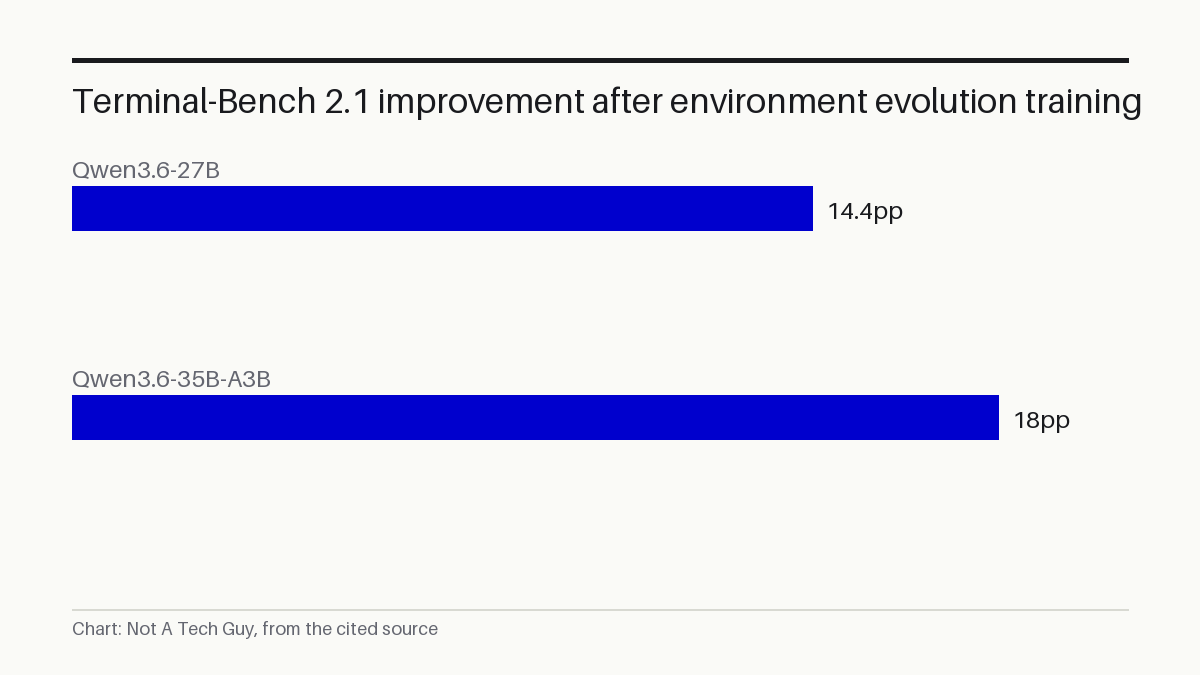
Qwen3.6-27B gained 14.4 percentage points. Qwen3.6-35B-A3B gained 18.0 percentage points S¹.
The paper does not report baseline scores, error bars, or statistical significance tests. The improvements are self-reported, and the preprint has not been peer-reviewed S¹. The models used for rollout evaluation (Hy4, Claude, GPT) are different from the models used for RL training (Qwen), so the two experiments answer different questions: one asks whether the environments are harder, the other asks whether training on them helps.
What to do about it
If you run a team that builds or deploys AI agents for command-line work, the idea worth borrowing is simple: do not let your training tasks stagnate. A DevOps team that uses AI agents to write deployment scripts might start the agent on single-file edits, then move to multi-service orchestration, then to debugging a failing production service under a time limit. The key is to raise the difficulty on a schedule, not when the agent seems ready.
The off-policy insight matters here. Most teams that fine-tune agents today collect data from the agent's own attempts and use that to generate new tasks. That works early, when the agent is bad at everything. It stops working when the agent gets competent, because the tasks it generates for itself are too easy. Scheduling difficulty independently of the agent's performance is a cheap structural change that could extend the useful training life of a fine-tuning pipeline.
One practical thing to check this week: pull your agent's last 100 training tasks and sort them by estimated difficulty. If 80 percent of them sit in the same difficulty band, your training signal has probably gone flat.
What we don't know yet
The preprint leaves several holes. Terminal-Bench 2.1 is referenced as the evaluation benchmark, but the paper does not provide enough detail for an outsider to verify its existence or compare against other benchmarks S¹. The percentage-point improvements lack baseline context: a 14.4 point gain from a starting score of 20 percent is very different from the same gain starting at 70 percent. No error bars or significance tests are reported.
The model names used in the paper, including GPT-5.6 Sol, Claude Opus 5, and the Qwen3.6 series, should be treated as labels from the preprint, not as confirmed commercial products available today. The SETA paper P⁴ and EvoArena P³, both related arXiv preprints on agent environment design, have zero citations between them, suggesting this subfield is too new for independent validation.
The next signal: whether any independent lab replicates the environment evolution method on a different model family and benchmark. Given the pace of terminal-agent research, with SETA appearing in July and this paper in September, a follow-up could land before the end of 2026. We will check any replication against the 14.4 and 18.0 point claims.
If you want to catch that follow-up when it lands, subscribe and we will send it your way.
Sources: S1 — Environment Evolution for Terminal Agents · P2 — [2609.04128] Environment Evolution for Terminal Agents · P3 — EvoArena: Tracking Memory Evolutionfor Robust LLM Agents in Dynamic En · P4 — SETA: Scaling Environments for Terminal Agents · P5 — 21pounder/terminalAgent
Related reading
- DiaSentinel AI agents screen diabetes risk on-premise — our technology desk, 2026-09-02
- OPTScientist: AI agents discover new transformer optimizer — our technology desk, 2026-07-26
- KnowPlan AI agents plan degrees with 99.5% certified accuracy — our technology desk, 2026-08-10
Generated from an audited evidence pack with primary-source research. Social-media items are discussion signals, not verified facts. Nothing here is financial, legal or medical advice.