

A degree-pathway planning system called KnowPlan, which appeared on arXiv on 10 August 2026, achieves a 99.5% certification rate for student planning requests, showing a utility gap of 0.015 when compared to a gold-standard reference S¹. Authored by Shuheng Cao and Jiaqi Wu and submitted to ICLR 2026 P², the research establishes a strict separation between the module responsible for reading university catalogs and the optimizer that constructs degree plans. The majority of AI agent architectures fail to maintain this separation, making it difficult to trace the origin of errors. The central question raised by this paper is whether this strict boundary is the cause of the strong results or merely a convenient reporting mechanism.
My read: This is the first agent architecture I've seen that treats the interface between stages as a measurable contract rather than a hopeful handoff. The closure certificate, a checklist of completeness instead of a reward score, is a genuinely different stopping criterion. I'm skeptical of the 100.0% feasibility claim because it comes from a six-school track the authors built themselves, and I don't buy the "AI Agents" framing in the title. This is a constrained optimization pipeline with an extraction front-end, not a conversational agent. The design pattern, though, is worth watching.
A wall between gathering and deciding
KnowPlan operates through two distinct stages that do not share state. The initial stage, named CatalogBrowse, scans university course catalogs and degree requirements. Lacking access to user profiles S¹, it cannot customize its findings based on the requester. It generates three JSON documents, each containing links to original sources for provenance tracking S¹. The subsequent stage, DegreeMap, relies exclusively on these three documents S¹.
This separation is the core design principle. In typical agent pipelines, the context-gathering component also handles decision-making, making it impossible to determine if errors stem from missed information or flawed reasoning. KnowPlan requires the gathering stage to verify its completion before the planning stage can begin.
Rather than using a reward threshold to determine completion, CatalogBrowse generates a closure certificate verifying four criteria: index completeness, schema completeness, provenance tracking, and reference completeness S¹. This functions as a checklist rather than a confidence metric. The stage cannot proceed to handoff until all items are verified.
DegreeMap processes the three JSON documents to construct a typed requirement hypergraph, capable of modeling complex dependencies such as "take two of these five courses, with at least one at the 300-level." Optimization is then performed using CP-SAT, Google's constraint programming solver P⁵, across a lexicographically ranked set of objectives: prioritizing hard feasibility, followed by completion horizon, load and risk, personalized utility, and finally option value S¹. This lexicographic ranking ensures each objective is satisfied only after higher-priority goals are met.
What the benchmarks show
KnowPlan was evaluated by its authors on two self-constructed tracks. Across a broad track of 100 universities, CatalogBrowse achieved 96.2% inventory recall and recovered 88.7% of masked sources, while reducing page access by 47% compared to an exhaustive crawler S¹. On a dense track of six schools, DegreeMap maintained 100.0% hard feasibility and increased personalized utility by 0.066 relative to the strongest baseline S¹. The complete pipeline certified 99.5% of requests, showing a utility gap of 0.015 against a privileged gold graph with direct access to perfect data S¹.
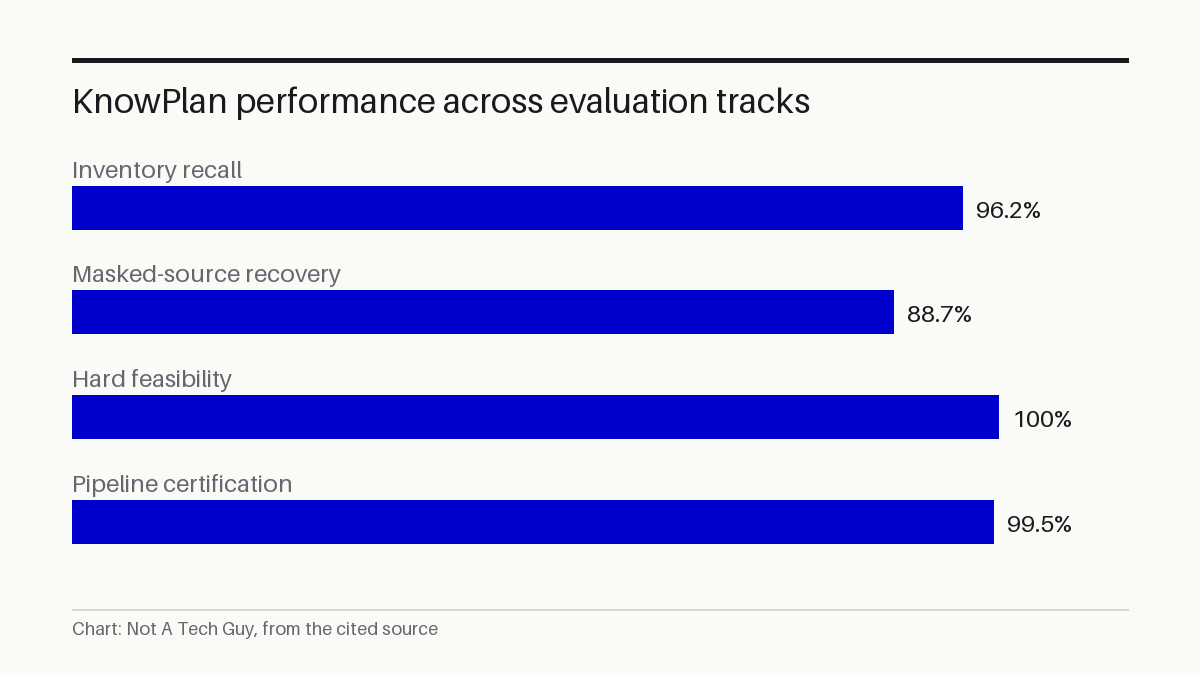
While these results are strong, they originate from author-designed benchmarks. The paper remains an arXiv preprint without independent replication or peer review S¹.
The "AI agents" label is doing heavy lifting
The OpenReview page lists "Large Language Model" among the paper's keywords P², and the title refers to "AI Agents." However, the methodology describes a constrained optimization pipeline. CP-SAT, used for optimization, is a combinatorial solver from Google's OR-Tools rather than a neural network P⁵. The extraction stage employs a "span-constrained clause-to-AST model fallback," which is a parsing technique rather than a generative model. While the "agent" terminology may describe the orchestration of components, readers should not expect a conversational chatbot that advises students.
This distinction is important because the agent label implies a level of flexibility and natural language interaction that the system may not provide. KnowPlan avoids the issue of AI agents forgetting old skills by not being that type of agent at all.
What to do about it
University registrars and software vendors developing course-advising tools should take note. A mid-size university advising office, such as one serving 15,000 undergraduates with three full-time advisors, typically depends on a human reading a 200-page catalog and a student's transcript to manually verify prerequisites, co-requisites, and program rules. If KnowPlan's approach generalizes, it could automate the catalog-reading portion of this process, generating a structured, provenance-linked representation for advisor verification.
The design pattern is valuable even if this specific system is never deployed. Teams building multi-stage AI pipelines can adopt the concept of defining a strict output contract between stages and verifying compliance before proceeding. This approach is easier to debug than a monolithic agent that combines gathering and decision-making in an opaque loop.
A practical step for this week: if you work with a multi-stage AI pipeline, document what crosses the boundary between your gathering and decision stages. If you cannot identify the exact fields and their sources, you are facing the issue KnowPlan aims to resolve.
What we don't know yet
The benchmarks are constructed by the authors. The 100-university broad track and the six-school dense track were designed by the same team that built the system, meaning the evaluation could favor KnowPlan's design choices. No independent group has replicated these experiments.
The 100.0% hard feasibility figure is specific to the six-school dense track and does not apply universally. The 47% reduction in source access is measured against an exhaustive crawler in a particular experimental setup, not against production web-scraping systems.
The role of large language models remains unclear. While OpenReview keywords include "Large Language Model" P², the abstract's technical description emphasizes constrained optimization and parsing. Whether LLMs are used within CatalogBrowse's extraction, or if the keyword is aspirational, will only be determined by reading the full paper.
The next signal is the ICLR 2026 review process on OpenReview, where reviewers will evaluate these claims against the full paper. We will compare the feasibility and recall numbers against the reviews once they are published.
Sources: S1 — KNOWPLAN: Knowledge-Driven AI Agents for Smart Degree Pathway Planning · P2 — KNOWPLAN: Knowledge-Driven AI Agents for Smart Degree Pathway Planning · P3 — THUDM/KARL · P4 — EthanYixuanMi/SmartCourse-Contextual-Advising · P5 — ortools/sat/docs/README.md
More from Not A Tech Guy
- Self-evolving AI agents stumble under real task streams
- Google Cloud scanner catches AI safety tampering in 10 of 14 models
- LLM agent: code-only verification flips goal abandonment 100% to 0%
Generated from an audited evidence pack with primary-source research. Social-media items are discussion signals, not verified facts. Nothing here is financial, legal or medical advice.