

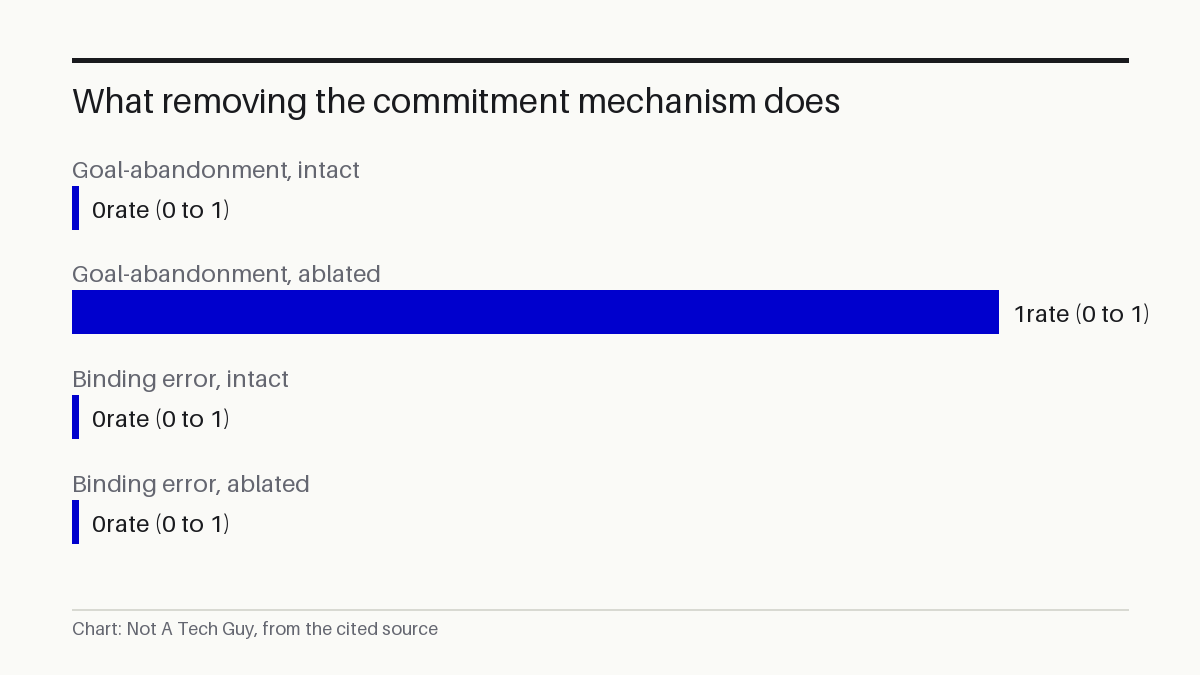
A new arXiv preprint published August 6 reports that stripping out an agent's commitment mechanism, the component that anchors it to its objective, sends goal-abandonment from zero to total collapse S¹. A second failure mode, binding error, remains at zero throughout S¹. That clean separation is the paper's real contribution: a verification method that can tell you which kind of drift is killing your agent. The authors also pre-registered their own failure on the task itself.
My read: This is the first agent paper I have seen that treats verification as architecture rather than audit. Most agent reliability work tries to make the model better at checking itself. This paper says: do not let the model check itself at all. Give a deterministic executive all the belief, let the LLM only file typed proposals, and admit a claim only when code matches a pre-registered prediction against observation. The 0-to-1 flip on goal-abandonment is a clean ablation result. The zero completions on ARC-AGI-3, pre-registered as a structural defeater, is honest reporting that I respect. I am skeptical of the small sample size, three seeds per cell, and the dense coinages like "salted-canary-echo floors" need clearer explanation than the paper gives them. But the core idea, that you can structurally separate two failure modes that everyone conflates, is worth watching.
The model proposes, code disposes
The architecture has two parts. A deterministic Executive holds exclusive control over belief and state. A language model, the proposer, is restricted to submitting typed proposals and has no direct authority to commit anything S¹. A claim is accepted into the system only after a prediction filed before the agent acts is checked against the actual outcome. That check is performed entirely by code, never by the LLM S¹.
This is structural verification, not post-hoc checking. The difference matters. Post-hoc verification asks the model whether it did the right thing, after the fact. Structural verification makes it impossible for the model to commit to a claim unless code has already confirmed the prediction against observation S¹.
What the ablation found
The paper's cleanest result comes from ablation, the standard technique of removing a component to see what breaks. Pulling out the commitment mechanism sends goal-abandonment from 0.00 to 1.00. Binding error, the other failure mode, holds steady at 0.00 S¹.
That separation is the paper's thesis made concrete. Commitment drift, the agent quietly abandoning its goal, and binding drift, the agent's beliefs coming unmoored from reality, are different failure classes. They need different fixes. Conflating them, as most agent debugging does, hides which one is actually killing your run.
The binding channel tells a different story. When its repair is stripped out, the failure does not resurface as per-beat drift because binding is governed by code and the failure class is absorbed by design S¹. What remains surfaces one layer earlier, appearing as a breakdown in the agent's ability to form hypotheses S¹. The failure moves rather than vanishes, and the instrument can see where it goes.
Four bugs caught in eight runs
Half of the first eight architecture runs were thrown out after tripping limits on per-organ write errors, render size, or salted-canary-echo thresholds S¹. Each invalidation pinpointed a genuine defect. This is the instrument working as designed: the verification floors caught real bugs before they could contaminate results.
The experiment used three seeds per cell and up to 394 reference beats per run, with every run gated as valid before results were counted S¹. A hidden shadow reference quietly builds the plan the full system would have executed in each ablation cell, so the authors can contrast what actually happened with the counterfactual S¹.
The honest zero
The paper reports zero level completions across 52 gated runs on ARC-AGI-3, a benchmark designed to stress abstract reasoning S¹. The authors registered this null outcome in advance as a structural defeater, they stated up front that the instrument was not expected to crack the task S¹.
This is unusual. Most agent papers lead with benchmark wins. This one leads with a verification methodology and a drift decomposition, and openly states the agent cannot complete the task it was tested on S¹. The drift problem this paper isolates is a close cousin of the broader reliability gap: the model drifts from what it was supposed to do, and most architectures cannot tell you why. This paper takes the opposite bet from approaches that let the model learn from its own errors: stop trusting the model to catch its own errors at all.
What to do about it
If you build agents that run for more than a few steps, the practical takeaway is to separate your trust. Let the LLM generate proposals. Let code verify them against pre-registered predictions before anything commits. A mortgage broker building an agent to scan loan documents across multiple lenders would not let the model assert "this application meets LVR requirements" and move on. The agent would file that as a proposal, and code would check it against the actual LVR calculation before the system accepted the claim.
The specific floors the paper uses, per-organ write-error limits and render-size caps, are tailored to this architecture. But the pattern transfers: set hard limits on what the model can write and how large its outputs can be. Test whether it echoes injected strings back. If the model breaches any floor, invalidate the run and debug.
One thing to check this week: look at your agent's last failed run and ask whether you can tell if it abandoned its goal or lost track of reality. If you cannot distinguish the two, you have the problem this paper is trying to solve.
What we don't know yet
This is an arXiv preprint and has not been peer-reviewed S¹. The sample size is small: three seeds per cell. The dense technical vocabulary, including "salted-canary-echo floors" and "render-invisible shadow reference," is explained only within the paper's own framework, and it is unclear how much of the instrument depends on the specific architecture versus the general principle.
The zero completions on ARC-AGI-3 are honest but also a ceiling. The paper does not test whether the verification methodology, combined with a stronger base model or a different task domain, would produce non-null task efficacy. Related work in the same space, including SafeCommit's approach to certifying when memory-grounded agents may safely act P⁴ and SmartSnap's proactive evidence-seeking framework P⁵, suggests the field is converging on structural verification. No one has shown these methods scaling to real-world task completion yet.
The next signal: whether the authors post runnable code to the GitHub repository linked from the paper, arjmandi/ARG, by September 6, thirty days after the preprint. Subscribe below for the follow-up.
Sources: S1 — The LLM Proposes, the Executive Disposes: A Self-Verifying Agent Instr · P2 — The LLM Proposes, the Executive Disposes: A Self-Verifying Agent Instr · P3 — Mridulkrishnaparauha/Zenos-Executive-Decision-OS · P4 — SafeCommit: Certifying When Memory-Grounded Agents May Safely Act · P5 — SmartSnap: Proactive Evidence Seeking for Self-Verifying Agents
More from Not A Tech Guy
- NVIDIA Cosmos 3 open model combines three physical AI skills
- Voice input degrades LLM agents more than typing, study finds
- LLM interpreter explains outputs with no extra API calls
Generated from an audited evidence pack with primary-source research. Social-media items are discussion signals, not verified facts. Nothing here is financial, legal or medical advice.