

Developer davila7's Claude Code component registry crossed 33,000 GitHub stars this week. It gained 102 in a single day to hit the platform's daily trending list S¹. The project is not affiliated with Anthropic. It has built a catalog of more than 1,980 reusable parts for Claude Code, the agentic terminal coding tool whose own GitHub repository shows 155,500 stars P³.
My read: The number that caught my eye is the component breakdown: 918 skills and 422 agents in a single community catalog. That is a lot of unvetted code running inside a tool that executes commands in your terminal. The pull-request validation pipeline, which runs Claude Code's own plugin validator plus NVIDIA SkillSpector, is a good gate, but neither tool guarantees safety or quality. I would treat every component as third-party code and read it before installing.
What the catalog actually contains
The registry at aitmpl.com is the project's public face, a browsable catalog that anyone can search or contribute to S¹. It was created on 4 July 2025 and is MIT-licensed, with 3,902 forks and 483 open issues on its GitHub page P⁴.
The catalog holds more than 1,980 components across seven categories S¹. Skills lead at 918 entries, with agents next at 422 and commands at 288.
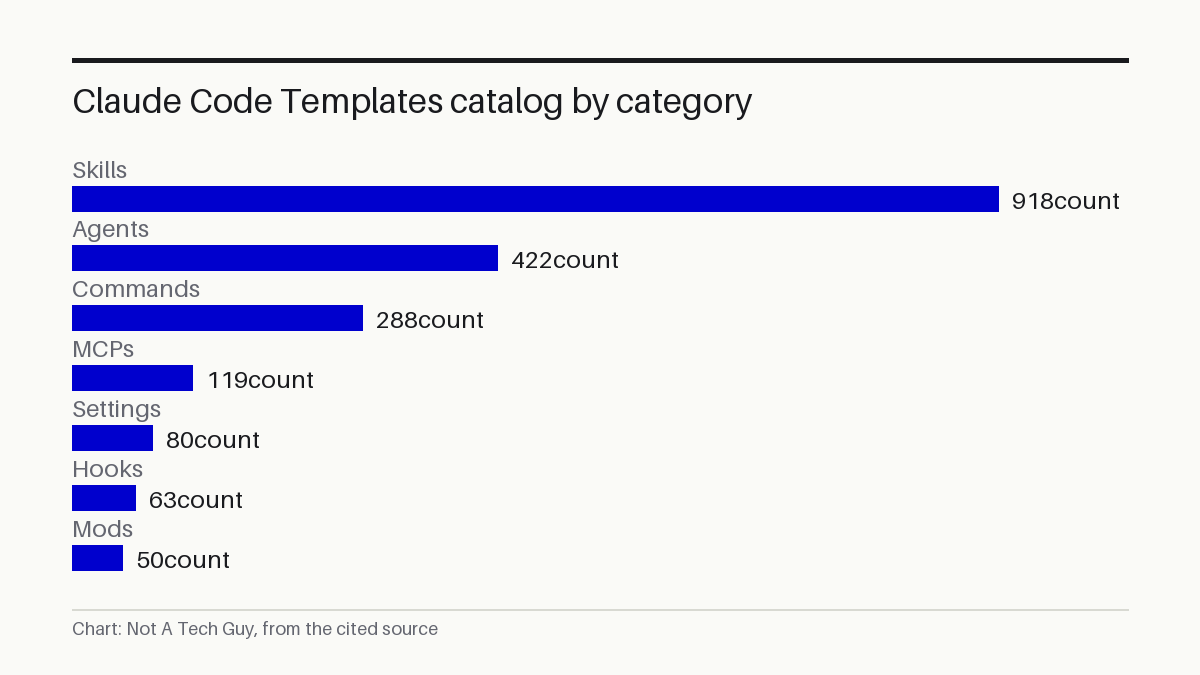
The tail is thinner. MCPs (Model Context Protocol servers that connect Claude Code to external data sources) account for 119, settings files for 80, hooks for 63, and mods for 50 S¹.
Validation and version requirements
Every pull request to the registry runs through Claude Code's plugin validator and NVIDIA SkillSpector, according to the README S¹. The NVIDIA scan is a tool the maintainers chose to use; it does not imply an official NVIDIA partnership.
Two features carry minimum version requirements. Loop functionality needs Claude Code 2.1.287 or higher, and plugins installed through the aitmpl marketplace require version 2.1.288 or higher S¹. The changelog, which follows semantic versioning, shows an unreleased pre-publish smoke test that runs install-path tests and a prepublish check script before any package goes out P².
What a developer should check first
A developer who wants to try this should start with a single skill from the catalog rather than an agent, because skills are scoped instructions while agents can execute multi-step workflows. Read the component's source on GitHub before installing it through the CLI, which runs via npx with no global installation required S¹.
The project lists Swiftproxy as a sponsor S¹, worth noting given that the catalog itself is free and open-source. Component counts are self-reported by the maintainers and have not been independently verified; some entries may be inactive or duplicates.
Community-driven component registries are becoming a pattern in open-source AI tooling, as we saw when ArtCraft's open-source AI studio trended with 40,263 stars earlier this month, and when the Otari LLM gateway routed 40+ providers in October. The difference here is that Claude Code Templates sits on top of a single proprietary tool rather than serving as standalone infrastructure. It is closer in spirit to doop's open-source canvas for live AI collaboration, which also extended an existing AI workflow rather than replacing it.
The next checkpoint is whether Anthropic acknowledges or integrates community registries like this one. Its own documentation at code.claude.com covers plugins and extensions P³, but makes no mention of third-party marketplaces.
Sources: S1 — davila7/claude-code-templates: Open-source registry and CLI for Claude · P2 — CHANGELOG.md · P3 — anthropics/claude-code · P4 — davila7/claude-code-templates · P5 — nktkt/ai-papers-cli
Related reading
- doop open-source canvas lets AI agents design live with humans — our technology desk, 2026-11-04
- Open-source LLM gateway Otari routes 40+ providers — our technology desk, 2026-10-20
- ArtCraft open-source AI studio trends on GitHub with 40,263 stars — our technology desk, 2026-11-10
Written from 5 sourced items, 4 of them primary.