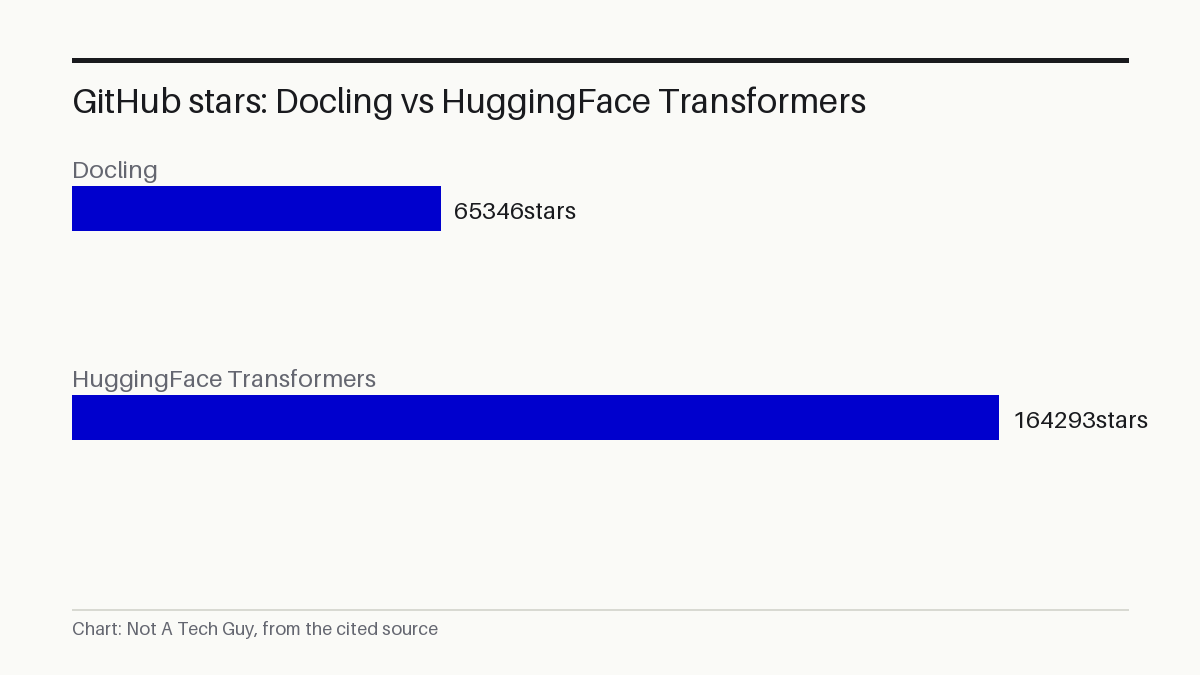
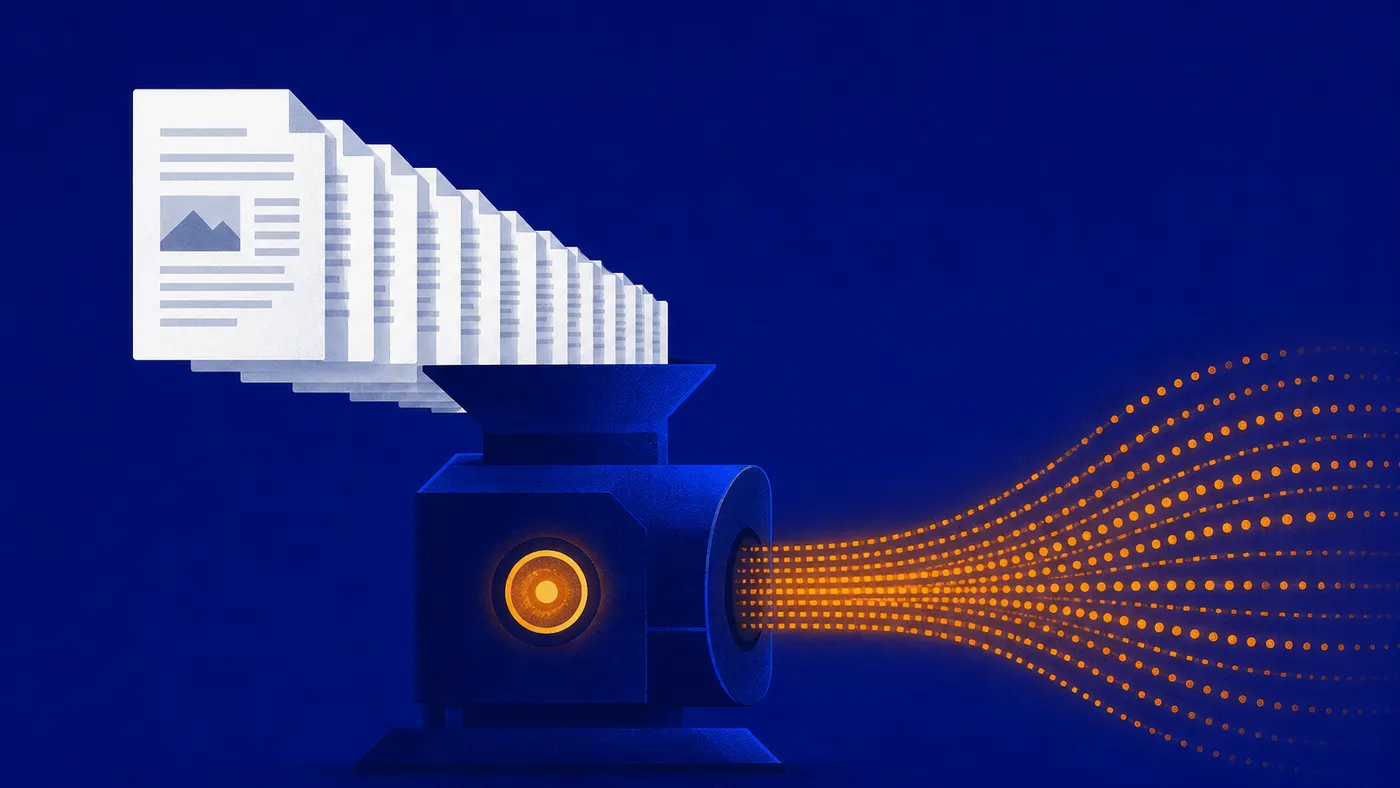
Docling, an open-source Python tool hosted on GitHub, now holds 65,346 stars and landed on the platform's daily trending chart this week S¹. The project turns messy real-world documents, everything from scanned PDFs to MP4 video files, into clean structured data that AI agents can actually use. What those stars signal is a bet that the unglamorous problem of document parsing might be the bottleneck holding agents back from real enterprise work.
My read: This is the first document-processing tool I've seen that treats video, audio, email attachments and financial reports as first-class citizens alongside PDFs. Most parsers stop at text extraction. Docling's bet is that agents need the full mess: tables, charts, formulas, reading order, even keyframes from a training video. I don't buy the "plug-and-play" framing yet, because every integration claim comes from the maintainers' own README with no independent verification S¹. But the breadth of format support and the MCP server connection are the details I'd watch. MCP positions Docling as infrastructure for any agent framework, beyond the four it names.
Why a document parser is trending
The recent feature additions tell the story. Docling added parsing for video files including MP4, AVI, MOV, MKV and WebM, with automatic speech recognition transcripts and representative keyframes S¹. It added chart understanding that converts bar charts, pie charts and line plots into tables or code S¹. It added support for ODF files, XBRL financial reports, email files, EPUB e-books and Markdown superset files S¹.
These additions push Docling beyond a PDF tool into something that ingests nearly any format an organisation might have sitting in a shared drive.
The agent connection
Docling offers integrations with LangChain, LlamaIndex, Crew AI and Haystack, four of the most widely used agent frameworks S¹. It can also connect to any agent through an MCP server S¹. MCP, or Model Context Protocol, is the emerging standard for letting AI tools talk to external data sources.
This matters because agents are only as good as the data they can reach. The agent layer is maturing fast. The document layer underneath it has been a mess. Docling is trying to fix that mess.
What it actually claims to do
According to the maintainers' README, which the source explicitly notes is their own description rather than an independent review S¹, Docling provides advanced PDF understanding including page layout, reading order, table structure, code, formulas and image classification S¹. It handles OCR for scanned PDFs and images, and supports visual language models such as GraniteDocling S¹. Audio files get processed with automatic speech recognition models S¹. Output can be exported to Markdown, HTML, WebVTT, DocLang, DocTags and lossless JSON S¹.
The project supports local execution for sensitive data and air-gapped environments S¹, which matters for organisations that cannot send documents to cloud APIs. It runs as a command-line tool or as a service via docling-serve S¹. It requires Python 3.10 or higher and works on macOS, Linux and Windows for both x86_64 and arm64 architectures S¹. An arXiv paper is linked from the README P⁴, and a maintainer posting as dolfim-ibm announced a full-day workshop at CH-Open P².
For scale, HuggingFace's Transformers library, the foundational model framework for the AI ecosystem, holds 164,293 stars P³. Docling at 65,346 is a strong showing for a tool with a narrower focus.
What to do about it
Consider a legal tech startup that needs to ingest discovery documents for a litigation matter. The files arrive as scanned PDFs, PowerPoint decks from expert witnesses, email threads in EML format, Excel spreadsheets of damages calculations and video recordings of depositions. Before Docling, that startup would need separate tools for OCR, video transcription, email parsing and table extraction, then custom glue code to normalise everything into a format their agent could read.
With Docling, the maintainers claim, one tool handles all of those formats and exports to Markdown or lossless JSON that feeds directly into LangChain or LlamaIndex S¹. The local execution option means sensitive legal documents never leave the firm's servers S¹.
If you build or deploy AI agents, the practical step this week is to install Docling from PyPI, point it at a messy real document from your own workflow, and check whether the structured output is clean enough for your agent to use. The README is the maintainers' sales pitch S¹, so verify the output quality on your own files before committing.
What we don't know yet
All functional claims come from the maintainers' README S¹. No independent benchmark, security audit or third-party review is cited in the evidence. The integration claims for LangChain, LlamaIndex, Crew AI and Haystack are the maintainers' description, not endorsements from those projects S¹.
Some listed features are marked as coming soon, including metadata extraction with titles, authors and references, and complex chemistry understanding for molecular structures S¹. These are not currently available.
The star count and trending status are point-in-time snapshots that can shift quickly. We have no data on Docling's download numbers from PyPI, its adoption inside enterprise pipelines, or whether the video and chart parsing features work reliably on real-world files rather than clean test cases.
The next signal: watch the Docling GitHub repository for the next tagged release, which should show whether the video parsing and chart understanding features move from recent additions into stable, documented releases. We'll check the changelog against the README claims when that release lands. Subscribe to catch that follow-up.
Sources: S1 — docling-project/docling: Get your documents ready for gen AI · P2 — [CH-Open] Docling: About Get your documents ready for gen AI · docling · P3 — huggingface/transformers · P4 — README.md · P5 — hybridfree/arxiv-papers · Datasets at Hugging Face
More from Not A Tech Guy
- Bioscience AI needs trust checks before lab action, preprint says
- BERT-LER: explainable AI reads 75 million health records
- LLM corrections usually die with each session, arXiv preprint says
Generated from an audited evidence pack with primary-source research. Social-media items are discussion signals, not verified facts. Nothing here is financial, legal or medical advice.