
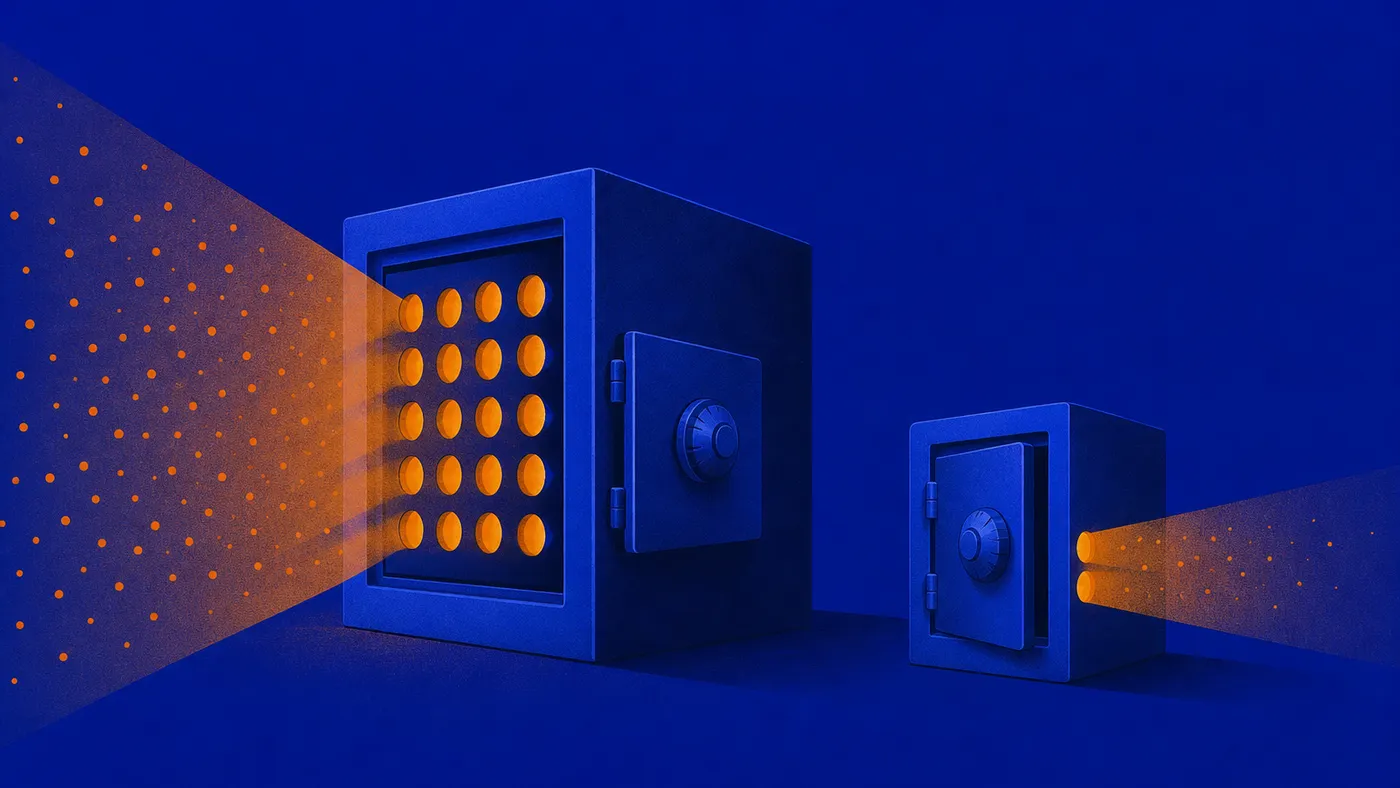
A preprint posted to arXiv on 5 August by researchers at USC, Carnegie Mellon, and Google Research cuts the error cost of privacy in federated learning from O(4^b) to O(2^b) S¹. At four bits, that is the gap between 256 and 16. The method, called SSTQ, tackles two problems that usually pull in opposite directions: hiding individual data and keeping the bandwidth bill low. Whether it survives outside two textbook image datasets is the question the paper leaves open.
My read: This is the first federated learning paper I've seen that treats privacy and compression as a single mathematical object rather than bolting one onto the other. The O(4^b) to O(2^b) reduction is the kind of result that matters in practice, because error compounds across thousands of communication rounds. But I don't buy the "optimal" label yet. The proof is unreviewed, and the tests cover only CIFAR-10 and Fashion-MNIST, two clean, balanced image sets that bear little resemblance to a real federated network with uneven data, flaky connections, and clients dropping out mid-round.
Why privacy and bandwidth fight each other
Federated learning trains a model across many devices without moving the raw data. Your phone, your hospital's server, your car's onboard computer each compute a gradient update on their local data and send only that update to a central server. The raw data stays put.
But gradient updates can leak the raw data. Researchers have shown you can reconstruct training images from gradient signals. The standard fix is local differential privacy: add calibrated noise to each client's update before sending it. Noise degrades accuracy, and the amount of noise you need grows with how much information each update carries.
Compression makes this worse. To save bandwidth, you quantize each update, packing a high-dimensional vector of floating-point numbers into a handful of bits. Existing methods like vqSGD use geometric constructions in high dimensions but suffer from variance that grows with dimension S¹. More dimensions, more noise, more error. Add privacy on top, and the error stacks.
SSTQ enters a crowded field with a specific claim: you can have privacy and compression in the same step, and the error cost is lower than doing them separately.
How SSTQ works
The method, from Adel Javanmard at USC, Vahab Mirrokni at Google Research, and David P. Woodruff at Carnegie Mellon P³, combines three ideas.
First, it projects each client's gradient vector onto what the authors call an overcomplete equal-norm tight frame S¹. A frame generalises a basis: instead of d coordinates, you spread the signal across N coordinates, where N is larger than d. This redundancy makes the signal more robust to noise and quantization.
Second, it subsamples. Rather than sending all N coordinates, each client picks a subset. This cuts the communication bill directly.
Third, it quantizes each selected coordinate to a small number of levels using a codebook designed with privacy in mind S¹. The quantization step itself injects the privacy noise, so you do not need a separate noise-adding step on top.
SSTQ comes in two variants S¹. The Flat Randomized Response version spreads probability uniformly across codebook levels. The Metric-Aware Laplace version shapes the noise to the geometry of the codebook, and the authors say it is better suited to higher bit-width regimes where you can afford more levels.
The number that matters
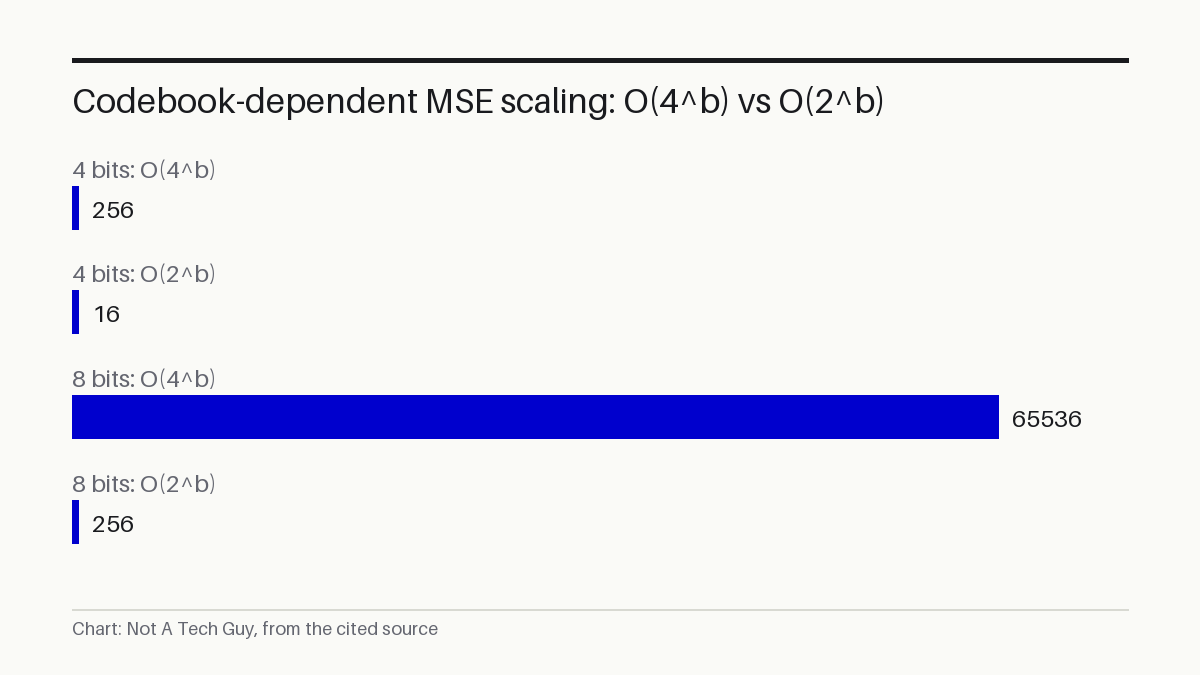
The headline result is a reduction in the mean squared error tied to the codebook, from O(4^b) down to O(2^b), where b is the bit-width of the codebook S¹.
At b=4 bits, the error term tied to the codebook drops from proportional to 256 to proportional to 16, a 16-fold reduction. At b=8, it drops from 65,536 to 256, a 256-fold reduction. The bigger your codebook, the bigger the saving.
The authors also show SSTQ uses only ceiling(log2 N) + b bits per client, where N equals Theta(d) is the frame size S¹. For a model with d=1,000,000 parameters and a frame of similar size, that is roughly 20 + b bits per client per round. The entire gradient vector, compressed and privacy-protected, fits in a few bytes.
The authors call this scaling "optimal." That claim is mathematical, based on their proof, and has not been checked by reviewers S¹.
What to do about it
If you run a federated learning system, the practical question is whether SSTQ's compression-plus-privacy in one step beats your current pipeline of compress-then-add-noise. The paper tests only CIFAR-10 and Fashion-MNIST S¹, so you cannot take the numbers at face value for your domain.
Consider a hospital network training a diagnostic model across 50 sites. Each site holds patient imaging data it cannot share. Today, that network might use a two-step approach: quantize the gradient, then add differential privacy noise. The noise budget is set by the privacy law that applies, and the quantization error is a separate tax on top. SSTQ's pitch is that folding both into one step reduces the total error, which means either better model accuracy at the same privacy level, or the same accuracy at a tighter privacy budget.
The honest move this week: read the paper's empirical evaluation section and check whether the baselines match what your system actually uses. If your baseline is not in their comparison, the "favorable utility" claim S¹ does not transfer automatically.
What we don't know yet
The paper is a preprint. It has not been peer-reviewed S¹. The mathematical claims, including the "optimal" MSE scaling and the privacy guarantees, rest on the authors' own proofs.
The empirical evaluation covers two datasets, CIFAR-10 and Fashion-MNIST S¹. Both are clean, balanced, 10-class image sets. The paper does not test on text, tabular data, or unbalanced non-IID data, which is what most real federated networks look like.
No source code for SSTQ is publicly available. A related GitHub repository from the same research group, Privacy-PORCUPINE, covers a different method and was last updated in October 2024 P².
A separate April 2025 preprint formally verified TurboQuant, the base method SSTQ builds on P⁴. That verification closed some gaps in the original TurboQuant proofs, which lends some credibility to the family of methods. But SSTQ itself has not been formally verified.
The next signal: whether the authors post SSTQ source code on their GitHub, which would let independent groups test the O(4^b) to O(2^b) claim on non-image data. We will check the authors' repository pages monthly for a code drop. If you want to know whether SSTQ's math holds up the moment someone checks it, subscribe.
Sources: S1 — SSTQ:Privacy-Preserving Vector Quantization via Subsampled Stochastic · P2 — MHVali/Privacy-PORCUPINE · P3 — SSTQ:Privacy-Preserving Vector Quantization via Subsampled Stochastic · P4 — Formal Verification of TurboQuant: Machine-Checked Proofs and Gap Clos
More from Not A Tech Guy
- Chiplet and AI chip-design security threats mapped in new preprint
- OlmoEarth Studio exports AI embeddings as GeoTIFFs
- VLA robots fail 100% under sticker attack, defense cuts to 26%
Generated from an audited evidence pack with primary-source research. Social-media items are discussion signals, not verified facts. Nothing here is financial, legal or medical advice.


