Gemma 4 12B recalls just 510 of 1,000 B2B SaaS brands from category prompts with no external lookup, according to an arXiv audit posted 26 November 2026 (arXiv cs.AI new (official RSS)). The 51.0% recall rate means the model omits nearly as many brands as it names when asked to list tools in a software category. The same audit found that when the model picks a brand's category from five candidates, it ranks a wrong answer first for 194 of 981 separated cases — a 19.8% error rate S¹. These figures are author-reported; the preprint is not peer-reviewed and reports no error bars S¹.
What it means: For any B2B software vendor counting on language models to surface their product in category searches, the numbers set a floor: half the field is invisible to Gemma without retrieval augmentation, and roughly one in five rankings the model does produce puts a competitor's category label ahead of the correct one. The error rate drops to 3.5% when the model's internal confidence margin exceeds 0.6 on the log-probability scale, but that clean signal covers only 547 of the 981 ranked brands S¹. The findings are specific to the Gemma family, and the authors explicitly state their regressions do not establish causal effects.
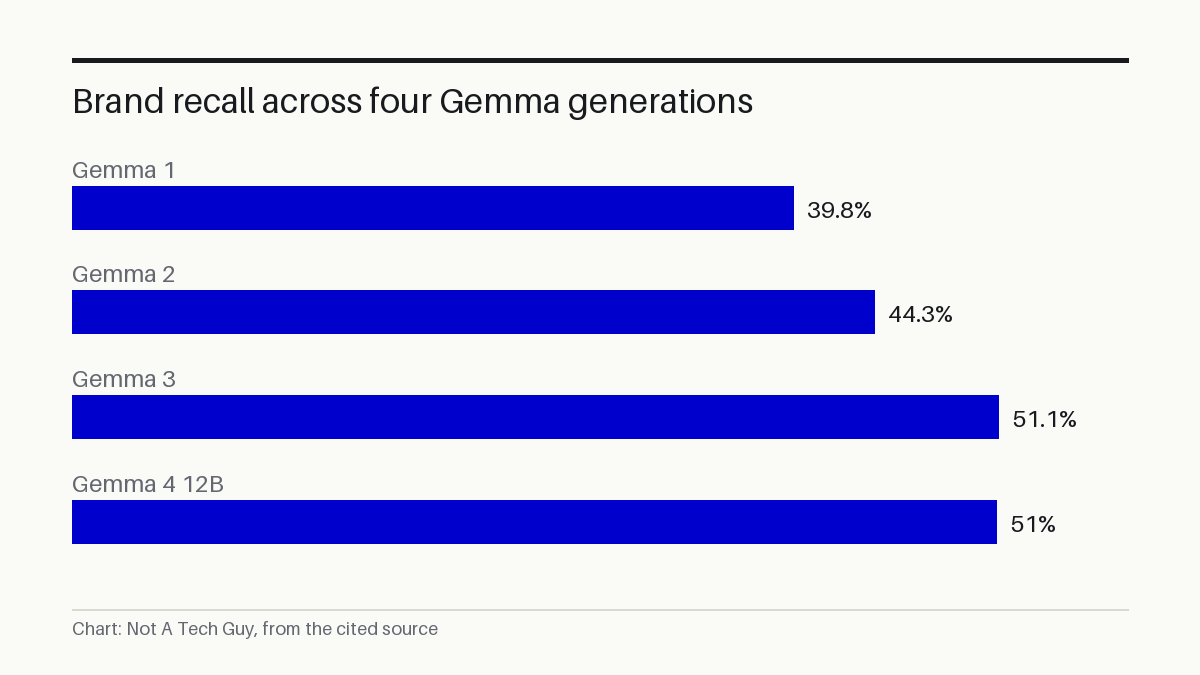
Recall creeps up across Gemma generations
The audit tested four generations of Gemma on the same 1,000-brand, 333-category set, measuring how many brands each generation produces when given a category name and no search tool. Recall rose from 39.8% to 44.3% to 51.1% and then plateaued at 51.0% in the latest generation S¹. The flattening between the last two generations suggests that scaling up the model has hit a ceiling for this kind of factual recall, at least within the Gemma line.
The audit's authors note that failure to elicit a brand does not prove the brand is absent from the model's parameters or training data S¹. A model might know a brand exists but not associate it strongly enough with a category prompt to name it.
Nearly one in five category rankings put the wrong label first
Recall is only half the audit. The other half tests whether the model can correctly classify a brand into its product category when given five candidates: the right answer plus four distractors. Gemma 4 12B ranked the reference label first for 787 brands, a distractor first for 194, and produced little separation for 19 S¹.
Among the 981 cases where the model showed a clear preference, those 194 wrong-first rankings produce a 19.8% error rate. That figure falls to 3.5% for the 547 brands where the model's top choice has a log-probability margin above 0.6 over the runner-up S¹. When the model is very confident, it is usually right. When it is less confident, it is wrong about one time in five.
The authors stress these are within-cohort measurements, not calibrated confidence estimates S¹. A margin of 0.6 does not mean the model is 96.5% certain in any absolute sense. It means that, within this dataset, brands with that margin were correct 96.5% of the time.
Documentation and web presence correlate with the two outcomes
The audit's exploratory regressions associate two factors with the two outcomes. Technical coverage, a measure of how much documentation and discussion surrounds a brand, correlates with recall. An owned-properties composite, capturing a brand's own website and marketing presence, correlates with category accuracy S¹. But the composites use different adjustment sets and do not establish causal effects S¹. A brand with more technical documentation is more likely to be recalled, but the audit cannot say whether the documentation causes the recall or whether both reflect the brand's overall prominence.
A separate finding shows how thin the model's brand knowledge can be. A representation-based sentiment measure, extracted from the model's internal states, shows almost no linear association with actual customer ratings (r=0.03, n=921) S¹. The model can sometimes name a brand and place it in a category, but its internal sentiment signal reveals almost nothing about whether customers like the product.
For a B2B SaaS marketing team, the practical step is direct: check whether the brand appears in zero-shot category prompts on the models customers might use. For a demand-generation manager, that means adding a zero-shot recall test to the weekly brand-visibility check — if Gemma omits the brand, the team needs to plan for retrieval-augmented tooling rather than assuming organic model recall S¹. The audit covers only Gemma, and the authors did not test retrieval-augmented generation, which would likely change the picture. The brand recall audit adds a quieter failure mode: the model does not hallucinate, it simply omits.
The findings support reporting recall and category accuracy as separate metrics S¹, a distinction that matters because a model can be good at one and poor at the other. The paper is an arXiv preprint posted 26 November 2026; it has not entered peer review, and all figures are author-reported S¹.
Sources: S1 — Brand Recall and Category Accuracy in Language Models: An Audit of 1,0 · P2 — htgan-ai/BrandEval · P3 — phueb/CategoryEval · P4 — allenai/awesome-open-source-lms