
The Wavefront authors tackle a known weakness in parallel block drafting: methods like DFlash and P-EAGLE propose a whole block of tokens in one forward pass but lose the dependence between them, which degrades the guesses that speculative decoding relies on (arXiv cs.AI new (official RSS)). The Wavefront method, posted November 25 on arXiv, lifts Qwen3-8B throughput 23.6% over DFlash across four benchmark types S¹. All gains are self-reported in a non-peer-reviewed preprint; no error bars are reported, no code has been released, and all figures are the authors' own measurements S¹.
What it means: The throughput figures come from a single arXiv v1 preprint tested only on the Qwen3 model family. No absolute tokens-per-second numbers are reported, only relative gains S¹. The improvements are measured under concurrent serving load, not single-user latency, so a solo user may not feel the same speedup. The number to watch is whether the 23.6% edge over DFlash survives independent testing on architectures outside Qwen3.
Wavefront swaps the full model head for a low-rank base
Speculative decoding works by having a small, cheap model guess tokens that a larger target model verifies in one parallel pass S¹. The faster the drafter produces good guesses, the more tokens the target accepts, and the fewer sequential steps the whole pipeline needs.
Parallel block drafters like DFlash and P-EAGLE speed up drafting by proposing an entire block in a single forward pass, but they discard the dependence between tokens within the block S¹. DSpark, a successor, restores part of that dependence with a lightweight correction head that runs sequentially, processing one token at a time S¹.
The authors' key finding is that DSpark's correction head overrides the base prediction on most slots S¹. That makes the target's full language model head — the final layer that turns hidden states into token probabilities, largely wasted effort, since its output is mostly overwritten before use.
Wavefront replaces that full head with a learned low-rank base S¹. The correction head then draws on the entire drafted prefix within the block, not just the previous token, and settles its predictions through a few parallel Jacobi passes where multiple slots update at once S¹ (arxiv.org). Because the number of passes is fixed, the draft step has no data-dependent control flow, so the authors capture it as a single CUDA graph in vLLM with fused kernels S¹. Several slots settle per Jacobi pass rather than advancing one at a time, which is where the speed comes from P².
Wavefront leads every baseline on Qwen3-8B
On Qwen3-8B, Wavefront improves throughput by 2.6% over xPress, 10.7% over DSpark, and 23.6% over DFlash, averaged across math, code, chat, and agentic benchmarks S¹. On long-context prompts from SPEED-Bench, the gaps widen to 9.6%, 14.3%, and 28.9% over the same three baselines S¹.
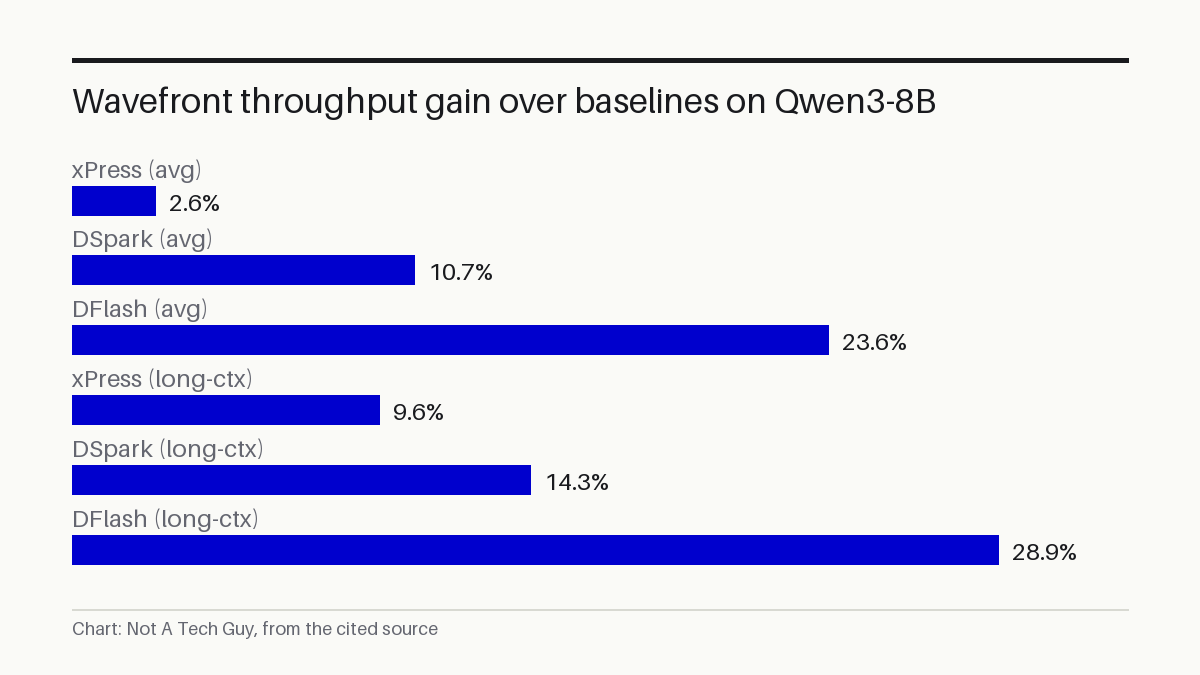
The authors report that these gains persist as serving load grows to concurrency 32 S¹.
The larger Qwen3.8-27B model tells a similar but narrower story. Wavefront leads DFlash2 by 7.6%, DSpark by 10.6%, and xPress by 5.0% on average, and by 7.4%, 5.8%, and 6.0% on long-context prompts S¹.
High-concurrency vLLM operators stand to gain first
Teams running vLLM, the open-source inference serving engine, with Qwen3-family models at high concurrency are the natural first users. For an operator managing a Qwen3-8B endpoint at concurrency 32, the reported 23.6% edge over DFlash would mean roughly a fifth more requests served per GPU-hour without adding hardware — if the self-reported numbers hold. The agentic benchmark results matter for multi-turn agent workflows, where output length and context grow with each turn.
The paper does not state whether Wavefront's code is publicly available or merged into the main vLLM distribution S¹. A related GitHub project, hao-ai-lab's JetSpec, covers causal parallel drafting with self-refinement and is open source under MIT licence with 265 stars (hao-ai-lab/JetSpec), but the evidence does not establish a direct link between JetSpec and Wavefront. Earlier work on speculative decoding, including the SpecDec code repository (hemingkx/SpecDec), laid the groundwork for the parallel and tree-based drafting methods that Wavefront builds on.
No independent third party has verified the performance claims, and the benchmarks cover only two models from the same family S¹. The next checkpoint is whether subsequent arXiv versions or peer review narrow the distance between self-reported throughput and reproduced results on other architectures.
Sources: S1 — Wavefront: Low-Rank Drafting with Parallel Causal Refinement for Specu · P2 — 1Whole-prefix conditioning lets several slots settle per Jacobi pass ( · P3 — Daily Papers - Hugging Face · P4 — hao-ai-lab/JetSpec · P5 — hemingkx/SpecDec