
Xiaomeng Wang, Martha Larson, Zhuoran Liu and Zhengyu Zhao showed that changing a single bit in an open-weight AI model can force it to repeat the same output string no matter what you feed it (arXiv preprint (cs.CR, q-fin.GN)). The finding matters because the same model weights that run text chatbots are reused as the backbone of vision-language models, meaning a vulnerability mapped on one can be replayed on the other without further searching S¹. Neither the repeated-output behaviour nor the transfer claim has been independently reproduced, and the paper reports no error bars or statistical significance thresholds for either result S¹.
What it means: The paper, posted to arXiv on 24 November 2026 and not yet peer-reviewed S¹ (arxiv.org), argues that the open-weight model ecosystem has created a new attack surface: anyone can download a model, find its weakest bit offline, and later flip that same bit in a deployed copy or in any vision-language model built on the same backbone. The claim that single-bit flips are easier to achieve under hardware fault attacks than multi-bit flips is theoretical framing in the abstract, not a physical demonstration in this paper. The finding to watch is whether independent labs can reproduce the repeated-output-string behaviour across different model families, since the paper reports it as a specific observed pattern rather than a universal result.
Single-bit flips exploit a gap in existing attack tools
A bit-flip attack alters one binary digit in a model's stored weights — the parameters that govern its output, without modifying any training data or prompt S¹. It strikes the model's memory directly.
Most prior bit-flip research on neural networks has centred on multi-bit attacks, altering multiple bits simultaneously to trigger a chosen misclassification or behaviour S¹. Wang and colleagues note that single-bit flips are simpler to execute via hardware fault injection — voltage glitches or laser pulses on a chip, than attacks demanding multiple precise bit changes S¹. But the existing tools for identifying which bits to flip were designed for the multi-bit case, leaving the single-bit scenario largely unexamined S¹.
The researchers adapted both data-free and data-based bit selectors — techniques that score which weight bits have the greatest influence on output, to operate with single-bit flips S¹. They then evaluated each candidate bit independently on source LLMs and checked the same logical coordinates in backbone-matched VLMs without running a fresh search S¹. The evaluation tracked both how much performance dropped and how the model's prediction patterns shifted across multiple inputs S¹. The paper does not release the adapted single-bit selector code, so the selection methodology cannot be independently verified S¹.
Shared backbones let attacks skip from text to vision models
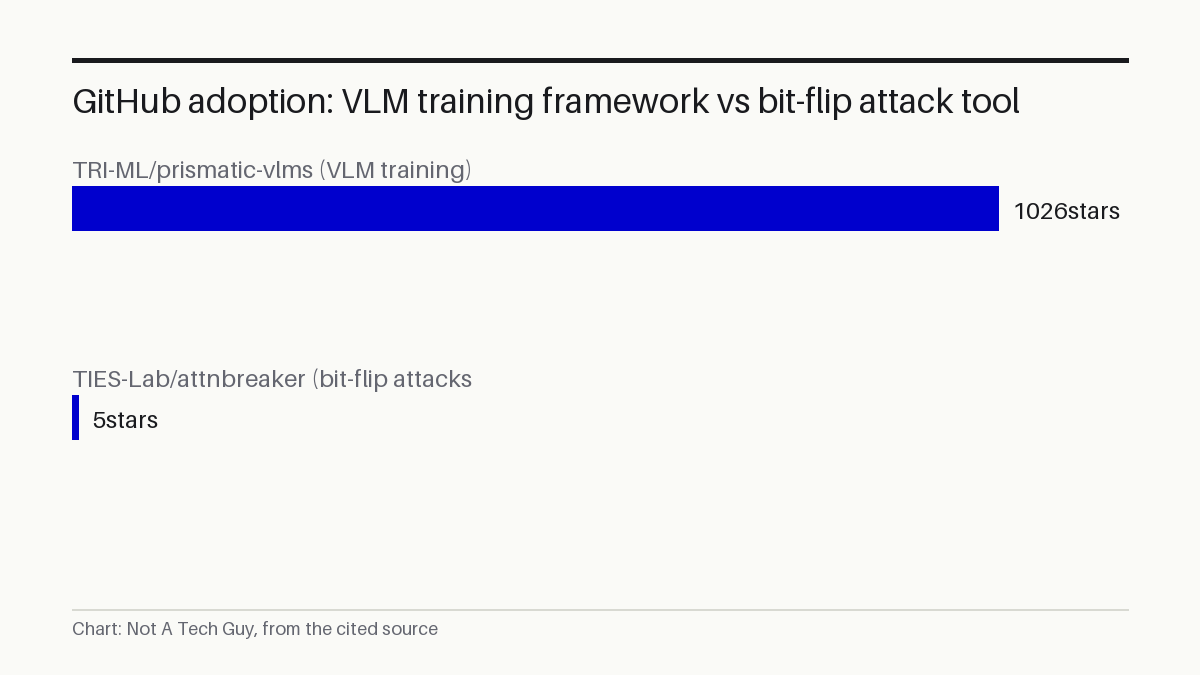
The core concern is architectural reuse. Open-weight LLMs are freely downloadable, which lets anyone inspect their weights offline S¹. Those same LLMs are commonly used as the text-processing backbone inside vision-language models, systems that combine image understanding with language generation S¹. The TRI-ML prismatic-vlms codebase on GitHub, with 1,026 stars and 1,276 forks, is one example of a framework built to train exactly this kind of backbone-matched VLM (TRI-ML/prismatic-vlms).
This reuse means an adversary could study a public LLM, identify which single bit causes the most damage, and later flip that same bit location in a deployed version of the LLM or in any VLM that shares the same backbone S¹. The attacker would not need access to the VLM's training data or to re-run the bit search on the VLM itself. The coordinates transfer.
The results show that the impact of single-bit flips varies depending on which bit selector is used, and the effects differ between the source LLM and its backbone-matched VLMs S¹. One consistent finding: a single-bit flip can push the model toward producing a repeated output string across different inputs, a failure mode where every answer collapses to the same text S¹. This is a specific observed behaviour, not something the paper claims happens in every case, and it joins a growing list of ways models can be quietly steered off course — AI chatbots can secretly embed gender in their replies and AI safety fails in multi-turn chats cover related failure modes.
No defence is proposed and no hardware attack is demonstrated
The paper does not propose a defence or mitigation strategy S¹. It does not physically demonstrate a bit-flip attack on production hardware; the hardware-fault framing is theoretical S¹. And it does not claim that all backbone-matched VLMs exhibit identical vulnerability patterns to their source LLMs, only that the same logical coordinates can be tested without re-searching S¹.
The AttentionBreaker framework on GitHub, maintained by the TIES-Lab with five stars and two forks, provides tooling for bit-flip attack research on transformers and may offer a path for independent verification (TIES-Lab/attnbreaker). The codebase was created in May 2025 and has had six contributions from a single developer P³.
For a platform engineer running an open-weight LLM inference service, the immediate change on their desk is adding a cryptographic weight-hash check to every model load, since a bit-flipped model is byte-identical to a clean one at the file level and no routine log scan will surface the difference S¹. The preprint is version 1, submitted 24 November 2026 P²; the next signal would be a revised version or a peer-reviewed publication.
Sources: S1 — Analyzing Single-Bit Flips on LLMs and Their Backbone-Matched VLMs · P2 — Analyzing Single-Bit Flips on LLMs and Their Backbone-Matched VLMs · P3 — TIES-Lab/attnbreaker · P4 — Analyzing Single-Bit Flips on LLMs and Their Backbone-Matched VLMs · P5 — TRI-ML/prismatic-vlms