Yulliwas Ameur, Samia Bouzefrane and Soumya Banerjee of CNAM Paris submitted a preprint on 23 November 2026 showing routine tool updates silently hand AI agents more authority than users approved S¹. In a pilot of 604 releases across 39 public MCP servers, 412 of 580 "compatible" schema changes widened what the tool could do, and not one of eight surveyed clients or scanners caught it S¹.
MCP, the Model Context Protocol, is the wiring standard that lets an AI agent call external tools, from reading files to querying databases. When a user approves a tool, they approve a specific JSON schema, the list of arguments the tool accepts and the fields it expects. Tool maintainers then update those schemas. A change that adds a new optional field is "compatible" in the software-engineering sense: old code keeps working. But that new optional field might let the agent write to a path the user never authorised, or pass a parameter that changes what the tool does. The rush to wire agents into real business systems is well underway, as Ropes & Gray's AI diligence tool built with OpenAI showed in October.
My read: The number I would watch is 76. That is the count of changes the authors' adjudicated review found to add or widen an authority-bearing argument: 66 that a naive name-based labeller also flagged, plus 10 the labeller missed S¹. The authors served as their own adjudicators, which invites confirmation bias, and the paper has not been peer-reviewed. But the core finding, that compatibility is treated as safety when it is not, is a real gap in the MCP ecosystem.
What "compatible" actually costs
The pilot covered 604 releases from 39 public MCP servers S¹. Of 580 schema changes classified as compatible, 412 broadened the tool's reach in some way: a new argument, a wider field the tool now accepts S¹. The authors' adjudicated double annotation found at least 76 changes that add or widen an authority-bearing argument, 66 that a name-based labeller also flagged plus 10 it missed S¹.
Not one of eight surveyed MCP clients and scanners re-approves a tool when its input schema widens; two cases could not be determined S¹. The survey is small, and the authors flag this. But the pattern is clear: compatibility, the property that lets old code keep running, is the same property that lets a tool quietly accept new inputs the user never vetted.
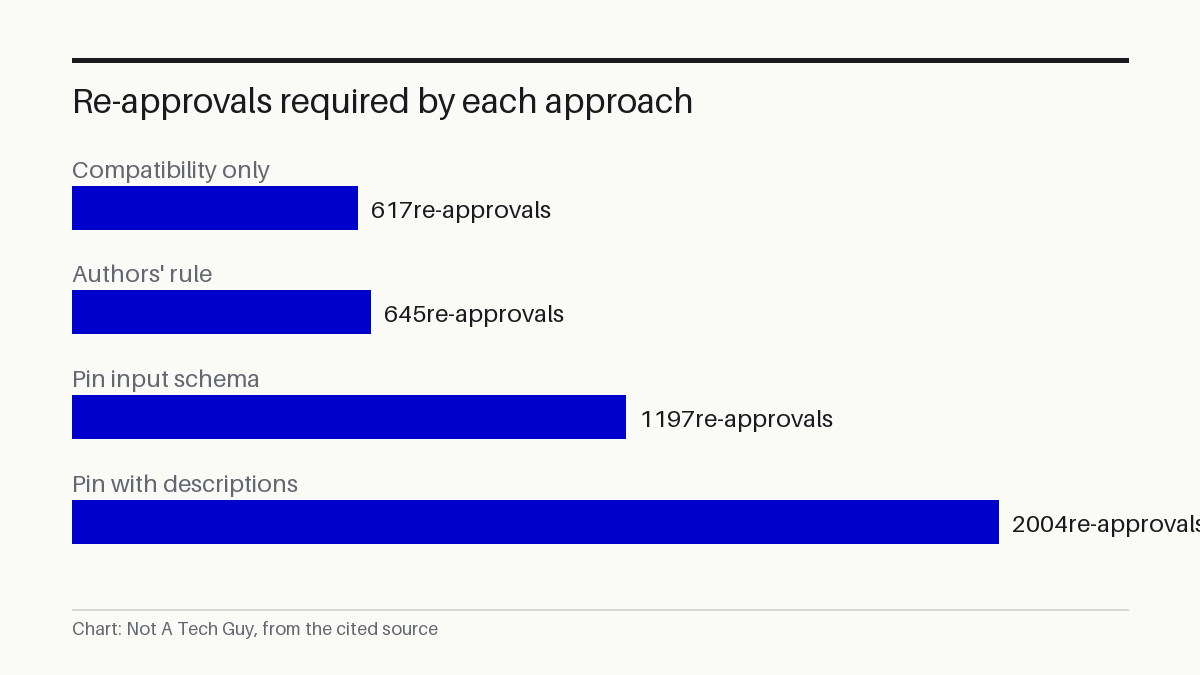
A rule that asks for 645 re-approvals, not 1,197
The authors propose a re-binding rule based on subschema inclusion: if the new schema contains the old one, the tool keeps its approval; if it widens, the client must re-approve S¹. They support it with a Coq proof of composition, 48 regression tests, and a benchmark built on exact references S¹.
On existing tools, the rule asks for 645 re-approvals, compared with 1,197 for pinning the input schema, or 2,004 if descriptions are pinned too, and 617 for pure compatibility S¹. The rule sits between the two extremes: it catches more than compatibility alone but demands fewer re-approvals than full schema pinning.
The benchmark also caught a flaw in the authors' own work.
An earlier version of the rule silently re-bound 27 amplifying changes instead of flagging them for re-approval S¹. Those are now fixed.
What it cannot catch
A behaviour change hidden behind an identical schema is still beyond this rule's detection S¹. If a tool maintainer changes what the tool does without changing its input schema, no schema-level rule will catch it. A tool that accepts the same "file_path" argument but now writes instead of reads is invisible to this approach.
The companion code repository, armanzareian/agentcompat on GitHub, describes itself as providing trace-driven compatibility testing for evolving LLM tool schemas, under an Apache 2.0 licence P³. It has no stars and two open issues as of this writing. The broader appetite for agent tooling on GitHub is visible in projects like PR-Agent, which trended with 122 new stars in a day, and OpenMontage, which hit 74,000 stars.
For a team building an MCP client or agent platform, the concrete check is simple: does your client re-approve a tool when its input schema widens, or does it treat compatibility as a green light? The evidence says none of the eight surveyed clients do, and 412 of 580 compatible changes in the wild widen something S¹.
The arXiv preprint, submitted on 23 November 2026, has not been peer-reviewed S¹.
Sources: S1 — SchemaCaps: When a Compatible Tool Update Silently Widens an AI Agent' · P2 — [2611.30750] SchemaCaps: When a Compatible Tool Update Silently Widens · P3 — armanzareian/agentcompat · P4 — Artificial Intelligence · P5 — rkriad585/authority
Related reading
- PR-Agent trends on GitHub with 122 new stars in a day — our technology desk, 2026-11-02
- Ropes & Gray builds AI diligence tool with OpenAI — our technology desk, 2026-10-29
- OpenMontage AI video agent hits 74,000 GitHub stars — our technology desk, 2026-11-01
Written from 5 sourced items, 4 of them primary.