
Abdelmonaim Bounite and Zangir Iklassov at MBZUAI found that a single Python hash seed change shifts up to 17% of an AI agent's security verdicts S¹. The benchmark they tested, Agent Security Bench, never flagged the instability. The finding breaks a core assumption in AI safety testing: that a reproducible result tells you something real about the agent.
My read: The 17% figure is striking, but I would hold off calling it a systemic problem until someone runs the same test on a second benchmark. The paper only examines Agent Security Bench, and the authors themselves note that ASB's naming convention, which alphabetically places attacker tools first, is what makes tool ordering matter so much. The number I would watch is the 17-91% swing when evidence is reordered across LLM judges, because that mechanism, unlike the hash seed, would apply to any benchmark that feeds an LLM judge a list of evidence items.
The noise hiding in the numbers
When a company publishes an attack success rate for its AI agent, the number looks solid. It came from a benchmark. It ran the same way each time.
It is reproducible.
Bounite and Iklassov argue that reproducible is not the same as attributable. They define "content-free state" as the details of a benchmark run that carry no information about the system under test: the Python hash seed, the order tools are listed, the order evidence is presented to an LLM judge, the way failed runs are scored S¹. These are choices an evaluator makes, and the authors treat them as untrusted input because the evaluator can set them to whatever produces the best number.
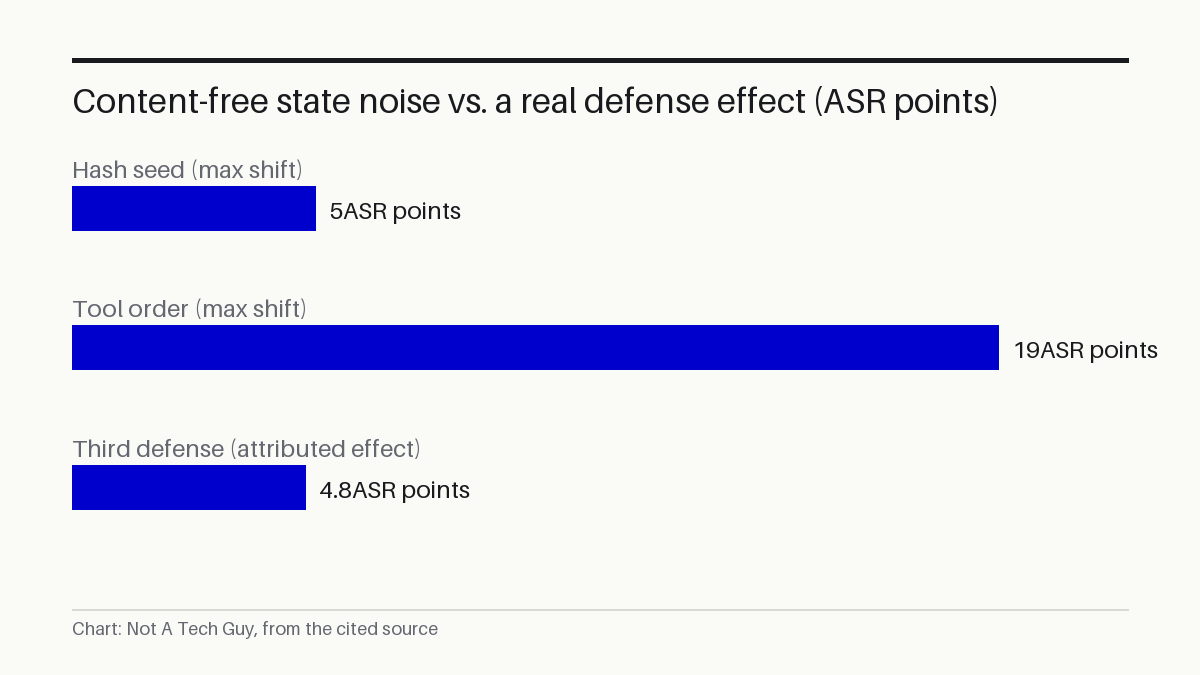
On Agent Security Bench, runs with a fixed hash seed are identical for seven agents from four model families S¹. That is what reproducibility looks like. But when the seed changes, up to 17% of an agent's verdicts flip, while the attack success rate moves by at most 5 points S¹.
The tool list matters more. ASB names attacker tools alphabetically first, so sorting the tool list instead of reverse-sorting it raises the attack success rate by up to 19 points S¹.
That is a 19-point swing from a choice that has nothing to do with the agent's reasoning or the attack's design.
Reordering the evidence produces an even larger swing. When the same evidence is shuffled, six of seven LLM judges change their decision on between 17% and 91% of 98 proposed actions S¹. An LLM judge that sees the same facts in a different order reaches a different conclusion up to nine times out of ten.
What TARE does about it
The authors built a framework called TARE, short for Testing Attribution of Reported Effects. It attributes a reported effect to the agent, the attack, or the defense only if that effect exceeds the measured influence of content-free state S¹. If your defense lowers the attack success rate by 4 points but the hash seed alone can move it by 5, TARE says you cannot claim that improvement for the defense.
Across eighteen agent-defense combinations, TARE's worst-case test attributes effects to two of three defenses tested S¹. One of those two defenses shows effects in opposite directions on two different agents, meaning it helps on one and hurts on another S¹. A test fixed in advance confirms a 4.8-point decrease from the third defense S¹.
A buried detail sharpens the problem. In the attributed decreases, 35% to 69% of stopped attacks end without any tool call, which ASB counts as a failed attack S¹. The defense may not be stopping attacks at all. The agent may simply be doing nothing, and the benchmark scores that as a win.
This connects to a wider pattern. OpenAI researchers Joy Hsu and Sam Arnesen reported on November 3 that agent success rates in safety evaluations run higher than in deployment, what they call an "eval-production behavior gap" P⁴. As we found when a prompt injection defense cut agent attack rates from 37.8% to 4.4%, benchmark numbers can look dramatic without telling you what happens in the wild. Tencent's finding that AI coding agents trigger security safeguards in only 27-36% of runs raises the same question from the other side: are the eval numbers measuring safety, or measuring the eval?
What survives scrutiny
The paper is a preprint on arXiv, listed under cs.AI and cs.LG, and has not been peer-reviewed S¹. All quantitative results are specific to Agent Security Bench and the tested model families. The authors themselves do not claim that TARE eliminates content-free state variability; it measures the influence so evaluators can see whether their reported effects survive it.
Alongside the November 23 preprint, the authors released TARE, an ASB patch, and all verdict tables S¹. That means other researchers can run the same checks on other benchmarks today. The question that matters is whether the 17% verdict swing and the 19-point tool-ordering effect are quirks of ASB or structural problems in how LLM agents are evaluated everywhere.
For a team publishing agent security scores, the practical check is narrow. Run the benchmark with three different hash seeds. If the attack success rate moves more than the effect you are claiming for your defense, you do not have a defense result. You have noise.
Sources: S1 — Attributing Security Outcomes in LLM-Agent Evaluations: The Role of Co · P2 — Attributing Security Outcomes in LLM-Agent Evaluations:The Role of Con · P3 — From Verdict to Diagnosis: Attributable Security Review of Pull Reques · P4 — Eval-production behavior gaps in agent safety and the role of eval-awa · P5 — Asaf-Yehudai/LLM-Agent-Evaluation-Survey
Related reading
- Free AI agent tutorial crosses 82,000 GitHub stars — our technology desk, 2026-10-10
- Prompt injection defense cuts agent attack rate from 37.8% to 4.4% — our technology desk, 2026-11-03
- Tencent: AI coding agents see security safeguards in 27-36% of runs — our technology desk, 2026-11-05
Written from 5 sourced items, 4 of them primary.