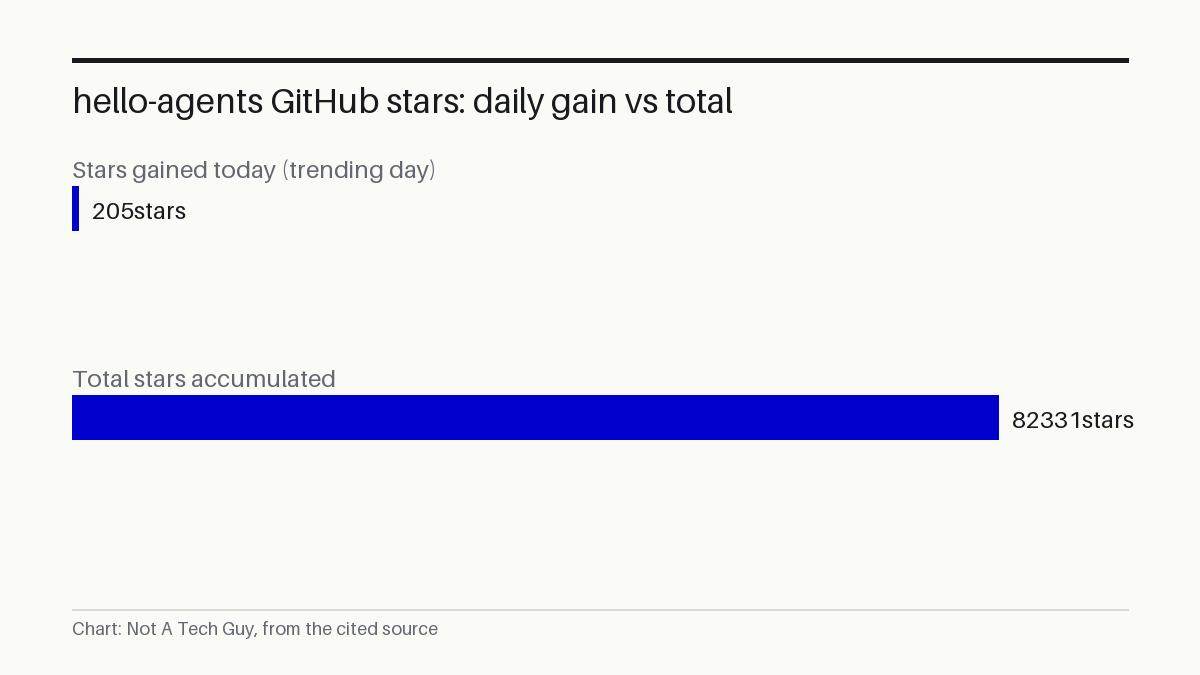

Datawhale is a Chinese open-source education community. It published a free tutorial for building AI agents from scratch that has accumulated 82,331 stars on GitHub S¹. The repository, hello-agents, landed on GitHub's daily trending list this week after gaining 205 stars in a single day S¹. Interest in agent development has accelerated since OpenAI said coding agents reshape its own AI research in September.
The maintainers declare 2025 "the Agent year" following 2024's "hundred models battle" and claim a severe lack of systematic, practice-heavy agent tutorials S¹. Both statements are the maintainers' own framing in the README, not independently verified market analysis, and the star count may reflect community coordination as much as organic discovery.
My read: This is the most complete free agent curriculum I've seen in a single repository. The chapter list reads like a university syllabus: ReAct, Plan-and-Solve, Reflection, then Agentic RL from SFT to GRPO, then MCP and A2A protocols. What I'm skeptical of is whether a single community-produced tutorial can deliver real depth on GRPO. That is frontier research territory, and nobody outside Datawhale has reviewed the pedagogical quality. The 828 commits P⁴ suggest genuine ongoing work, not a dump-and-run, but the advanced chapters are unverified by any third party.
What the tutorial actually covers
The curriculum spans 11 chapters, starting with LLM fundamentals and building toward an agent framework the maintainers wrote from scratch using OpenAI's native API S¹. Chapter four walks through hand-implementing three classic agent paradigms: ReAct (reason-then-act), Plan-and-Solve (break the task, then execute), and Reflection (self-critique and retry) S¹. Chapter ten covers agent communication protocols including MCP, A2A and ANP S¹, the same protocol layer that matters as LLM security agents act but lack guardrails, according to an August review.
The maintainers draw a deliberate line between what they call "AI Native Agents" and workflow-driven platforms like Dify, Coze and n8n S¹. The tutorial targets the former: agents that reason and act autonomously, not pre-built pipelines assembled in a visual editor. An English README is available P², countering any assumption the material is Chinese-only.
The watermark that tells the bigger story
The PDF version ships with a Datawhale watermark, and the maintainers explain why in the README: to stop marketing accounts from downloading the free PDF and reselling it to beginners S¹. That detail captures something real about the current agent-learning market. Demand from people who want to build agents is high enough that reselling free tutorials is a viable business.
The tutorial is completely free and open source S¹, with community-contributed blog posts and extra chapters supplementing the core material S¹. The maintainers recommend basic Python skills and a conceptual understanding of LLMs as prerequisites S¹.
For a developer who has been experimenting with systems that spawn Claude Code agents with pre-loaded memory and wants to understand the underlying mechanics rather than calling an API, the ReAct and Reflection chapters are the practical starting point. The GRPO chapter is the one to approach with caution: it covers frontier training techniques that no third party has validated for teaching quality.
The repository's 828 commits P⁴ and active community blog suggest continued development. The next checkpoint is whether independent reviewers or English-language educators assess the advanced chapters, particularly the Agentic RL material, against established courses.
Sources: S1 — datawhalechina/hello-agents: 📚 《从零开始构建智能体》——从零开始的智能体原理与实践教程 · P2 — README_EN.md at main · datawhalechina/hello-agents · P3 — gemmozero/ai-github-trending-2026 · Datasets at Hugging Face · P4 — GitHub - datawhalechina/hello-agents: 📚 《从零开始构建智能体》——从零开始的智能体原理与实践教程 · · P5 — MokshithRao/ai-research-assistant
Related reading
- New system spawns Claude Code agents with pre-loaded memory — our technology desk, 2026-08-29
- OpenAI says coding agents reshape its own AI research — our technology desk, 2026-09-06
- LLM security agents act but lack guardrails, review finds — our technology desk, 2026-08-31
Written from 5 sourced items, 4 of them primary.