A paper posted to arXiv on 24 August 2026 lays out a system that spawns Claude Code agents already loaded with memories from your personal databases S¹. Every developer who has restarted a coding agent session and re-explained the entire project knows the problem: the model starts cold, every time S¹. Whether four months of real deployment actually closed that gap, and what broke across three redesigns, is what the paper quietly reveals.
My read: This is the first agent-memory system I've seen that doesn't try to build a single unified memory store. The author explicitly chose to bridge two independent backends, a PostgreSQL entity database and a Cloudflare Worker search index, rather than merge them S¹. That's a pragmatic call that trades elegance for not having to migrate existing infrastructure. I'm skeptical of the "filesystem injection" language, which sounds more dramatic than it is: the system writes a briefing file that Claude Code reads automatically on startup, the same way it reads any project config. The four-month deployment window ended in March 2026, so this is a retrospective, not a live system. And the paper is a self-reported experience report with no independent verification S¹.
The cold-start problem, made concrete
Every time you open a new session with a coding agent like Claude Code, Anthropic's terminal-based tool with 143,300 GitHub stars P⁵, the model starts with a blank slate S¹. Everything you discussed yesterday, every file it edited, every bug it chased: gone. You re-explain the project. You paste the same context. The agent relearns what it already knew.
This isn't a minor annoyance at scale. The field is crowded with approaches, and PAO enters it with a specific angle: don't build new memory infrastructure, use what you already have.
How PAO works
The system, built by Myron Koch of Peak Summit Labs [P2, P3], sits between your existing personal databases and Claude Code. When you spawn a new agent, PAO fires two queries in parallel S¹:
- A PostgreSQL entity-observation database, which stores structured records about people, projects, files and events
- A Cloudflare Worker semantic search index, which does meaning-based retrieval across unstructured notes
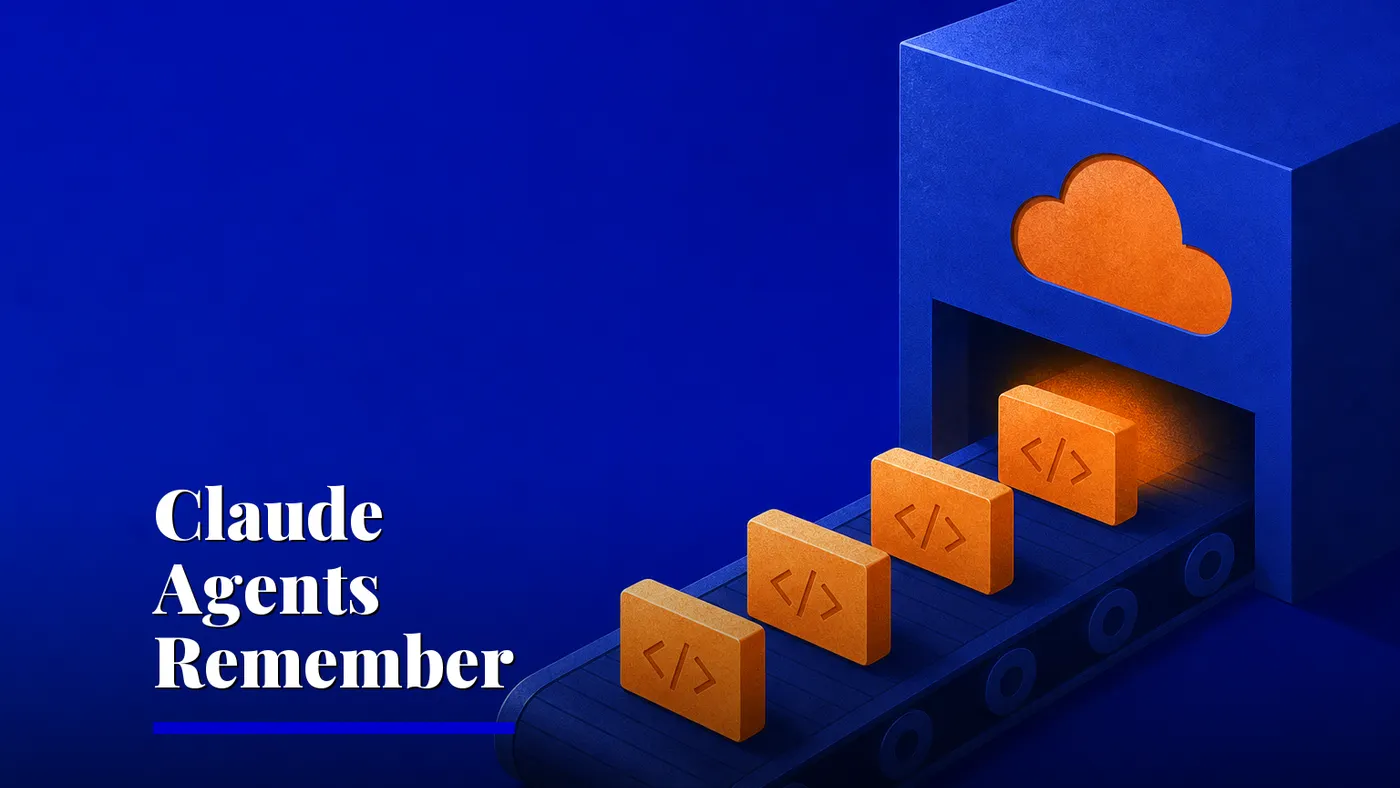
The results come back and PAO fuses them using backend-specific retrieval strategies S¹. The compiled output becomes a briefing, delivered to the spawned Claude Code instance through a mechanism the paper calls "filesystem injection" S¹. In practice, this means writing a file that Claude Code automatically reads on startup, the same auto-read behaviour it uses for project configuration files. No model modification, no Anthropic infrastructure involvement. PAO is a third-party layer, not an Anthropic product S¹.
The system also manages the agent's full lifecycle: pre-seeding trust settings, polling for readiness, detecting errors, and injecting text into the terminal adaptively S¹.
Three generations of getting context into the agent
The paper documents three iterations of the context-delivery mechanism, each motivated by a failure mode in the previous version S¹. The authors don't detail every failure in the abstract, but the fact that they went through three redesigns over four months of real use (December 2025 through March 2026) suggests the "just paste the context in" approach is harder than it sounds S¹.
The deployment period ended in March 2026, making this a retrospective experience report rather than a live, ongoing deployment S¹. A HuggingFace dataset page exists under the author's name P³, but the evidence does not indicate the system itself is publicly released or open-sourced.
What to do about it
If you're a developer running Claude Code sessions repeatedly on the same project, the cold-start problem is real and measurable in wasted tokens and repeated explanations. PAO's approach, bridging existing databases rather than building a new memory store, is a design pattern you can apply even without this specific system.
Consider a small web development shop that maintains a PostgreSQL database of client project specs and a separate search index of Slack discussions and meeting notes. Today, a developer starting a Claude Code session manually pastes relevant context from both sources. The PAO pattern would query both at spawn time and compile a single briefing file that Claude Code reads automatically. The engineering tradeoff the paper highlights is real: bridging two systems means dealing with two query languages, two latency profiles, and two relevance-ranking approaches, but you avoid the cost and risk of migrating everything into one unified store S¹.
One thing to check this week: look at Claude Code's configuration auto-read behaviour on Anthropic's documentation page. Understanding what files it loads on startup is the first step to seeing whether a pre-compiled briefing file could work for your workflow.
What we don't know yet
The paper is a self-reported experience report from a single author S¹. The four-month deployment claims have not been independently verified, and the deployment ended in March 2026, five months before the paper appeared on arXiv S¹. We don't have benchmark numbers, accuracy scores, or comparative results against other memory systems. The three generations of context delivery are mentioned but their specific failure modes are not detailed in the available evidence.
We also don't know whether the system will be released publicly. The HuggingFace dataset page P³ exists, but the evidence does not confirm a public code release. And the paper does not address how the approach performs at scale, with larger teams, or across different coding agents beyond Claude Code.
The next signal: watch for community response and potential code releases following the arXiv posting. If Koch opens the system, we'll check the three-generation failure modes and deployment claims against the actual code.
If you found this useful, subscribe to get the next one delivered.
Sources: S1 — PrimeAgentOrchestrator: Memory-Primed Agent Spawning for Personal AI I · P2 — PrimeAgentOrchestrator: Memory-Primed Agent Spawningfor Personal AI In · P3 — myronkoch/prime-agent-orchestrator · Datasets at Hugging Face · P4 — PrimeIntellect-ai/prime-agent · P5 — anthropics/claude-code
More from Not A Tech Guy
- wayfinder: map AI projects too big for one session
- New STAR metric catches AI translations that drop sentences
- Google Gemini Omni 1.1 Flash: 10x more scene context
Generated from an audited evidence pack with primary-source research. Social-media items are discussion signals, not verified facts. Nothing here is financial, legal or medical advice.