
NVIDIA and Cisco unveiled a proposed optical module called USFP that delivers 12.8 terabits per second of capacity in a footprint equivalent to current standard pluggable transceivers S¹. The module quadruples front-panel bandwidth density and improves power efficiency by approximately 1.3 times relative to the 200Gb/s-per-lane modules now in production S¹ — figures that come solely from the vendors' own announcement, with no published error bars, no released code, and no independent benchmark. The two companies argue the jump is necessary to match the scale of AI training clusters.
Why the density claim matters: The 4x density figure is the number that matters for anyone building AI fabrics. The "first module" framing remains unverified, because no independent body has ratified USFP as a standard and nothing has shipped.
The problem USFP addresses is physical. Every GPU in an AI training cluster needs high-bandwidth links to every other GPU, and the switches that connect them have a fixed amount of front-panel space. Double the lane speed from 200 to 400Gb/s and you double the data each port can move, but only if the module fits the same slot. USFP, which stands for Ultra-Dense Small Form Factor Pluggable, is intended as the first pluggable form factor to transmit 400Gb/s-per-lane electrical signals S¹. Initial transceivers are planned to carry 16 full-duplex lanes within an OSFP-sized envelope — the same physical dimensions as the octal small form factor modules already deployed in data centres S¹.
USFP's 12.8Tb/s capacity reshapes how many GPUs a single fabric can link
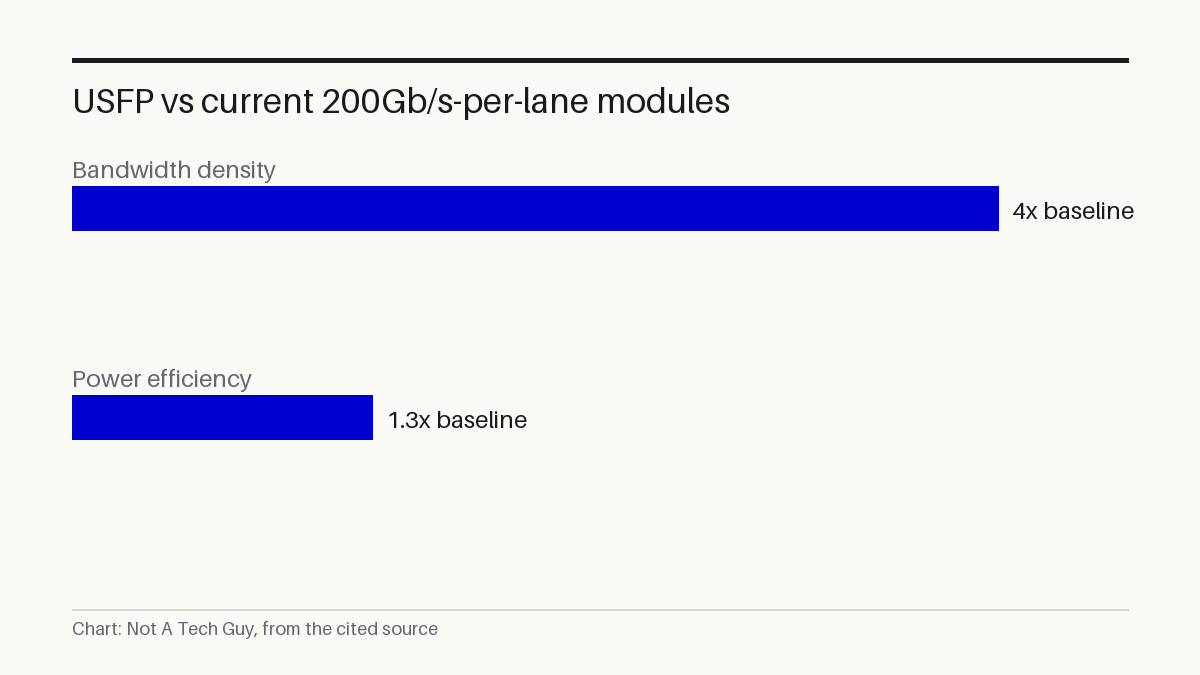
The 12.8Tb/s capacity figure derives from 16 lanes each running at 400Gb/s in both directions. Against today's 200Gb/s-per-lane modules, that amounts to four times the bandwidth in the same panel space, with about 1.3 times the power efficiency S¹ — again, a vendor's own figure that has not been independently tested.
For a hyperscaler adding GPU racks, fewer switch ports are consumed per connection and less heat is generated per terabit, which directly affects how many GPUs a single fabric can link.
Bill Gartner, senior vice president and general manager of optical systems at Cisco, said the two companies recognised that scaling to 400Gb/s per lane would require more than an incremental extension of existing module designs S¹. Gilad Shainer, senior vice president of networking at NVIDIA, framed it as rethinking "the smallest of connections" to build larger AI factories S¹. Shainer joined NVIDIA through its 2020 Mellanox acquisition and chairs the HPC-AI Advisory Council P⁶.
Nothing has shipped.
No price has been set, no independent benchmark has verified the density or efficiency claims, and USFP has not been ratified by IEEE or any multi-source agreement body. TE Connectivity and Amphenol are named as ecosystem partners but have not yet manufactured USFP hardware S¹. The module is designed to support both switches and NVIDIA's SuperNIC cards, with a path to expand to 32 or more lanes in future generations S¹.
NVIDIA's separate Spectrum-X Photonics programme targets co-packaged optics with 1.6Tb/s per port switches, promising 3.5x energy savings and 10x resilience for AI factories scaling to millions of GPUs P⁵.
For a network architect at a hyperscaler designing an Ethernet AI fabric today, the practical question is timing. USFP is designed to extend the same pluggable deployment model used across generations of data centre networks, moving from 200 to 400Gb/s per lane without replacing the switch chassis S¹. On that architect's desk, USFP would mean fewer switch ports consumed per GPU rack link and a smaller power allocation per terabit of throughput — but only once physical modules exist. Until TE Connectivity or Amphenol produce physical modules, and until an MSA ratifies the form factor, the only action available is planning rack space and budgeting the power envelope. NVIDIA and Cisco have not announced a target quarter for first USFP shipments.
Sources: S1 — NVIDIA and Cisco Introduce New Pluggable Optics Form Factor to Scale A · S2 — NVIDIA and Cisco Introduce New Pluggable Optics Form Factor to Scale A · S3 — NVIDIA and Cisco Introduce New Pluggable Optics Form Factor to Scale A · P4 — Safactory: A Scalable Agentic Model Factory for Trustworthy Autonomous · P5 — NVIDIA Announces Spectrum-X Photonics, Co-Packaged Optics Networking S · P6 — Gilad Shainer Author Page | NVIDIA Blog
Written from 6 sourced items, 4 of them primary.