

Stanford and UC Berkeley researchers' open-source inference framework SGLang landed on GitHub's daily trending page with 36,973 stars, adding 42 today S¹. The project claims to run on seven hardware platforms from NVIDIA to Apple Silicon, but every performance claim is self-reported and a further seven chip families are still listed as works in progress S¹.
My read: This is the first serving framework I've seen that lists fourteen hardware platforms in its README, seven supported and seven incomplete. That breadth is a bet, not a fact. The performance claims against vLLM and TensorRT-LLM come from the maintainers' own release notes P², not from an independent benchmark, and the source material itself flags that the README is the maintainers' description, not a review S¹. I'd want third-party latency numbers on my own hardware before betting a production pipeline on it.
Repository has grown roughly 28% since an earlier snapshot
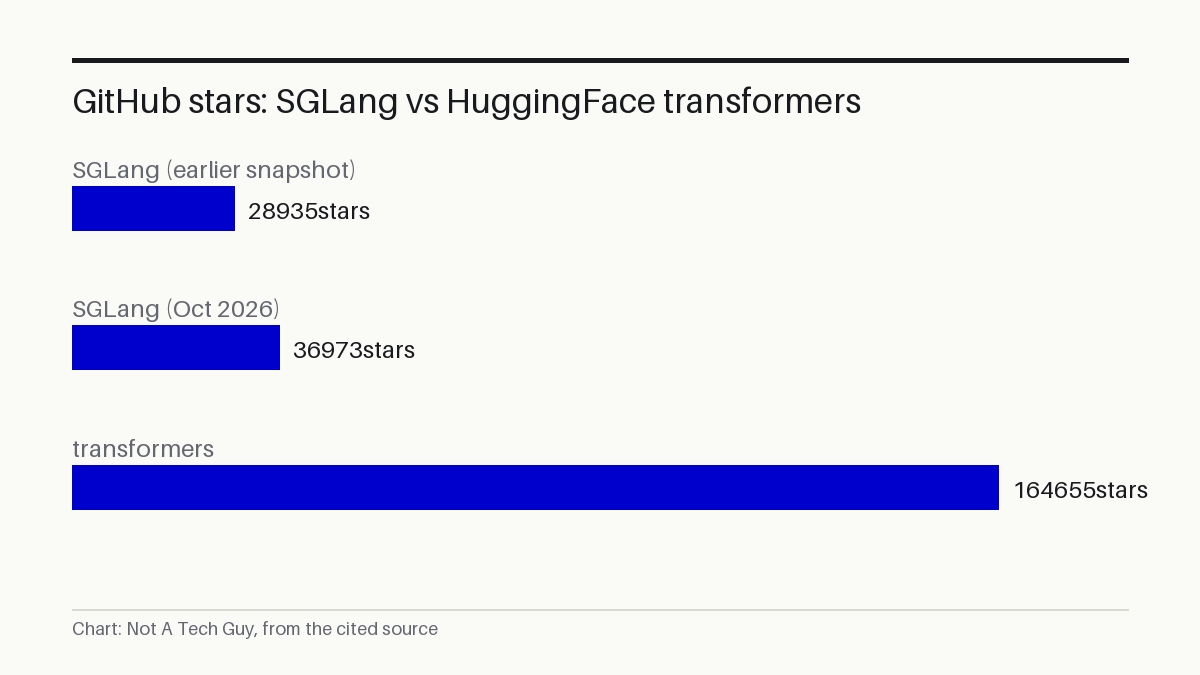
The project traces back to an arXiv preprint by Lianmin Zheng, Liangsheng Yin, and collaborators at Stanford, UC Berkeley, Shanghai Jiao Tong University, and Texas A&M P³. The repository was created in January 2024 under the Apache 2.0 licence P⁴. An earlier snapshot showed 28,935 stars P⁴; the current reading of 36,973 S¹ marks roughly 28% growth since that snapshot.
Maintainers describe SGLang as a framework for running large language, vision-language, and diffusion models, tuned for agentic workloads (multi-step tasks where AI agents call models repeatedly), large-scale serving, and reinforcement learning rollouts, the repeated inference runs used to train models through trial and error S¹. It includes a built-in image and video generation engine called SGLang Diffusion, packaged inside the main Python library S¹. The vision-language support arrives as the field works through how multimodal AI models merge vision and text via two distinct pathways.
SGLang lists NVIDIA, AMD, Google TPU, Intel, Apple Silicon, Huawei Ascend, and Moore Threads as supported platforms S¹. A further seven, including AWS Trainium, Qualcomm QAIC, and Cambricon MLU, are marked as incomplete or experimental S¹. The v0.2.0 release from July 2024 reported that SGLang matched or exceeded TensorRT-LLM and vLLM across models from Llama-8B to Llama-405B on A100 GPUs P². Those claims are self-reported: no error bars, no released benchmark code, and no independent evaluation appear in the evidence pack — the figures are the maintainers' own.
For teams running reinforcement learning workloads, the framework's RL rollout optimisation is a distinguishing feature.
Open issue count signals where integration friction sits
A platform engineer evaluating SGLang today would start with the hardware they already own. If that is NVIDIA A100 or H100, the v0.2.0 release notes P² suggest the framework has been tested most thoroughly there. If it is AWS Trainium or Qualcomm QAIC, the incomplete tag means the integration is not production-ready.
For an ML platform engineer running Llama-70B on A100 GPUs, switching from vLLM to SGLang means reconfiguring inference endpoints and absorbing a framework with 3,539 open issues P⁴ — a trade-off that lands directly on their on-call queue.
The project's 3,539 open issues P⁴ give a rough sense of where the friction sits. By comparison, HuggingFace's transformers library has 164,655 stars and 2,410 open issues P⁵. That lower ratio reflects its longer maturity since 2018. SGLang is not yet three years old.
The next checkpoint is the release history on the SGLang GitHub page, where version tags and changelogs show whether the incomplete hardware integrations are advancing toward full support or stalling.
Sources: S1 — sgl-project/sglang: SGLang is a high-performance serving framework for · P2 — Release v0.2.0 · P3 — SGLang: Efficient Execution of Structured Language Model Programs · P4 — sgl-project/sglang · P5 — huggingface/transformers
Written from 5 sourced items, 4 of them primary.