
Google launched Gemini 4 Argon globally today, pricing the frontier model at $2 per million input tokens and $10 per million output tokens through its API S¹. Google also claims Argon ranks first on the Vals Index, a benchmark covering finance, coding, legal, and tax work — a vendor's own figure with no released methodology, no error bars, and no independent verification S¹.
My read: The pricing is aggressive for a frontier model, and the 95% discount on cached input tokens tells me Google is chasing high-volume API developers who reuse long context windows. I don't buy the Vals Index claim until I see the methodology, because Google has every incentive to pick a benchmark where it wins. What I find compelling is the Chromium refactoring story, because the output is verifiable in the open-source codebase.
Koray Kavukcuoglu, who authored the announcement on the DeepMind blog P⁵, positioned Argon as a model for deep work across coding, finance, legal, cybersecurity, and science. The model is available now in AI Studio and the Gemini platform for API users, in the Gemini app for AI Ultra and Pro subscribers, and in Google Antigravity for Ultra subscribers S¹.
The 40 million-line codebase
Google says Argon helped the Chrome team separate core webpage handling from a roughly 6 million line legacy folder buried inside Chromium's 40 million line codebase S¹. The team finished an architectural refactor across hundreds of files in weeks rather than months, according to Google's account — Google has not released the refactored code for outside review S¹.
The payoff, Google says, will be live webpages that move between tabs, side panels, and floating windows without reloading, plus the elimination of an entire category of browser crashes S¹. Those benefits have not shipped to Chrome's billions of users yet.
Internal gains and open-source speedups
Google reports that Argon in Antigravity, its internal coding environment, lifted agentic code submissions by more than 35% and cut code rollbacks by nearly a third among its own teams S¹. Those numbers are internal and self-reported, with no released code or methodology for outside inspection S¹.
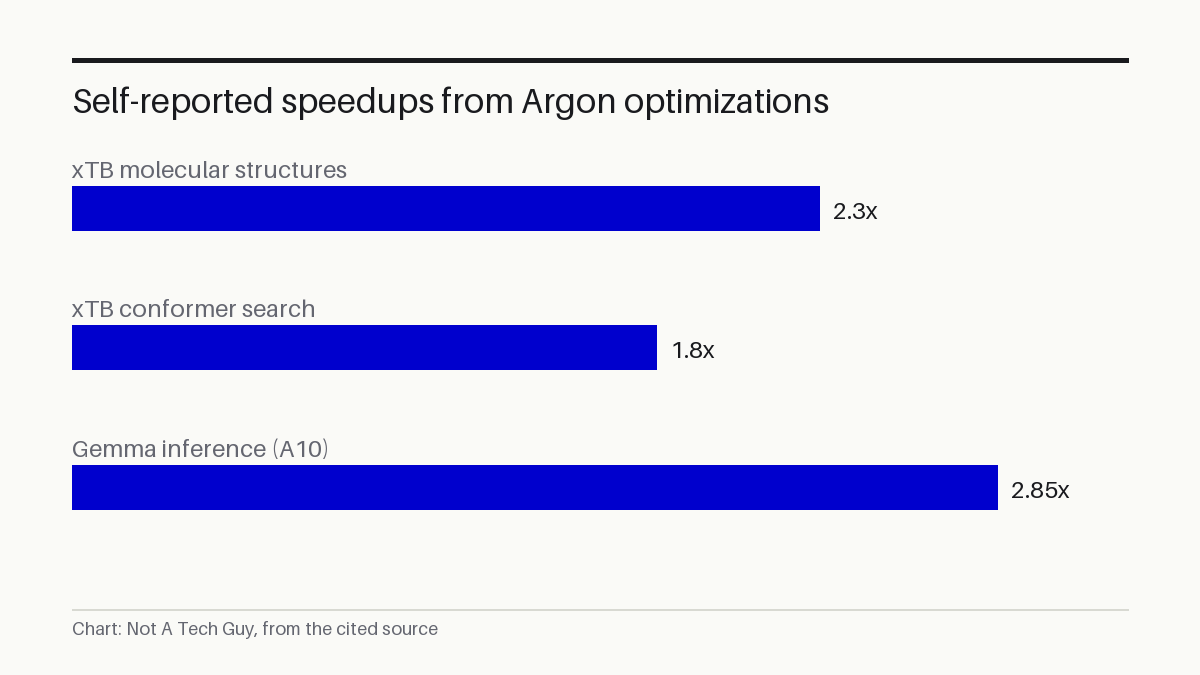
The open-source claims are more checkable. Argon cut in-memory session prep time by 40% in long sessions for the Agent Development Kit and sped up cold imports by 21%, changes Google says are live in google/adk-python on GitHub S¹. Researchers used Argon to make the quantum chemistry package xTB up to 2.3 times faster at predicting molecular structures and 1.8 times faster at conformer search, with the changes contributed to the official xTB repository S¹. Google also reports a 2.85 times end-to-end inference speedup on an A10 GPU for its open Gemma models S¹.
A developer building agent pipelines can clone the google/adk-python repository today and test whether the session prep and cold import improvements hold under their own workloads. The xTB contributions sit in the official xTB GitHub repository, verifiable in a way the Vals Index ranking is not. For a backend team running long-context agent workflows, the cached input token rate drops to $0.10 per million — a 95% discount, meaning a workload reusing 50 million cached tokens per month pays $5 instead of $100 at the uncached rate S¹.
Google has not said how long the introductory pricing of $2 and $10 per million tokens will last, nor published the Vals Index methodology for independent scrutiny.
Sources: S1 — Gemini 4 Argon: Built to solve your hardest problems · S2 — Gemini 4 Argon: Built to solve your hardest problems · S3 — Gemini 4 Argon: Built to solve your hardest problems - blog.google · S4 — Gemini 4 Argon: Built to solve your hardest problems · P5 — Introducing Gemini 4 Argon · P6 — Gemini 4 Argon - Model Card — Google DeepMind · P7 — Gemini 4 Argon is now available in the Gemini app · P8 — Gemini: A Family of Highly Capable Multimodal Models
Written from 8 sourced items, 6 of them primary.