Calesthio, the developer behind OpenMontage, landed on GitHub's daily trending list with 74,127 stars and 583 added in a single day S¹. The Python repository calls itself "the world's first open-source, agentic video production system" S¹, a label no one outside the project has checked — no independent benchmark exists, no error bars have been published, and the cost figures are the maintainers' own.
My read: The initial commit is substantial, 240,221 lines across 300 files P⁴, and the growth from a March release to a trending repository in seven months is the kind of trajectory that gets attention. But every capability and cost figure comes from the maintainers' own README. The "world's first" claim is promotional, and the cost examples almost certainly exclude compute, API subscriptions, and human oversight. The number I would watch is whether anyone independently reproduces a finished video at the costs the README claims.
The first release shipped on March 29, 2026 with 11 production pipelines and 47 tools P⁴. By November, those counts had grown to 12 pipelines, more than 100 tools, and over 700 agent skill and production-knowledge files S¹.
In concept, the workflow is straightforward. An AI coding assistant that a developer already runs locally doubles as a media production pipeline. The agent gathers free stock footage and open-archive material, selects motion clips, arranges them on a timeline, and renders the output S¹.
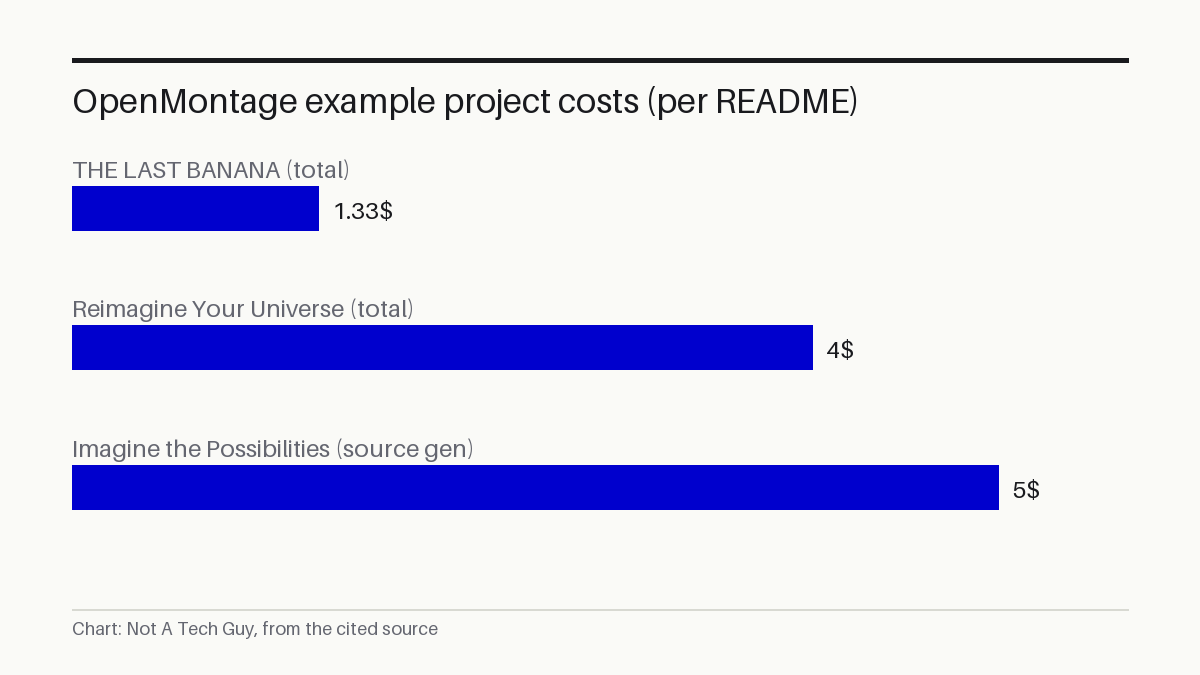
Three example projects come with cost figures. "THE LAST BANANA" cost $1.33 total. "Reimagine Your Universe" cost about $4 total. "Imagine the Possibilities with OpenMontage" cost about $5 for source generation alone S¹. Those figures likely cover API calls to generation models but not the compute, storage, or labour involved — no released code verifies them, and the README is the maintainers' own description, not an independent review S¹.
700 skill files, 700 attack surfaces
The system orchestrates production through agent skill files, the same modular capability descriptors that security researchers have flagged as an attack surface. A repository of 700 skill files is also 700 potential injection points. Anyone pulling OpenMontage into their environment should treat those files as untrusted code.
OpenMontage applies the same model-routing approach to media production, batching API calls across stock retrieval, scripting, generation, and editing.
Small teams and freelancers get an assembly shortcut
A small marketing team that already runs an AI coding assistant could point OpenMontage at a brief, generate a rough cut from stock footage, and spend human time on the edit review rather than the assembly. A freelance video producer might use it to assemble reference cuts or b-roll compilations from open archives without manual sourcing. For a marketing coordinator, the change on their desk is a rough cut arriving from the agent rather than a blank timeline — their job shifts from sourcing clips to reviewing and revising what the pipeline already assembled.
The evidence pack contains no licence information, no independent benchmark, and no peer review. The star count reflects a single day's trending data S¹. The repository's About section lists an update date of October 28, 2026 P², and the next checkpoint for anyone evaluating it is whether the maintainers publish reproducible cost logs or an independent user posts a finished video with their own cost breakdown.
Sources: S1 — calesthio/OpenMontage: World's first open-source, agentic video produc · P2 — GitHub - calesthio/OpenMontage: World's first open-source, agentic vid · P3 — OpenMontage/README_zh-CN.md at main · calesthio/OpenMontage · GitHub · P4 — a3e735c Initial release — OpenMontage: the first open-source agentic v · P5 — Trending repositories on GitHub today · GitHub
Written from 5 sourced items, 4 of them primary.