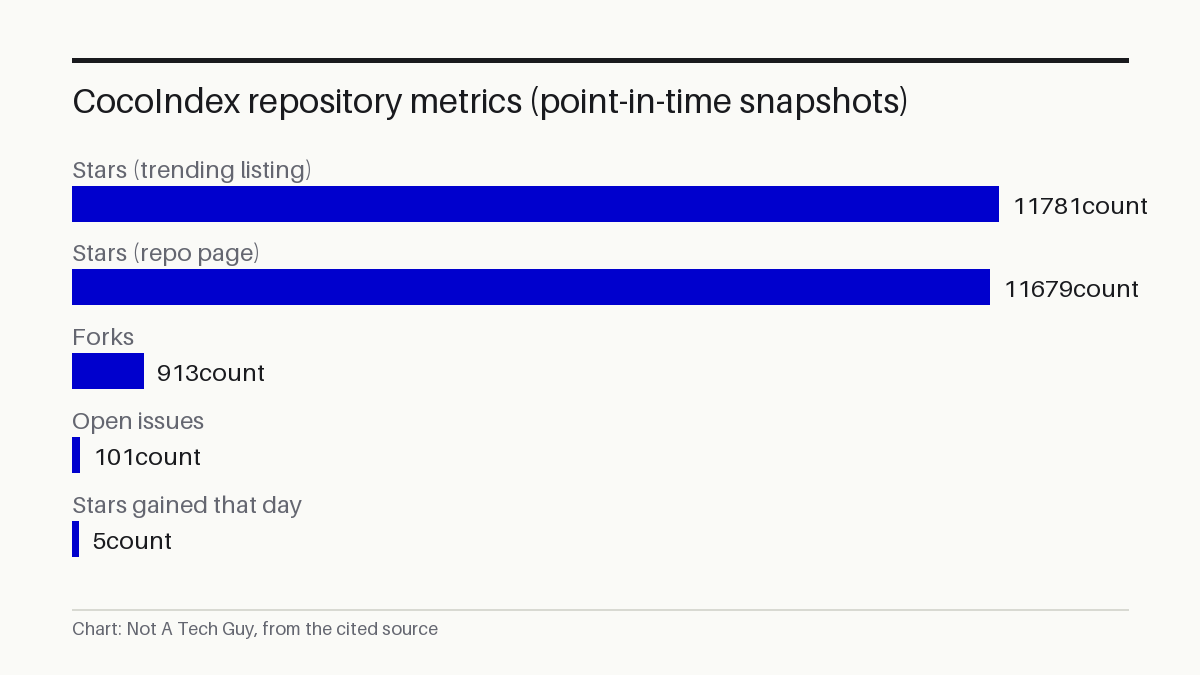

CocoIndex appeared on GitHub's daily trending list on 29 October with 11,781 stars S¹, pitching itself as an incremental engine that keeps codebases, Slack threads, and PDFs updated as context for AI agents S¹. Every functional claim on the repository, from the 10-minute setup promise to the incremental processing design, is maintainer-written copy that no one outside the project has independently checked S¹ — no benchmark results have been published, no third-party review exists, and the star count is a point-in-time figure from GitHub's own counter.
My read: The number I would watch is the open issue count. The repository's own page shows 101 open issues against 11,679 stars and 913 forks P², which is a rough but real signal of how much is actually working versus how much is aspiration. The "10 minutes to production" claim is the one I don't buy yet, because the repository provides no benchmark, no case study, and no third-party review to support it. What is verifiable: the code exists, it carries an Apache 2.0 licence, the core is Rust, and it offers Python bindings P². That is enough to be worth a look, not enough to be trusted.
The repository was created on 3 March 2025 P², giving it roughly 20 months to accumulate its star count. The +5 stars on the day of the trending listing S¹ is a single-day snapshot, not evidence of sustained momentum.
Incremental updates without full reprocessing
The maintainers describe a system that pulls in codebases, meeting notes, inboxes, Slack messages, PDFs, and videos, then maintains that material as current context for AI agents and LLM applications S¹. The central design choice is incremental processing: when a source changes, the engine recalculates only what changed instead of reprocessing the entire dataset S¹ — though no benchmark data has been released to quantify the efficiency gain, and this description comes entirely from the maintainers' own repository copy S¹. The engine itself is written in Rust, with Python for the declarative interface that users interact with S¹P².
This addresses a real pain point. AI agents that answer questions about a company's own data need that data to stay current, and re-indexing an entire codebase or document store every time one file changes is expensive.
Apache-licensed Rust core with 101 open issues
The repository is real and open under Apache License 2.0 P². The languages listed on the repo page are Astro, Handlebars, Python, Rust, and Shell P². It has 913 forks and 101 open issues P². The homepage is cocoindex.io P².
What is not verifiable: the 10-minute setup claim (vendor's own figure, no benchmark), the incremental processing efficiency (no error bars, no released benchmark code), the breadth of supported data sources (maintainer's description only), and any performance benchmark (none published in the repository or elsewhere in the evidence) S¹. The star count itself is a point-in-time figure that may already be stale.
Development teams with live codebases and Slack archives
A development team building an internal AI assistant that answers questions against a live codebase and a Slack archive is the natural first user. The workflow the maintainers describe: set up data sources through Python, rely on the Rust engine for incremental updates, and pull updated context into an LLM query S¹. The risk is that the 101 open issues P² may surface exactly in the scenarios that matter most, such as handling large PDF collections or maintaining consistency across frequent Slack changes.
For a platform engineer running an internal AI assistant, CocoIndex would replace a manual re-indexing job with a Python-defined pipeline that the Rust engine updates incrementally — meaning a single-file change no longer triggers a full reprocess of the entire knowledge base S¹.
The agent infrastructure space is crowded. CocoIndex sits on the data side of that stack, not the security side.
The next checkpoint for anyone evaluating CocoIndex is the repository's issue tracker at github.com/cocoindex-io/cocoindex, where the 101 open issues P² are the fastest way to see what is actually broken before investing a sprint in integration.
Sources: S1 — cocoindex-io/cocoindex: Incremental engine for long horizon agents 🌟 S · P2 — cocoindex-io/cocoindex · P3 — zzz47zzz/codebase-for-incremental-learning-with-llm · P4 — Davinci-XLab/STAR-T2I
Written from 4 sourced items, 3 of them primary.