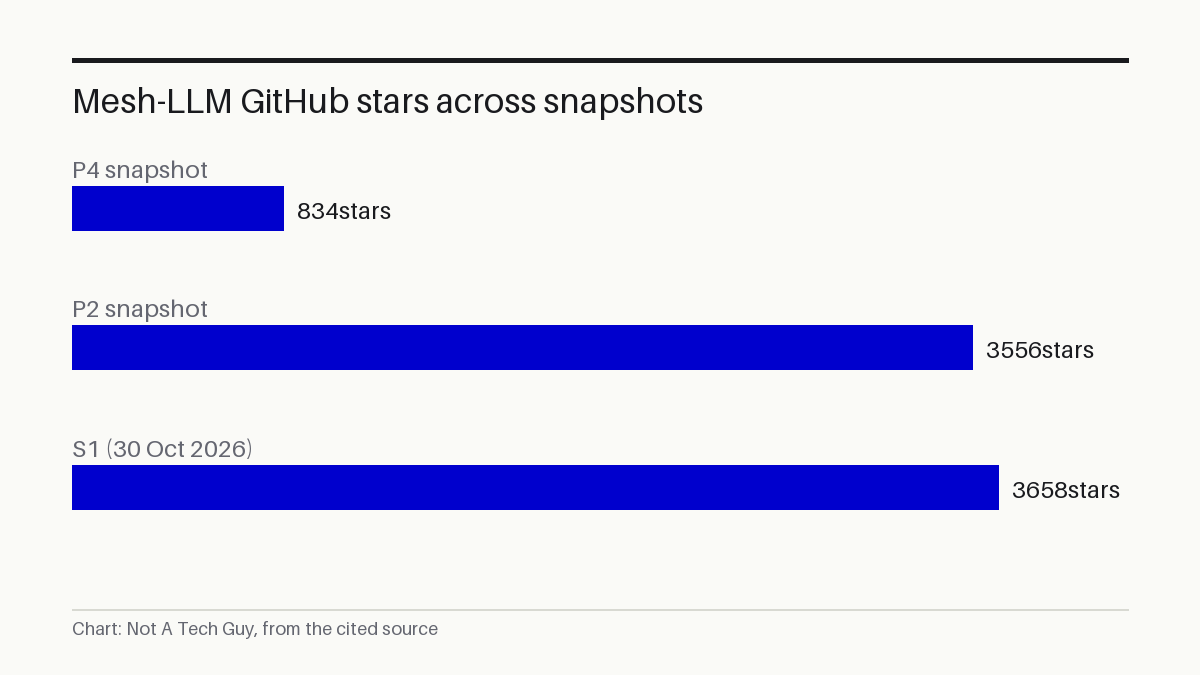

The Mesh LLM Team, a non-profit listed on HuggingFace P³, drew 51 new stars in a single day for a Rust project that pools GPUs across ordinary machines to run language models no single computer can hold S¹. The repository was created in February 2026 and had reached 3,658 stars by 30 October S¹ (star count from the project's own GitHub page; no third-party audit of the figure has been published). That challenges the assumption that large models require a cloud API or a rack of data-centre cards.
My read: This is the first distributed-inference project I've seen that targets the gap between "I have a laptop" and "I need a 70-billion-parameter model." The architecture sounds plausible, the Rust codebase is real, and the Apache 2.0 licence checks out P². What I don't buy yet is the security model. Routing prompts to peers you cannot verify, and auto-downloading models from a public mesh, is a recipe for trouble. Until someone runs an independent security audit, I would treat this as a fascinating experiment, not production infrastructure.
What the project claims to do
According to the maintainers' README, Mesh-LLM combines two components S¹ (vendor's own description; no independent testing has confirmed these capabilities). Skippy manages models, runs inference, splits execution across boxes and serves the OpenAI-compatible endpoint. Mesh wraps that with peer discovery, transport, routing, plugins and a console. Together they expose a single API at localhost:9337 that looks like OpenAI's to any client S¹.
The pitch is that a model too large for one machine can be split across several. The mesh decides whether to run locally, route the request to a peer, or use what the maintainers call "Skippy stage splits" to break a model across boxes S¹. Running mesh-llm serve --auto picks a backend, downloads a model, joins the best public mesh it can find, and starts both the API on port 9337 and a console on port 3131 S¹ (these operational details are unverified outside the maintainers' documentation).
Installation is available through a curl script, a PowerShell script for Windows, or a Homebrew formula for Apple Silicon S¹. The separate mesh-packaging repository produces versioned Ubuntu and Arch packages, checksums, software bills of materials, and OCI container images S¹.
What nobody has verified
Every functional claim above comes from the maintainers' own README S¹. No independent review confirms the system works as described, and no security audit has been published. The public mesh has no disclosed count of active nodes or users. The HuggingFace organisation page lists three team members and names jamesdumay as the active contributor updating datasets and models P³, but the project's funding, governance, and geographic jurisdiction are not documented.
The curl-to-shell install pattern carries standard supply-chain risk. More fundamentally, the distributed model raises questions that anyone who has followed LLM security will recognise. Running models downloaded from peers you cannot verify introduces a trust problem, and routing agent prompts through untrusted nodes exposes sensitive instructions to interception.
Where this fits
Distributed training across volunteer machines is not new. Yandex Research published DeDLOC at NeurIPS 2021, showing that loosely connected collaborators could train large models together P⁵. Mesh-LLM applies the same cooperative idea to inference, the cost of actually running a model, rather than training one.
For a developer with a desktop GPU and a colleague with another, the appeal is obvious: skip the API bill, keep data local, and run a model that neither machine could load alone. The Apache 2.0 licence P² and the Rust codebase, split across two product trees sharing one Cargo workspace S¹, are verifiable. The 201 open issues on the repository P² suggest the project is active but rough.
A team building internal AI agents for air-gapped deployments might find Mesh-LLM worth evaluating. But anyone considering it should read the source before piping it to a shell, and should keep the mesh private until a security review exists.
The repository's next release and issue tracker, both public on GitHub, are the checkpoints to watch.
Sources: S1 — Mesh-LLM/mesh-llm: Distributed AI/LLM for the people. Share compute pr · P2 — Mesh-LLM/mesh-llm · P3 — meshllm (Mesh LLM) · P4 — Mesh-LLM/mesh-llm · P5 — yandex-research/DeDLOC
Written from 5 sourced items, 4 of them primary.