NVIDIA published a Halloween projection on October 30 that listens and talks to visitors while reading their costumes in real time, all on one workstation with two GPUs and no internet connection S¹. The project, called MonsterHouse, responds to trick-or-treaters in the voice of a grumpy old pirate ship and softens its tone when visitors remember their manners S¹. Every component in the conversational pipeline is an NVIDIA model running on those two cards.
My read: This is the first end-to-end voice agent demo I have seen that bundles speech recognition, a language model, text-to-speech, plus vision and facial animation onto a single machine and actually shows it working in front of real people. I am skeptical of the performance claims because nobody outside NVIDIA has tested this hardware configuration, and the blog post reads like marketing for the RTX PRO Blackwell line. But the architecture is the interesting part: if a 4GB small language model can carry a real-time character conversation with personality injected via a LoRA adapter, that changes what a single developer can build without renting GPU time in the cloud.
How the pipeline fits on two cards
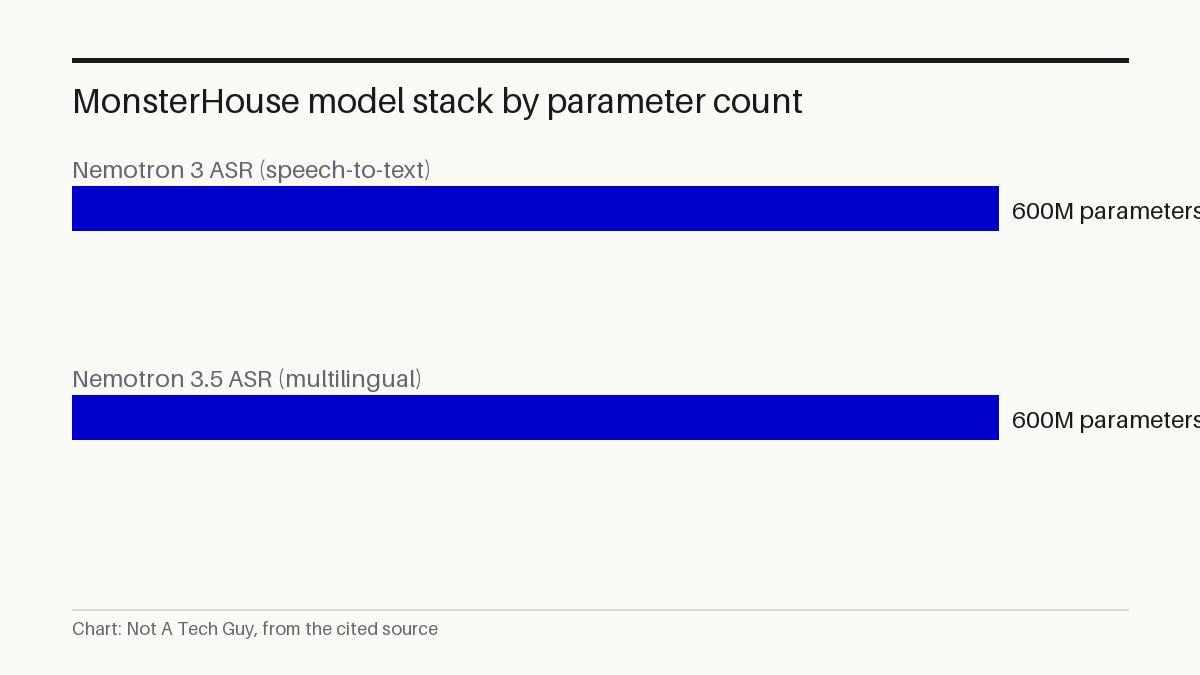
The MonsterHouse stack moves a visitor's voice through five NVIDIA models in sequence S¹. Nemotron 3 ASR converts spoken words into text. It is a 600-million-parameter streaming speech recognition model confirmed on NVIDIA's NIM model card P⁴. Nemotron 3.5 Bolt E4B 4GB generates each reply S¹. The blog describes it as an open small language model for conversational agents. A LoRA adapter supplies the pirate's grumpy character S¹. This lightweight fine-tuning technique overlays a learned personality onto the base model without retraining it. NVIDIA Magpie TTS Zeroshot then voices each reply from a short reference sample of the character S¹.
Two vision models run alongside the conversation pipeline. Nemotron 3 Nano Omni describes what visitors are wearing, so the pirate can comment on costumes S¹. YOLO and ByteTrack, open-source object detection and tracking tools, count and follow people as they approach the door S¹. NVIDIA Audio2Face-3D converts the synthesised speech into mouth movement for a 3D character built in Autodesk Maya and rendered in Unreal Engine 5, with virtual fire and effects added behind the door S¹.
The entire system runs on one workstation equipped with an NVIDIA RTX PRO 6000 Blackwell Max-Q and an NVIDIA RTX PRO 4000 Blackwell S¹. NVIDIA has not published latency figures or benchmark results for this configuration, and no independent testing has verified that the full pipeline sustains real-time performance under load.
What a developer can actually use
The underlying blueprint is publicly available. NVIDIA's Nemotron Voice Agent, the foundation MonsterHouse is built on, is a developer example hosted on NVIDIA's build platform P² with a reference implementation on GitHub that has accumulated 336 commits across multiple releases P³. The ASR model card on NVIDIA's NIM page lists two profiles: the English-only Nemotron 3 ASR at 600 million parameters, and a newer Nemotron 3.5 ASR that extends to 40 language locales in the same parameter count P⁴. A June 2026 update on the Hugging Face model page notes the multilingual expansion P⁵.
A developer building a museum kiosk, a retail greeter, or a themed attraction could take the voice agent blueprint from GitHub, swap the LoRA adapter for their own character personality, and run the pipeline on a single workstation instead of provisioning cloud GPUs. The Magpie TTS Zeroshot component means the voice can be cloned from a short audio sample rather than recorded line by line. The limitation: the "open" designation on Nemotron 3.5 Bolt E4B is asserted by NVIDIA but not independently verified against standard open-source licence definitions, and the hardware requirements point squarely at NVIDIA's newest professional GPUs.
The MonsterHouse blog post was published on October 30, 2026 on Hugging Face S¹. The Nemotron Voice Agent reference code and model cards remain available on NVIDIA's build platform and GitHub for anyone wanting to inspect the pipeline [P2, P3].
Sources: S1 — nemotron-halloween · P2 — Nemotron Voice Agent Blueprint by NVIDIA | NVIDIA NIM · P3 — GitHub - NVIDIA-AI-Blueprints/nemotron-voice-agent: Reference implemen · P4 — nemotron-asr-streaming Model by NVIDIA | NVIDIA NIM · P5 — nvidia/nemotron-speech-streaming-en-0.6b · Hugging Face
Written from 5 sourced items, 5 of them primary.