
Google DeepMind announced Genie 4 on October 27, calling it a "new generation of world simulation" that adds native audio to real-time interactive environments S¹P³. The blog post, indexed by Google News the same day S², arrives with no published benchmarks, no public release date, and no technical architecture details, leaving outside researchers unable to verify any performance claim.
My read: This is the thinnest major DeepMind announcement I've seen in a while. The company is claiming "unprecedented realism" for a world model, but the public blog post is mostly acknowledgements and partner credits. Until there is a paper, a model card, or a playable demo that independent people can test, "unprecedented" is a marketing word, not a measurement. The native audio detail is the one genuinely new signal, and even that is unquantified.
What the announcement actually says
DeepMind's post, also published on Google's main blog P³, describes Genie 4 as a "world model for real-time interactive simulation" that "incorporates and builds on capabilities" from earlier work. The post names Hang Qi, Diego Rivas, and Aleksander Hołyński among core contributors and credits trusted testers and early access users with guiding the research S¹. Beyond those headlines, the supplied source text covers only the acknowledgements section. No technical details, feature descriptions, or capability lists are present in the excerpts.
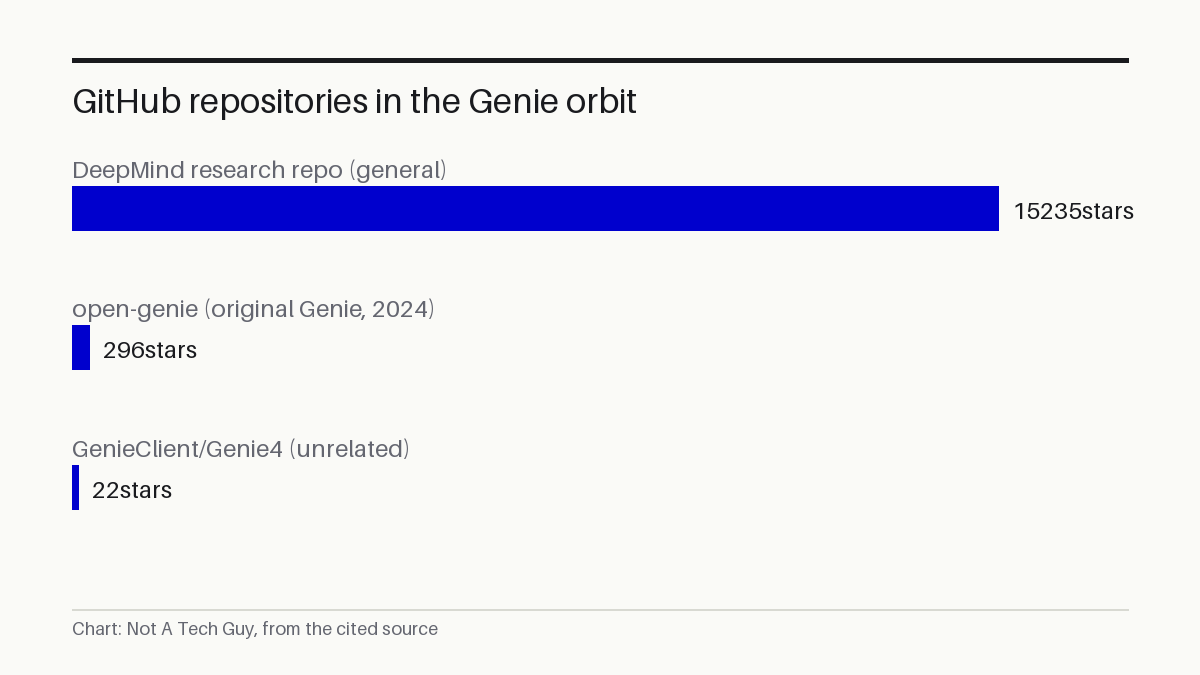
The original Genie, described in a 2024 paper by Bruce et al. as a system for generative interactive environments, has an open-source PyTorch implementation on GitHub with 296 stars and an MIT licence P⁴. DeepMind's broader research repository, which houses code accompanying its publications, has accumulated over 15,200 stars since 2019 P⁵. Neither repository contains Genie 4 code. A separate GitHub project called GenieClient/Genie4, with 22 stars and a GPL v3.0 licence, is a .NET 6 update of an unrelated game client and has no connection to DeepMind's work P⁶.
What is missing
DeepMind has not published benchmarks, training data, model size, or a public availability date. The company has not said whether Genie 4 will be released as an API, a product, or remain a research artifact. The unsupported angles are specific: no architectural improvements over prior versions are described, no performance metrics are cited, and no datasets or computational resources are named.
World models, the systems that simulate environments an AI agent can act inside, have become a competitive frontier. The promise is that a model which can generate a believable, interactive world in real time could change game development, robotics training, and agent evaluation. But as we found when clean-data prediction improved diffusion generation at Adobe and Cornell, the gap between a generative model's marketing claims and its measurable output is where the real story lives.
Who this touches, and what they cannot do yet
A game studio evaluating whether Genie 4 could replace hand-built physics engines for prototyping environments has nothing to test. A robotics lab that uses simulated worlds to train manipulation policies would need latency numbers, frame rates, and physics fidelity scores, none of which DeepMind has published. The trusted testers who gave feedback S¹ have seen something the rest of the world has not.
The next checkpoint is whatever DeepMind publishes next, whether that is a technical paper, a public demo, or an API. On October 27, all the public has is a title and a team list.
Sources: S1 — Genie 4: A new generation of world simulation · S2 — Genie 4: A new generation of world simulation - Google DeepMind · P3 — We’re announcing Genie 4, our new world model for real-time interactiv · P4 — myscience/open-genie · P5 — google-deepmind/deepmind-research · P6 — GenieClient/Genie4
Related reading
- Adobe-Cornell: clean-data prediction improves diffusion generation — our technology desk, 2026-09-24
Written from 6 sourced items, 5 of them primary.