

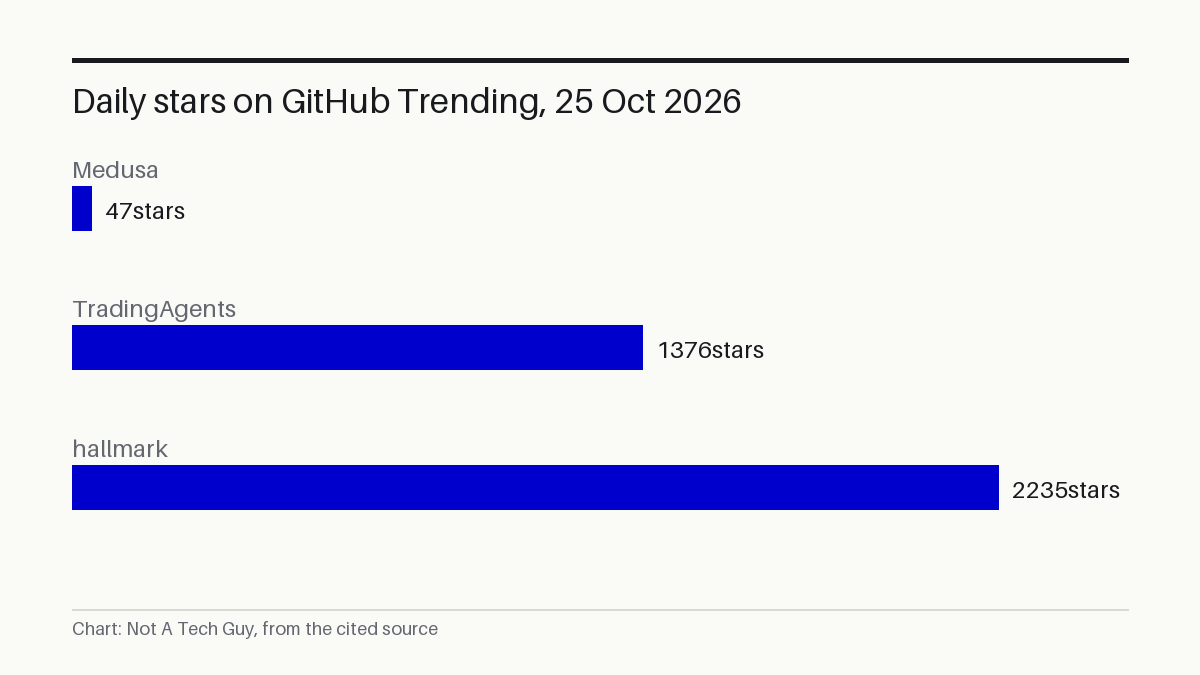
Medusa, an open-source commerce platform written in TypeScript, appeared on GitHub's daily trending list with 36,935 total stars after picking up 47 new ones in a single day S¹S². The maintainers describe it as "the world's most flexible commerce platform for agents and developers" S¹, a tagline that puts AI agents on equal footing with human programmers as intended users of a commerce engine.
My read: This is the first commerce platform I've seen that names AI agents in its headline pitch rather than tucking the capability into a developer doc. The "world's most flexible" claim is the maintainers' own marketing language from their README, not an independent assessment S¹, and the 47-star daily gain is small next to other repos trending the same day. Nutlope's hallmark pulled 2,235 stars and TradingAgents pulled 1,376 P⁴. What I'd watch is whether the agent-facing commerce primitives, the carts, orders, and payments that an AI can call programmatically, actually get traction or whether this is positioning ahead of real adoption.
What Medusa actually ships
The platform is an open-source commerce engine with a built-in framework for customisation S¹. The maintainers say it can power B2B or direct-to-consumer stores, marketplaces, distributor platforms, and point-of-sale systems, anything that needs commerce primitives like products, carts, orders, and payments S¹.
The codebase is a Yarn workspaces monorepo, and the commerce modules are freely available on npm S¹.
Medusa runs on an open-core model: the core platform is open-source, while Enterprise Edition features are listed separately in the repository S¹. The exact licence terms are not fully visible in the available sources, so anyone evaluating it for production should check the licence file directly. Local development requires Node.js v22.22.0 or later and a running PostgreSQL database S¹. The maintainers point to Medusa Cloud, a managed environment, as the fastest way to start S¹.
The current version is the product of a complete rewrite. Medusa 2.0 shipped on 23 October 2024 after more than 16 months of work and over 3,500 merged pull requests, according to release notes authored by olivermrbl P³. A B2B starter template appeared in December 2025 with 55 stars and an MIT licence P⁵, suggesting the project is actively building out vertical-specific entry points.
The agent question
The word "agents" in the tagline is doing heavy lifting. Most commerce platforms are designed for human merchants who click through admin panels and human developers who write integrations. Medusa's framing implies that an AI agent, software that can autonomously browse catalogues, build carts, and submit orders through APIs, is a first-class user.
This connects to a broader pattern. As we found when LLVM trended on GitHub as AI agents targeted compiler code, developers are increasingly building tools that assume autonomous software will interact with their systems. The reliability of those agents remains an open question: AI email agents complied with 45% of adaptive phishing attacks in testing earlier this month, a reminder that agent-facing APIs need guardrails that human-facing ones do not. And as we saw when OpenAI trained AI agents on Ironclad contracts, the gap between an agent reading a document and an agent executing a transaction is where most of the engineering work lives.
For a team building a marketplace or distributor platform on Medusa, the agent angle changes the design calculus. A B2B procurement system where an AI agent negotiates bulk pricing, builds a cart, and triggers a payment workflow needs the same commerce primitives Medusa ships, but exposed in a way an autonomous caller can use safely.
The README does not detail specific agent-facing APIs or authentication patterns, so how much of the "for agents" pitch is built infrastructure versus roadmap is not verifiable from the available sources.
Every capability claim in the README is self-reported, not independently reviewed S¹. A developer evaluating Medusa should clone the repository, check the npm packages, and test whether the commerce modules expose the programmatic interfaces their agent architecture needs.
The star count and trending status are snapshots: the 36,935 total and 47 daily gain were recorded on 25 October 2026 S² and will shift. The project has not announced a next release date in the available sources, but the v2.0 release in October 2024 P³ and the B2B starter in December 2025 P⁵ show development continuing across both years.
Sources: S1 — medusajs/medusa: The world's most flexible commerce platform for agent · S2 — medusajs/medusa: The world's most flexible commerce platform for agent · P3 — v2.0.0 · P4 — Trending repositories on GitHub today · GitHub · P5 — medusajs/b2b-starter · P6 — gong-io/call-playbook
Related reading
- OpenAI trains AI agents on Ironclad contracts — our technology desk, 2026-10-06
- AI email agents comply with 45% of adaptive phishing attacks — our technology desk, 2026-10-24
- LLVM trends on GitHub as AI agents target compiler code — our technology desk, 2026-09-28
Written from 6 sourced items, 4 of them primary.