

Hayate Iso and NVIDIA colleagues showed speculative decoding accelerates RL rollouts in April 2026 P². A preprint posted October 23 proposes NgramRL, claiming 7.0× more tokens per forward than prompt-lookup decoding, with no auxiliary model S¹. It targets two problems in existing methods: the GPU memory cost of a separate drafter model, and the failure to exploit repetition across training epochs S¹.
My read: This is the first speculative-decoding approach I've seen that builds its draft from the model's own recent rollouts on the same prompt, rather than from a separate draft model or a static suffix tree. The idea is elegant: during RL training, the model sees the same prompt many times, and its outputs converge. Why not cache the patterns? I'm skeptical of the warm-cache-only results, because real training pipelines don't always keep caches hot. And the 1.38× throughput gain from the prefetcher is measured against synchronous NgramRL, not against a baseline without NgramRL at all. None of these numbers have been peer-reviewed or independently verified S¹.
Why rollout generation eats training time
RL post-training works by having a model attempt a task, scoring the attempt, and updating weights. The authors state that this improves reasoning in large language models S¹, aligning with broader trends in RL training methods we examined in September. But each attempt requires the model to generate a complete response, token by token, before any learning happens. When the model is large and the task demands long structured outputs like SQL queries, that generation step can exceed 70% of total training time S¹.
Speculative decoding offers a shortcut. A lightweight drafter proposes several tokens at once, and the target model verifies them in a single forward pass. If the draft is good, you get multiple tokens for the cost of one inference step.
But RL post-training adds complications. A separate drafter model consumes GPU memory that is already scarce during training S¹. As the policy model evolves through RL updates, a fixed drafter can drift out of sync with what the model actually produces S¹. Existing model-free alternatives, like prompt-lookup decoding, don't exploit the fact that RL training revisits the same prompts across epochs S¹.
How NgramRL works
The core observation: recent rollouts of the same prompt are a high-quality, self-updating draft source S¹.
If the model has already generated several responses to a prompt in previous epochs, the patterns in those responses can predict what it will generate next. NgramRL builds a per-prompt n-gram model from a bounded window of recent rollout history S¹. It needs no auxiliary model, no drafter training, and no persistent GPU-resident drafter state S¹. The n-gram table lives in regular memory and updates itself as new rollouts arrive.
Because the target model still verifies every drafted token, the authors claim the method preserves the exact rollout distribution S¹. On top of the basic drafter, they add an adaptive fan-out prefetcher that predicts likely verification outcomes, specifically the accepted draft length and the next token the target model would emit S¹. A causal budget allocator concentrates prefetches on the highest-probability outcomes S¹. When the prefetcher guesses wrong, the system falls back to sequential lookup without changing any committed tokens S¹.
The numbers, and their limits
Across two model families and three workloads spanning reasoning and structured generation, NgramRL commits between 3.60 and 7.77 tokens per target-model forward pass in the warm-cache regime S¹. That is up to 1.99× more than SuffixDecoding and up to 7.0× more than prompt-lookup decoding S¹.
On the Spider text-to-SQL benchmark using Qwen3-8B, the prefetcher covers 96.6% of verification outcomes at a candidate budget of 16 S¹. That coverage translates to a 1.38× improvement in measured rollout throughput over synchronous NgramRL, approaching a 1.40× overlap ceiling that represents the theoretical limit of hiding verification behind computation S¹.
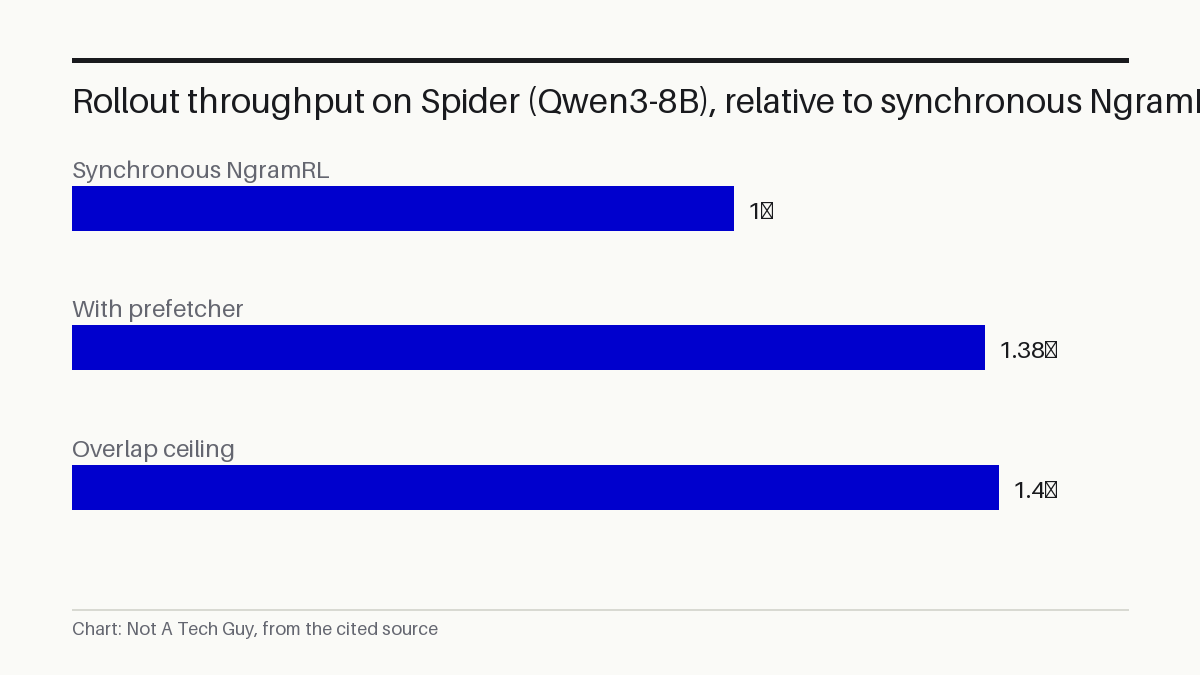
Every figure is self-reported in a preprint that has not been peer-reviewed S¹.
The comparisons cover only SuffixDecoding and prompt-lookup decoding, not the full spectrum of speculative-decoding methods. Speedups are specific to the warm-cache regime, two model families, and three workloads S¹. The 70% rollout-generation cost figure that motivates the work is a general claim from the authors, not a measured constant across all RL setups.
Who would use this first
The most natural users are teams running RL post-training on structured-generation tasks, where outputs follow repeatable patterns. A team fine-tuning a model to generate SQL from natural language would see the same schema-aware phrasing recur across epochs on the same prompt, giving the n-gram drafter rich material. Tools like Hugging Face's TRL library, with 19,578 stars on GitHub and an Apache 2.0 licence P³, and xgrammar, a structured-generation library with 1,973 stars P⁴, are the kind of infrastructure where NgramRL could plug in. Structured generation benefits from clean, predictable patterns, as Adobe and Cornell researchers demonstrated for diffusion models last month.
NVIDIA published its own work on this bottleneck in April 2026 with an arXiv version by the same authors P²P⁵. That work takes a system-integration angle. NgramRL takes a complementary model-free approach that trades a separate drafter for recycled rollout history. As weight tying's hidden accuracy cost showed, training-stage decisions ripple into model quality in ways that are easy to miss.
For a team evaluating whether to try NgramRL, the first check is simple: measure what fraction of RL training time is actually spent on rollout generation. If it is below 50%, the gains from accelerating rollouts shrink proportionally. If your workloads involve highly structured, repetitive outputs and your caches stay warm, the method's assumptions fit.
The preprint lists no code release or date for public availability S¹. The next checkpoint is whether the authors release a reference implementation and whether independent teams reproduce the 3.60 to 7.77 token range on other model families.
Sources: S1 — NgramRL: Accelerating RL Post-Training for Structured Generation via R · P2 — Accelerating RL Post-Training with Speculative Decoding in NeMo RL - N · P3 — huggingface/trl · P4 — mlc-ai/xgrammar · P5 — Accelerating RL Post-Training Rollouts via System-Integrated Speculati
Related reading
- Pistis multimodal models blend distillation and RL training — our technology desk, 2026-09-26
- Adobe-Cornell: clean-data prediction improves diffusion generation — our technology desk, 2026-09-24
- Weight tying costs private LLM training 4.74 accuracy points — our technology desk, 2026-10-01
Written from 5 sourced items, 4 of them primary.


