
The Pistis team posted a technical report to arXiv on September 25, 2026, describing 27B- and 9B-parameter multimodal models that train distillation and reinforcement learning in a single alternating loop S¹. The report claims both model scales beat their Qwen base models, but names no benchmarks, reports no scores, has not been peer-reviewed, and offers no evidence anyone outside the team has tested the results S¹.
My read: This is the first post-training framework I have seen that interleaves distillation and RL inside one loop rather than running them as separate phases or mashing them into a single loss function. The idea is sound in principle, but I do not buy the performance claims yet, because the abstract contains zero benchmark names, zero scores, and zero comparators against non-Qwen models. The PAH claim, that you can boost an agent's output quality without changing its weights or giving it more turns, is the most interesting and least substantiated part of the report. I would watch for whether the team releases code or weights, because without those this is a design document, not a result.
Two models, two jobs each
The Pistis family comprises two sizes: a 27B-parameter model built on Qwen3.6 and a 9B-parameter model built on Qwen3.5 S¹. Both are multimodal, meaning they process text and images together. The Qwen3 family, as described in its own technical report, includes dense and Mixture-of-Experts architectures across a range of parameter scales P². The specific versions Pistis cites, Qwen3.6 and Qwen3.5, do not appear in the public Qwen3 documentation, which may indicate internal or unreleased variants.
At each scale, the framework produces two specialised variants. Pistis-Thinking targets deep multimodal reasoning. Pistis-Agentic adds agentic trajectory data to support long-horizon planning, iterative reasoning, and tool use, and the authors say it is particularly strong in multimodal search S¹.
Alternating distillation and RL
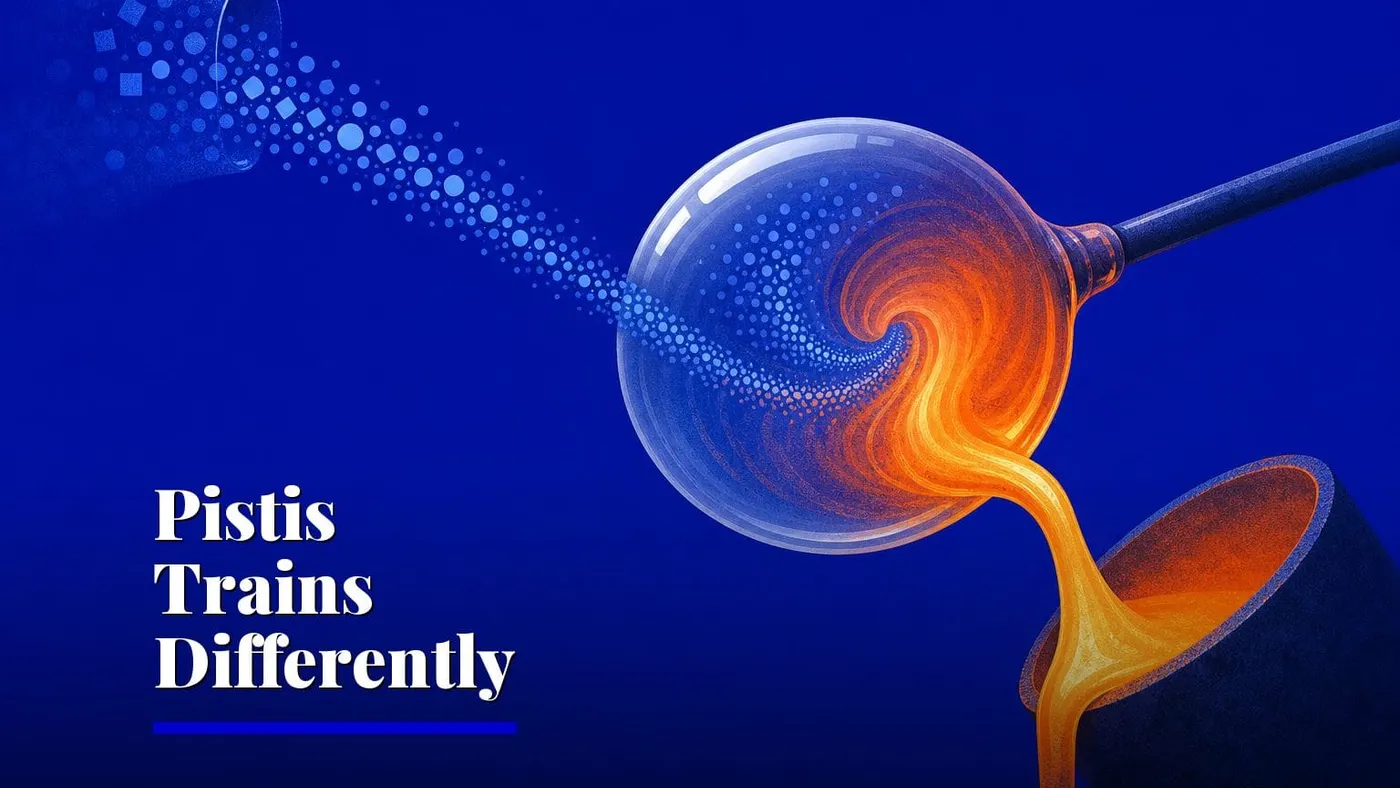
The core method is Interleaved Distillation and Reinforcement Learning, or IDRL. Most post-training pipelines run distillation, where a student model learns from a teacher's outputs, and reinforcement learning, where a model learns from reward signals, as separate stages. Some combine them into a single static loss function. IDRL instead alternates between the two objectives within one training loop S¹.
The authors claim this alternation produces more effective knowledge transfer, greater optimisation stability, and more precise credit assignment for long-horizon agentic trajectories S¹. The framework starts with large-scale multimodal supervised fine-tuning to establish a foundation, then applies IDRL on top S¹. The concept of interleaving distillation with sampling has precedent: a 2024 paper on Speculative Knowledge Distillation explored bridging the teacher-student gap through interleaved sampling rather than one-shot transfer P⁵. Pistis extends the idea by weaving reinforcement learning into the same cycle.
The report also introduces Pistis-Auto-Harnessing, or PAH, a system-level method that automatically improves the agent's inference scaffolding through iterative optimisation S¹. The authors report that PAH enhances model performance without updating model parameters or increasing the interaction budget S¹. If true, this would mean better agent outputs from the same model weights and the same number of tool-call rounds, purely by tuning the infrastructure around the model. The report provides no quantitative evidence to support this, and no third party has verified it.
What the report does not prove
Everything in the report is self-reported. The abstract names no benchmarks, reports no scores, and offers no comparisons against non-Qwen models such as GPT-4o or Claude S¹. The paper has not undergone peer review. Whether the models are open-source, API-accessible, or downloadable is not stated. The base model versions cited, Qwen3.6 and Qwen3.5, do not match any publicly documented Qwen release P².
For a team building multimodal agents, the IDRL approach is worth tracking because it addresses a real bottleneck: agents that plan over many steps often lose credit assignment signal when distillation and RL are applied separately. A team building a visual search agent, for instance, could test whether alternating distillation and RL in one loop improves tool-call accuracy compared with a sequential pipeline. Without released code or weights, that test is not yet possible.
The arXiv preprint, posted September 25, 2026, is the only public artefact so far S¹.
Sources: S1 — Pistis Technical Report · P2 — Qwen3 Technical Report · P3 — Qwen3 Technical Report · P4 — Does the Proof Prove It That Way? Faithful Formalization of Elements P · P5 — Speculative Knowledge Distillation: Bridging the Teacher-Student Gap T
Written from 5 sourced items, 4 of them primary.