
NobodyWho, an open-source inference engine built in Rust, appeared on GitHub's daily trending list with 1,419 stars after shipping bindings for six application frameworks that run large language models locally without API keys S¹. That "any device" framing sits awkwardly beside the project's own documentation, which lists no web export, no Windows ARM64 support, and no iOS path through its Godot binding S¹.
My read: This is the first local-LLM inference engine I've seen that takes the "write once, bind everywhere" bet seriously across six language ecosystems at once. I don't buy the "any device" framing yet, because the maintainers' own README excludes three platforms in fine print. What I would watch is whether the tool-calling grammar generation actually holds up across Kotlin, Swift, and Flutter, or whether it works cleanly only in Python.
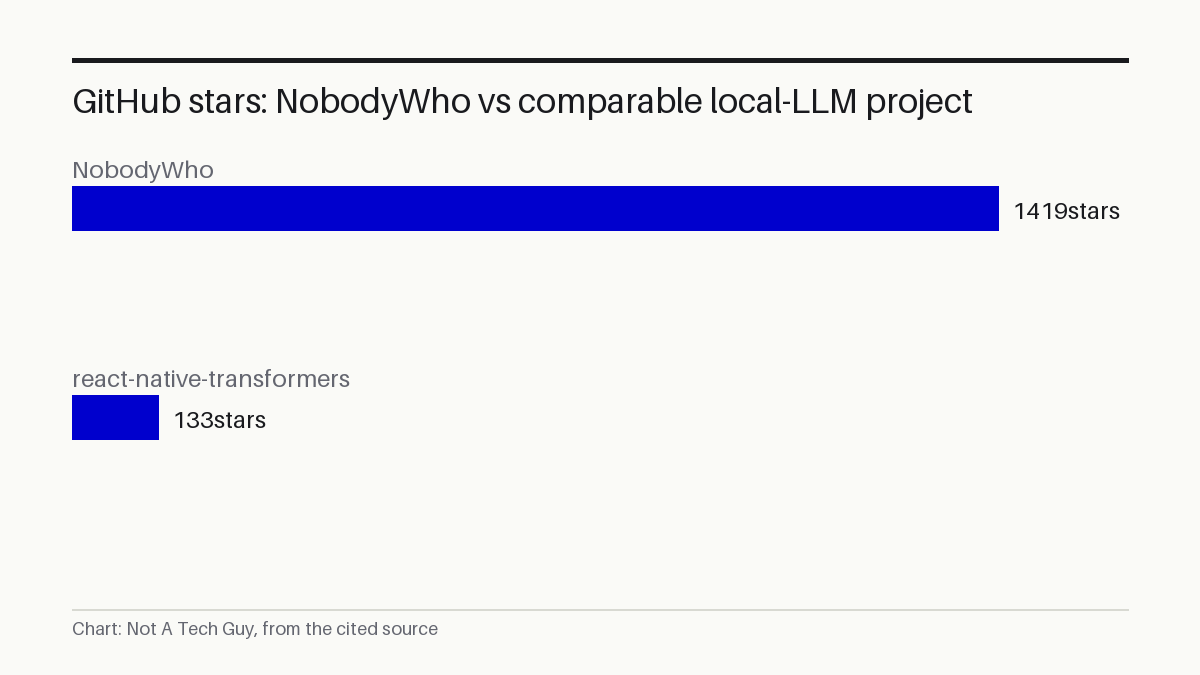
The project ships bindings for six ecosystems: Kotlin via Maven Central, Swift via SPM, React Native and Expo via npm, Flutter via pub.dev, Python via PyPI, and Godot via its asset library S¹. That breadth is unusual for a project at this stage. A comparable React Native-only project, daviddaytw/react-native-transformers, sits at 133 stars P³. NobodyWho has roughly ten times that following S¹.
GGUF chat inference and ONNX speech modules form the core feature set
The engine executes quantised chat models using the GGUF file format, the compressed standard that allows models to run on consumer-grade hardware S¹. The maintainers list support for Gemma, Qwen, and Mistral model families, with direct loading from Hugging Face or arbitrary URLs S¹. The project's own Hugging Face organisation, comprising six team members including AsbjornOlling and pielouNW, publishes GGUF conversions of Google's Gemma4 and Liquid AI's LFM2.5 models P⁵.
For audio, the engine packages Whisper for transcription, Kokoro and Pocket TTS for speech synthesis, and Silero for voice activity detection, all routed through ONNX Runtime S¹. The maintainers also describe multimodal input for images and audio, plus type-safe tool calling that produces structured grammars from function signatures without manual schema authoring S¹. No error bars, benchmark scripts, or third-party test results accompany any of these performance or compatibility claims; the 1,419-star figure is GitHub's own metric, and the feature descriptions rest on the maintainers' README alone S¹.
GPU acceleration is handled through Vulkan on Linux and Windows, and through Metal on macOS by default S¹. Machines lacking a Vulkan-capable GPU driver drop back to CPU execution S¹. Memory requirements amount to approximately 1.5 times the model file size in free RAM, though the documentation cuts off mid-sentence at "or 2" S¹.
Three platform gaps contradict the any-device pitch
The README invites testing on iOS, Android, Vision Pro, and Apple Watch S¹. Desktop coverage spans Linux, macOS, and Windows, but Windows builds are x86_64 only, with no ARM64 variant S¹. There is no web export at all, a gap tracked in issue #111 S¹. The Godot binding has no iOS export S¹. A developer building a browser-based game in Godot, or targeting a Windows ARM laptop like the Surface Pro X, is out of luck today.
The project carries the European Union Public Licence 1.2 and was created in September 2024 P². No commercial entity or venture backing is named in any source.
For a mobile developer who wants to ship a local chatbot in a Flutter app without routing user conversations through a cloud API, NobodyWho offers one of the few cross-platform paths. A Kotlin developer adding the Maven Central dependency now faces a build that carries a native Vulkan or CPU fallback path, shifting desk work from wiring a cloud chat endpoint to profiling GGUF model load times against device RAM S¹. The practical first step is pulling the Python binding from PyPI, loading a small GGUF model like Gemma 2B, and checking whether the grammar generation works for your function signatures before committing to a mobile target.
The next checkpoint for anyone needing browser support is issue #111 on the project's GitHub repository, where web export is being tracked S¹.
Sources: S1 — nobodywho-ooo/nobodywho: NobodyWho is an inference engine that lets yo · P2 — nobodywho-ooo/nobodywho · P3 — daviddaytw/react-native-transformers · P4 — MoonshotAI/Kimi-K3 · P5 — NobodyWho (NobodyWho)
Written from 5 sourced items, 4 of them primary.