
The PyTorch team shipped torchtitan v0.4.0 on October 28, aligning the training platform with PyTorch 2.15 and unifying core training with its TitanRL stack on a single engine P². The project claims one readable codebase can carry a model from pretraining through supervised fine-tuning to reinforcement learning without rewriting it S¹, a claim nobody outside the project has tested.
My read: The v0.4.0 release is the real signal, not the GitHub Trending appearance. A repo with 5,926 stars P⁴ that gains zero new stars on the day it trends S¹ is surfacing on accumulated momentum, not a viral moment. What I would watch is whether the unified training-and-RL engine actually holds up on multi-node mixture-of-experts workloads, because the release notes say v0.4.0 "improves large-scale MoE training" P² but provide no benchmark numbers to compare against the previous version.
What torchtitan actually does
The maintainers describe torchtitan as a clean-room, PyTorch-native implementation of large-scale training for generative AI models S¹. The codebase supports composable parallelism: FSDP2 (the second generation of PyTorch's Fully Sharded Data Parallel, which shards model weights across GPUs), tensor parallelism, pipeline parallelism, context parallelism, and expert parallelism, all stacking into N-dimensional layouts through PyTorch's DeviceMesh and DTensor abstractions S¹.
The model coverage is broad. The README lists DeepSeek, Qwen, Kimi, gpt-oss, Llama, and FLUX as supported, alongside MXFP8 and NVFP4 low-precision training formats, distributed mixture-of-experts, and CUDA graphs S¹. The v0.4.0 release expanded that coverage further, though the release notes do not specify which models were added P².
This matters because training infrastructure has been fragmenting. Teams that want to pretrain, fine-tune, and run RL on the same model typically stitch together separate frameworks for each stage, then fight to keep model definitions in sync. The promise of torchtitan is that a single codebase handles all three. That fragmentation is the same pressure we saw from the inference side when uzu built a Rust engine for on-device models, and from the routing side in NVIDIA's Switchyard work on AI traffic. The AI stack keeps trying to collapse separate tools into fewer layers.
What you can verify and what you cannot
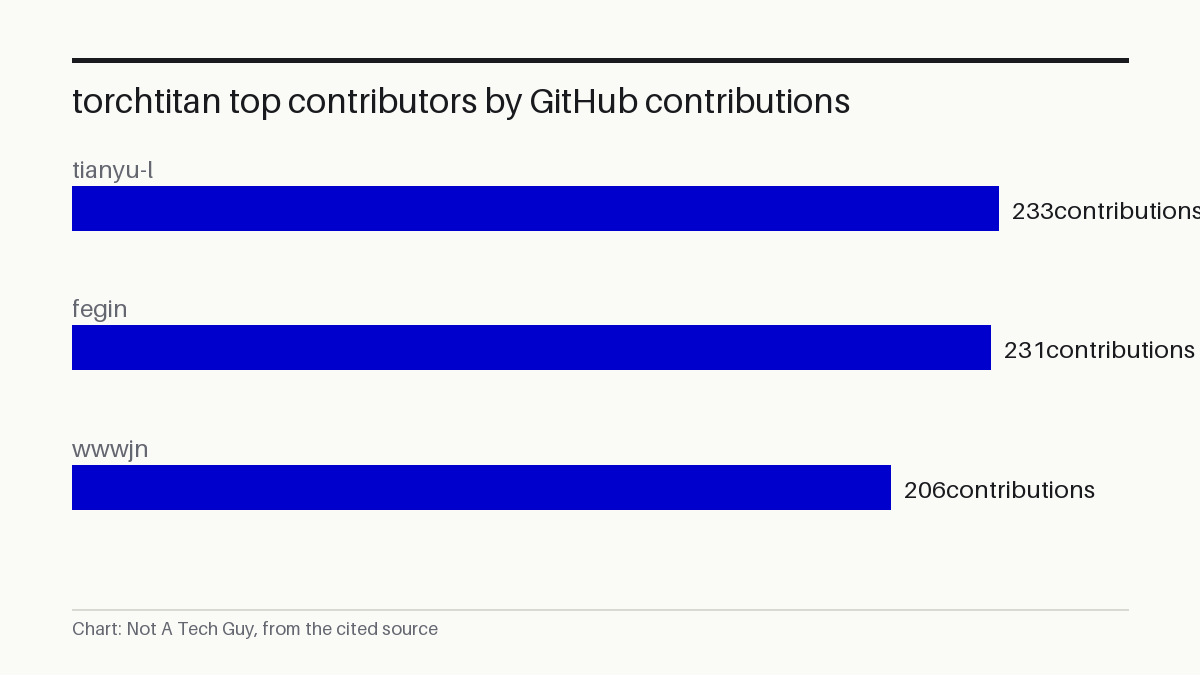
The project is real and active. It carries a BSD 3-Clause licence, has 1,091 forks and 486 open issues, and was created in December 2023 P⁴. The top contributors, tianyu-l with 233 contributions, fegin with 231, and wwwjn with 206, are PyTorch team members P⁴. A contributor named acisseJZhong cut the v0.4.0 release P². An earlier torchtitan paper was accepted at ICLR 2025 S¹.
But the capability claims rest entirely on the maintainers' own description. The README explicitly states it is "not an independent review" S¹. No third-party benchmark compares torchtitan against alternatives like Megatron-LM or DeepSpeed. The project is under active development and requires a recent PyTorch nightly build to access the latest features S¹, which means anyone running it today is working with code that can change between installs.
The ecosystem is growing around it. AMD released an optimised fork for AMD GPUs in November 2025 S¹. SkyPilot, a cloud provisioning tool, added torchtitan support in October 2025 S¹. In August 2026, the project announced TitanRL, which reuses torchtitan model definitions and kernels across training and vLLM generation S¹. In October 2026, DatologyAI's Zephon data loader released a torchtitan integration S¹.
Who should look and what to check
A team training or fine-tuning large language models on multi-GPU clusters is the natural audience. The quickest way to evaluate torchtitan without committing to a full training run is to use the bundled debug model, which ships with its own tokenizer and requires no external downloads S¹. That lets you verify the parallelism configuration and distributed setup on your hardware before investing GPU hours in a real run.
For a real model like Llama 3, you need to download the tokenizer separately and have Hugging Face access for the weights S¹. The project requires Python 3.11 or higher and a PyTorch nightly build S¹, a constraint that limits it to teams willing to track upstream PyTorch changes between installs.
Sources: S1 — pytorch/torchtitan: A PyTorch native platform for training generative · P2 — Releases · pytorch/torchtitan · GitHub · P3 — Trending repositories on GitHub today · GitHub · P4 — pytorch/torchtitan · P5 — pytorch/pytorch
Related reading
- NVIDIA Switchyard routes AI traffic across models — our technology desk, 2026-11-18
- OpenAI brings frontier models to Google Cloud — our technology desk, 2026-10-21
- uzu: Rust inference engine for on-device AI models — our technology desk, 2026-11-15
Written from 5 sourced items, 4 of them primary.