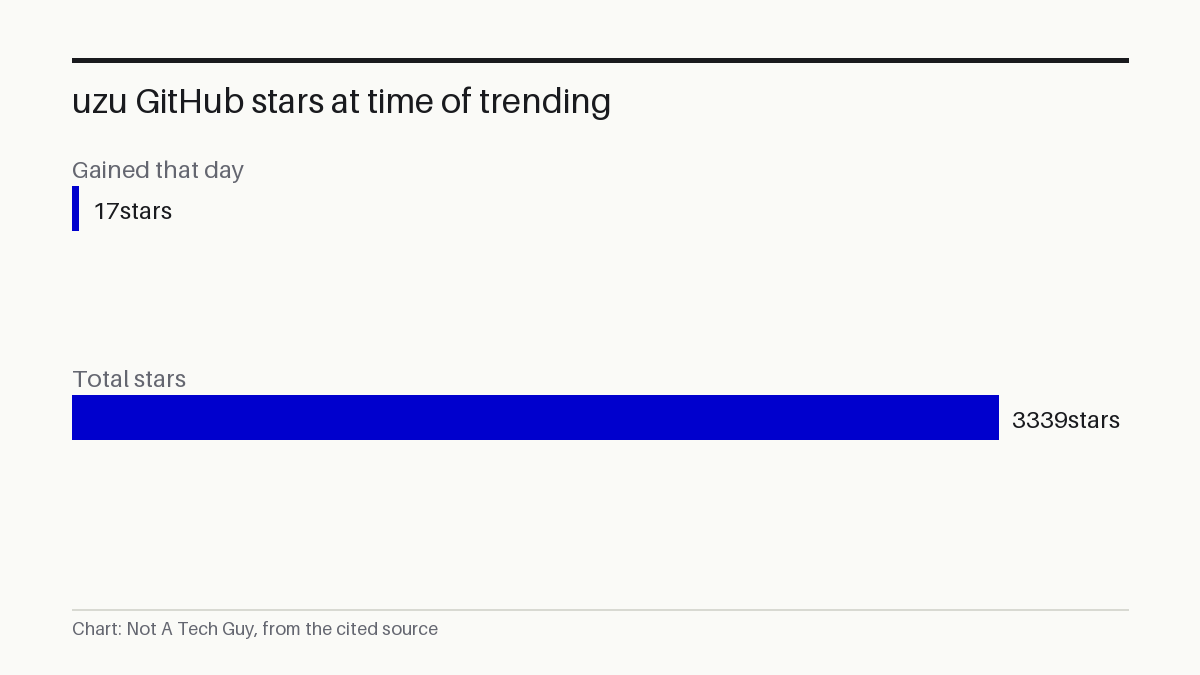

trymirai's uzu, a Rust inference engine that runs AI models inside apps, hit GitHub's daily trending list on 15 November with 3,339 total stars after gaining 17 that day S¹. The maintainers promise zero latency, full data privacy, and no inference costs, but no one outside the project has verified any of those claims S¹.
My read: The pitch is seductive for any developer paying per-token API bills, but "zero latency" is physically impossible for any computation and "no inference costs" ignores the hardware and electricity your device already consumes. What is verifiable is the code: bindings exist for Rust, Python, Swift, and TypeScript, the current package version is 0.6.17, and the project ships a quantized Qwen checkpoint as its reference model S¹P². I would treat this as an early-stage tool worth watching, not something to build production around. The number I would watch is whether any third-party benchmark appears comparing uzu's throughput against llama.cpp or MLX on the same Apple Silicon.
What uzu actually is
uzu is the inference engine behind Mirai, a Mac app and command-line tool P². You can call it directly from Rust, Python, Swift, and TypeScript, which means a developer can embed model inference into a desktop or mobile application without routing requests to a remote API S¹P².
The engine uses unified memory on Apple devices S¹. Unified memory is a feature of Apple Silicon where the CPU and GPU share the same memory pool, avoiding the data-copying overhead that slows inference on traditional architectures. Apple's own OpenELM model family, published by Apple researchers including Sachin Mehta and Mohammad Rastegari on arXiv, was built to exploit this same design P⁵.
The reference model in the project's documentation is "trymirai/Qwen3.5-4B-M", described as a quantized medium checkpoint P². The README quick-start code references a different model string containing "0.8b" S¹, suggesting a smaller 800-million-parameter variant may also be available. The "qwen3.5" label in both may not correspond to a publicly released Alibaba model version; the widely known Qwen series currently sits at version 2.5.
Who would use it and how
A developer building a Mac application that needs text generation, summarisation, or classification without sending user data to a cloud provider is the obvious target. The workflow: install the Python package at version 0.6.17, load the quantized Qwen checkpoint, and call the model in-process S¹. The same pattern works in Swift for iOS or macOS apps, and in Rust for systems-level code S¹.
This sits in the same space as other local inference engines that target Apple Silicon. The difference uzu claims is a unified API across four languages and what the maintainers call "traceable computations" S¹. The README does not specify what that tracing produces or in what format.
What is unverified
The README is the maintainers' own description, not an independent review S¹. The claims of "zero latency" and "no inference costs" are marketing language. Local inference still takes time, and the device still draws power. No benchmark has been published comparing uzu's speed or memory usage against established local inference engines. The project's 3,339 stars measure attention, not production-readiness S¹.
The broader context matters. Cloud-based AI inference has its own reliability problems, as a semantic relay attack demonstrated earlier this month. The cost of running frontier models through APIs has pushed developers toward open-weight alternatives, like the four Cosmos 3 models NVIDIA released in early November. Meanwhile, OpenAI's move to put frontier models on Google Cloud in October deepened the dependence of many apps on remote inference. uzu targets the same cost and privacy pressure from the opposite direction: instead of cheaper cloud inference, it offers no cloud at all.
One thing to check first
If you develop for Apple platforms and want to test uzu, clone the repository, install the Swift package at version 0.6.17, and run the quick-start example with the reference Qwen checkpoint S¹. Measure the time-to-first-token on your target hardware. If that number is not competitive with what llama.cpp or MLX already deliver on the same machine, the "zero latency" claim does not survive contact with a stopwatch. The how-to guide on the project's how-to branch walks through the full setup P².
Sources: S1 — trymirai/uzu: A high-performance inference engine for AI models · P2 — docs/how-to-run-uzu.md · P3 — huggingface/transformers · P4 — nktkt/ai-papers-cli · P5 — OpenELM: An Efficient Language Model Family with Open-source Training
Related reading
- OpenAI brings frontier models to Google Cloud — our technology desk, 2026-10-21
- Semantic communication relay attack degrades AI inference — our technology desk, 2026-11-08
- NVIDIA releases four open-weight Cosmos 3 world models — our technology desk, 2026-11-06
Written from 5 sourced items, 4 of them primary.