
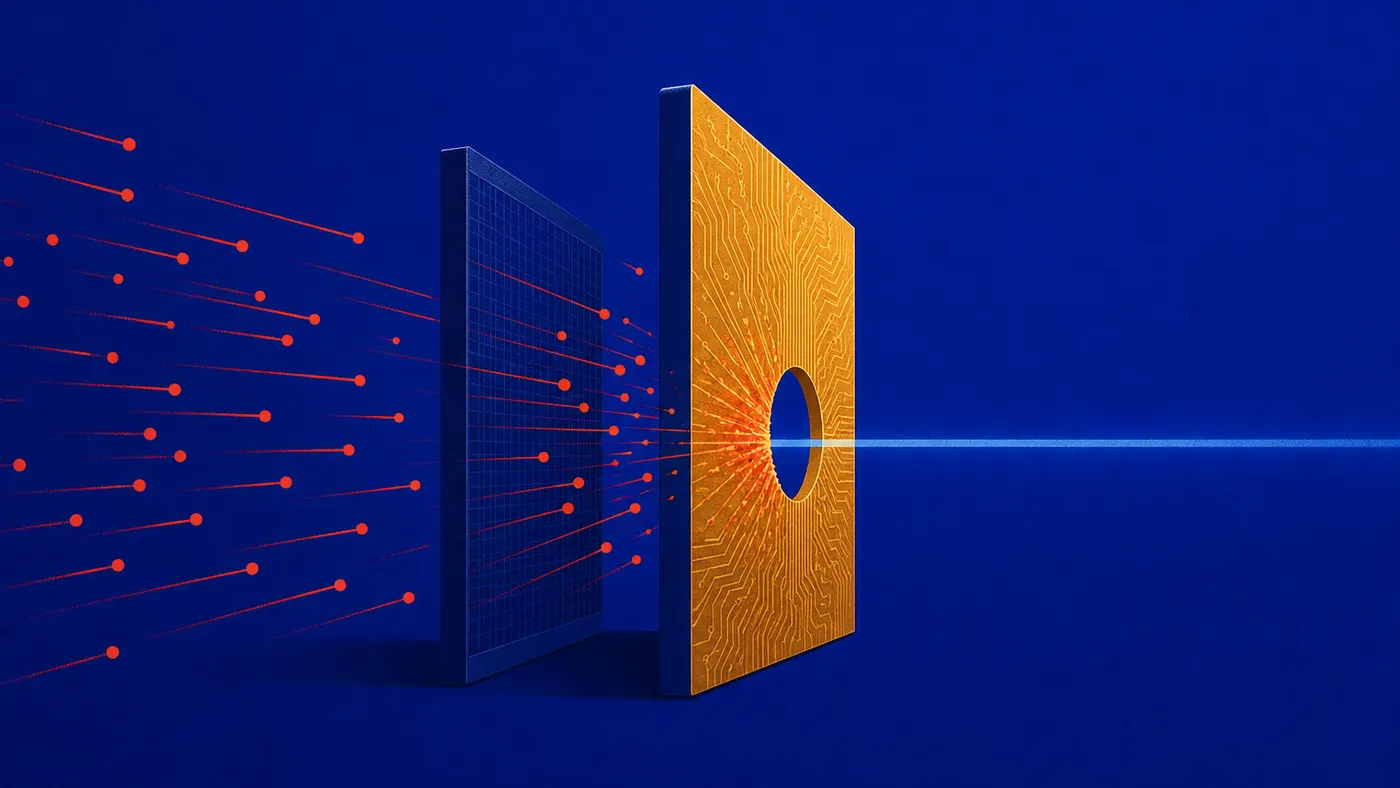
A new arXiv preprint proposes a dual-layer defence against cyber attacks that deliberately camouflage their behaviour to evade detection S¹. The approach pairs software-level anomaly detection with an independent hardware monitor that checks the same activity from a different vantage point. The gap it targets is real: attackers who know they are being watched can manipulate what the monitoring system sees. Whether a second layer actually closes that gap, or just shifts where attackers focus their effort, is the question this early outline begins to answer.
My read: This is the first cybersecurity architecture I have seen that explicitly frames camouflage as a failure mode of attack-tree diagnosis and of detection. The authentication-service example is compelling but theoretical. I don't buy the claim yet that hardware monitoring makes camouflage "much harder" in practice, because the paper is an outline, not an empirical study. What I would watch is whether the hardware monitor itself becomes a new attack surface.
The camouflage problem
Control-flow monitoring tracks the sequence of operations a program executes at runtime and flags deviations from the expected pattern S¹. The authors describe this method as providing a sound foundation for verifying program integrity S¹. Once an anomaly is detected, analysts use attack trees, diagrams that map possible attack paths, to identify what kind of attack is underway S¹.
The weakness is that attackers who understand this pipeline can game it. They deliberately manipulate the system's observed control flow so that the anomaly looks like something benign S¹. The monitoring system still sees a deviation, but the attack tree maps it to a harmless root cause. The attack is detected as an anomaly but misidentified as a maintenance issue, and the real intrusion goes unnoticed.
This preprint takes a different angle: rather than smarter detection algorithms, it argues for a second, independent monitoring layer.
Why two layers see more than one
The proposed architecture splits the work. Software-level observation runs first, flagging suspicious activity S¹. A separate hardware-level monitor then checks the same activity in more detail, independently S¹. The key word is "independently": the hardware monitor looks at the real instruction transitions as they happen on the processor, rather than relying on the abstracted view that an attacker may have already tampered with S¹.
In the paper's authentication-service example, the software observer sees an anomalous control-flow deviation and maps it to a benign root cause in the attack tree S¹. It misses the true intrusion S¹. The hardware monitor, watching the real transition sequence, reclassifies the event from a minor configuration or maintenance problem to a likely code injection or control-flow hijack S¹.
The combined approach, the authors argue, strengthens both the initial anomaly detection and the accuracy of attack-tree-based diagnosis S¹. It makes camouflage "much harder" because an attacker would need to simultaneously deceive two monitoring layers that do not share the same view of the system S¹.
What to do about it
For a security operations team running an authentication service, the kind the paper uses as its example, the practical takeaway is conceptual rather than ready to deploy. The paper is an outline, not an implementation guide S¹. No production system has been tested.
Consider a mid-sized fintech whose authentication service handles login requests. A software-level control-flow monitor might flag a spike in unusual login patterns and map it to a configuration error. A hardware monitor, if one existed in the stack, would see the actual instruction-level transitions and potentially flag a code injection that the software layer dismissed. The value is in the cross-check: two independent readings of the same event.
The practical step this week: if your team uses control-flow monitoring and attack trees for intrusion detection, audit whether your current setup has a single point of observation that an attacker could manipulate. The paper's argument is that any single layer is gameable. A second, independent layer is the proposed fix.
What we don't know yet
The paper is a preprint that has not been peer-reviewed S¹. It is described as an outline, not an empirical evaluation S¹. The authentication-service example is a theoretical illustration, not a documented real-world attack S¹. No claims about production deployment or testing have been made S¹.
The architecture has not been implemented or benchmarked against real attack data. The claim that hardware monitoring makes camouflage "much harder" is a theoretical argument, not a measured result S¹. Whether the hardware monitor itself introduces new attack surfaces or performance overhead is not addressed.
The next signal: whether the authors release a companion paper or arXiv v2 with empirical results from an implementation. We'll check this claim against it.
If decoding the mechanics behind security news is what you're here for, subscribe below. I'll be watching for the implementation study.
Sources: S1 — Towards Model-based Run-time Cybersecurity: On Control-Flow Anomaly De · P2 — GitHub - HHousen/TransformerSum: Models to perform neural summarizatio · P3 — The Geometry of Harmful Intent: Training-Free Anomaly Detection via An · P4 — basel/ATTACK-BERT · Hugging Face
More from Not A Tech Guy
- Reinforcement learning cuts AI training power violations 89%
- AI image models fingerprinted without watermarks
- AI agent rewrites its own code, hits 22% on DBpedia
Generated from an audited evidence pack with primary-source research. Social-media items are discussion signals, not verified facts. Nothing here is financial, legal or medical advice.