A reinforcement-learning controller reduced power-limit violations by 89.8% and enhanced energy efficiency by 26.2% during LLM training on A100 GPUs, according to a preprint posted on arXiv on 13 August S¹. But when the same researchers scaled their controller from a 7-billion-parameter model to 72 billion, it yielded nothing. The diagnosis, the fix, and what it means for datacenters running thousands of GPUs are on the other side of this wall.
My read: This is the first paper I've seen that measures reinforcement-learning post-training power behavior at half-second resolution and then tries to control it with RL itself. The 7B numbers are strong. The 72B failure is more interesting than the success, because it tells you where the simple version of this idea breaks: when a model is sharded across multiple GPUs, the knob you were turning no longer moves the dial. The rebuilt controller's 35.7% output gain at 72B is real but modest compared with the 7B results, and the twofold oversubscription claim is explicitly speculative. I would watch whether any cloud operator picks this up for a pilot, because the paper says they designed one.
Why GPU power management is blind today
The researchers point out a problem relevant to anyone managing electricity costs. Current datacenter GPU power management relies on methods that ignore the specific task being run, relying on fixed limits and reactive throttling that uniformly slow down the hardware S¹. This leads to lost performance and unnecessary power consumption.
This matters more for reinforcement-learning post-training than for other workloads. The authors observe that RL post-training, the phase where models learn reasoning and responses via rewards, currently dominates language-model development, but its power consumption patterns on GPUs remain uncharacterized S¹. A separate study from Microsoft's Azure team highlighted this issue from a cloud perspective, observing that LLMs generate unique power signatures that standard tools struggle to manage effectively P². Earlier efforts such as Perseus focused on reducing energy waste during large-scale model training by cutting unnecessary computation P⁴, yet the detailed, sub-second power profile of RL training had not been documented.
What the power telemetry revealed
The researchers instrumented GRPO training, a popular RL post-training method, with half-second power telemetry at three scales: 7B, 14B, and 72B parameters, running on one to four A100 GPUs. They collected more than 380,000 power samples S¹.
The measurements revealed brief, intense power surges during the generation phase of RL training, which occurs when the model creates text for a reward function to evaluate. At the 72B scale, these surges appeared in 23.6% of half-second intervals. However, these spikes are fleeting. Expanding the window to 30 seconds reduces the transient proportion to 1.6%, and at five minutes, they disappear completely S¹.
That finding alone changes how an operator should think about power budgeting. The surges that cause throttling at sub-second levels cannot be seen at the longer timescales used for infrastructure planning.
The controller that worked at 7B
The researchers developed a PPO meta-controller, an RL agent that monitors power readings and dynamically modifies the workload's generation parameters S¹. Instead of imposing an external power limit on the GPU, it adjusts the workload internally by altering the number of tokens generated simultaneously, which directly impacts power usage.
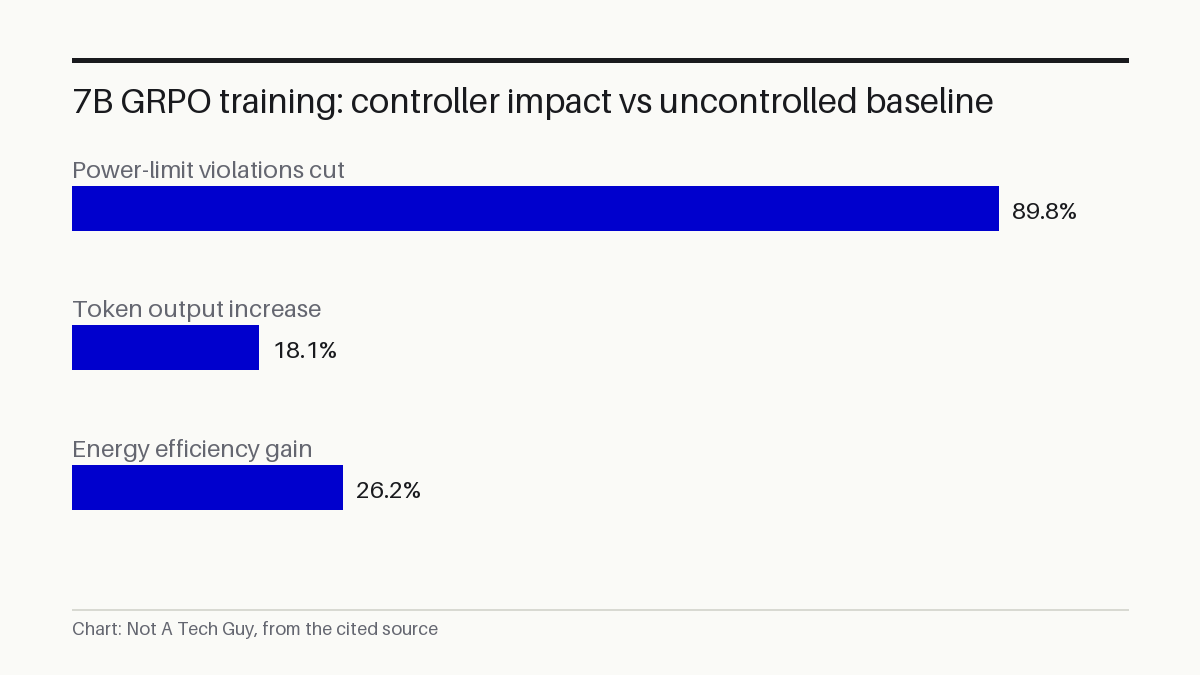
Tested against a complete 500-step training trace at 7B scale, the controller reduced power-limit violations by 89.8%, boosted token output by 18.1%, and enhanced energy efficiency by 26.2% (measured in tokens per MWh) S¹. It achieved higher output, fewer violations, and lower energy per token, succeeding across all three metrics.
What broke at 72B
Here is where the story turns. When deployed live at 72B scale, the same controller family yielded replicated null results S¹. The improvements completely disappeared.
The cause: when a 72B model is sharded across multiple GPUs, divided so each GPU contains a portion of the model, the controller's main lever loses its ability to influence power draw S¹. This lever is a parameter known as group size, which dictates the number of responses generated per training step. The setting can still be adjusted, but the hardware no longer reacts.
An actuator-authority sweep verified this. When the same parameters were applied as generation concurrency, a different lever controlling the number of parallel generation requests, they maintained 17 to 22% power authority even with sharding S¹. The team also identified an occupancy-versus-volume principle: at large scales, the critical factor is the number of active GPU cores, rather than the workload of each individual core S¹.
The rebuild
A controller redesigned to use generation concurrency instead of group size executed a live 72B rollout-generation workload across three replications. It generated 35.7% more output than a static safe baseline, with 2.27% budget violations (plus or minus 1.08%) S¹. This represents 87.2% fewer violations compared to uncontrolled operation S¹. The redesigned controller attained the highest mean throughput and best energy efficiency per token among all constrained controllers evaluated S¹.
An adaptive threshold rule, a simpler heuristic lacking a learned policy, performed as well as the redesigned controller in one of three operating conditions S¹. This detail is significant: in certain scenarios, a basic rule can be just as effective as a complex one.
What the fleet-level numbers say
The authors constructed a simulated 16-GPU fleet using their recorded traces. At 30-second measurement windows and above, the fleet exhibited zero power-limit violations S¹. Peak demand reached only 50 to 56% of the nameplate power capacity S¹.
Based on these findings, the authors propose that approximately twofold oversubscription of nameplate power could be viable for this fleet composition, pending operator validation S¹. This implies that a datacenter might fit twice as many GPUs within a specific power envelope as the nameplate rating would indicate, since actual peak demand is only about half of the rated capacity. The authors clearly state that this is speculative and requires operator approval.
The study also calculates economic and carbon impacts and outlines a low-cost operator pilot program S¹, although the abstract does not provide specific dollar or tonnage figures.
What to do about it
Imagine a mid-sized AI lab conducting GRPO post-training on an eight-A100 GPU cluster. Currently, their infrastructure team likely enforces a static power cap per GPU to remain within the rack's power limits. During training spikes, this cap throttles all GPUs uniformly, which slows down the rollout and wastes time. The RL generation phase, where the model creates candidate responses, is responsible for these spikes. The weight-update phase consumes less power.
This research indicates that a better approach is to adjust generation concurrency based on measured power, rather than applying an external GPU cap. The lab's ML engineers already manage generation concurrency as a training hyperparameter. The key insight is that it can serve as a real-time control variable, modified every few seconds according to actual power consumption, instead of being a static setting configured once and ignored.
For a practical initial step this week: if you operate RL post-training, extract half-second power telemetry from your GPU monitoring system during a training run. Examine the ratio of peak to average power. If your peaks are significantly below nameplate, you are underutilizing rack capacity. This ratio reveals your actual oversubscription headroom, even before implementing any controller.
What we don't know yet
This is a single arXiv preprint, version 1, lacking peer review and independent verification S¹. All hardware claims are specific to Nvidia A100 GPUs and GRPO-style RL post-training. The controller has not been evaluated on other GPU models, inference workloads, or non-RL training techniques.
The 72B results originate from a redesigned controller, not the initial version. The original failed entirely at that scale, and the solution required identifying a specific interaction between model sharding and the control lever. It remains unknown whether the redesigned controller will generalize to other sharded configurations or larger scales.
The twofold oversubscription claim is derived from fleet-level trace calculations, not from a deployed, safety-certified result. The paper references economic and carbon figures, but the abstract lacks specific details.
The next signal: whether any cloud operator announces a pilot of workload-aware GPU power control in the coming months. The paper outlines a low-cost pilot design, meaning the blueprint is available. We will compare any operator announcement against the paper's claimed efficiency gains. If you want to follow this development with us, subscribe and we will keep you updated.
Sources: S1 — Cutting AI Datacenter Energy with Reinforcement Learning: Measured Pow · P2 — Characterizing Power Management Opportunities for LLMs in the Cloud · P3 — HewlettPackard/sustain-cluster · P4 — Perseus: Removing Energy Bloat from Large Model Training · P5 — pytorch/rl
More from Not A Tech Guy
- AI image models fingerprinted without watermarks
- AI agent rewrites its own code, hits 22% on DBpedia
- Liquid AI's 3B vision model jumps 54% on grounding
Generated from an audited evidence pack with primary-source research. Social-media items are discussion signals, not verified facts. Nothing here is financial, legal or medical advice.