

Liquid AI released LFM2.5-VL-3B on August 12, a 3-billion-parameter vision-language model that scored 87.9 on the RefCOCO grounding benchmark, up from 57.1 in its predecessor S¹. Grounding is the ability to locate a specific object in an image from a text description, and a 54% jump in one generation suggests something changed in how this model sees. Whether that change holds up outside the lab, and whether the model actually runs fast enough on edge devices as its title claims, is the question worth answering.
My read: This is the first small vision-language model I've seen that claims a grounding score above 87 at the 3B scale. The RefCOCO jump from 57.1 to 87.9 is large enough to be suspicious, but the training recipe, four times more vision data and a two-stage post-training pipeline with reinforcement learning, explains a plausible mechanism. I don't buy the "faster" and "edge" framing yet, because the announcement provides zero latency, throughput, or power metrics. The benchmark table also shows the model trails larger rivals like InternVL 3.5 4B on document understanding and OCR tasks, which tempers the "leads its size class" claim. What I'd watch is whether independent teams can reproduce these numbers.
How the model is built
LFM2.5-VL-3B pairs a SigLIP2 400M NaFlex vision encoder, the component that processes images, with the same pre-trained backbone as Liquid AI's LFM2.5-2.6B text model S¹. The whole system was pre-trained on about 34 trillion tokens, with four times more vision data than the previous generation S¹. That training data came from curated and synthetic image-caption pairs, OCR datasets, grounding sets, and instruction-following collections S¹.
The tokenizer, the system that chops text into pieces the model can process, had its vocabulary doubled to 128,000 tokens to support non-Latin scripts. Liquid AI extended the tokenizer in place rather than retraining from scratch S¹.
Post-training happened in two stages. First, supervised fine-tuning with knowledge distillation from a larger teacher model and something called "Antidoom training." Second, multi-reward reinforcement learning S¹. The LFM2 technical report on arXiv describes the broader LFM2 family as designed for efficient on-device deployment using hardware-in-the-loop architecture search under edge constraints P².
Where the numbers land
Liquid AI evaluated the model across benchmarks covering multilingual visual comprehension, instruction following, visual math, scientific reasoning, document understanding, object detection, multi-image understanding, and screen understanding S¹.
The three benchmarks where LFM2.5-VL-3B shows the biggest gains over its predecessor tell the story:
- RealWorldQA, which tests visual comprehension of real-world scenes: 73.1, up from 71.1 S¹
- RefCOCO-avg, which tests grounding, the ability to locate objects from text descriptions: 87.9, up from 57.1 S¹
- BLINK, which tests multi-image reasoning: 61.5, up from 50.2 S¹
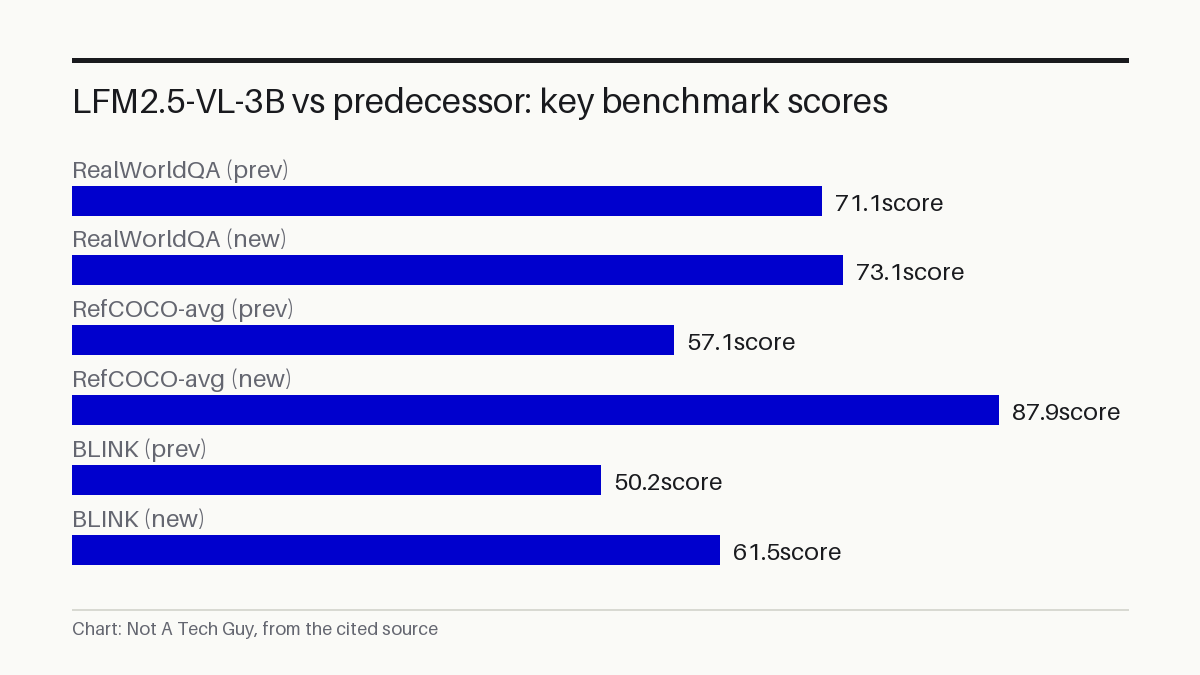
The grounding jump is the headline number. RefCOCO asks a model to identify the exact location of an object described in natural language, like "the red mug on the left shelf." Going from 57.1 to 87.9 in one generation is the kind of leap that usually means either a fundamentally better training recipe or a change in how the vision encoder connects to the language model. The fourfold increase in vision data during pre-training is the most likely explanation S¹.
Liquid AI asserts that the model outperforms others of a similar size on real-world image tasks and can interpret on-screen UI elements, charts, and documents S¹. The benchmark table tells a more mixed story. The model trails larger competitors on several measures: InternVL 3.5 4B outperforms it on MME and DocVQA, and Qwen3.5-4B beats it on OCRBench v2 S¹. The "leads its size class" claim holds only if you define the class narrowly as 3B-parameter models.
Four new capabilities
Four new capabilities are introduced in this model compared to the prior version: function calling, multi-image input, grounding, and screen and UI comprehension S¹. Function calling means the model can trigger external tools or APIs based on what it sees in an image, which matters for agent-style applications where vision feeds into automated workflows.
The screen and UI understanding capability lets the model interpret what is displayed on a phone, tablet, or computer screen. Combined with grounding, this opens up use cases like automated accessibility testing, where a model identifies interactive elements on a page and checks whether they meet design standards.
What to do about it
A warehouse logistics company running tablets on forklifts could point a camera at a pallet and ask the model to identify and locate specific cartons by description, not by barcode. At 3B parameters, the model is small enough to run on a mid-range mobile chip without sending images to a cloud server, which matters for warehouses with poor Wi-Fi or strict data-residency rules. The function calling feature means the same model could then log the count directly into an inventory system.
But anyone evaluating this model should run their own tests on their own data. The benchmark numbers are self-reported, and the model trails larger rivals on document-heavy tasks. If your use case is reading dense financial statements or scanned forms, a 4B model like InternVL 3.5 may serve you better despite the extra size.
One practical step this week: download the model weights from Hugging Face S¹ and run the RefCOCO grounding test on ten of your own images. If the model can reliably locate objects described in plain language across those ten images, the benchmark numbers are worth taking seriously for your application.
What we don't know yet
While the release title advertises improved and quicker vision features for edge devices, the actual text lacks any data on power usage, throughput, latency, or speed S¹. We do not know how many tokens per second the model generates on any specific edge hardware, how much RAM it requires, or whether it has been optimised for any particular chip. The LFM2 technical report describes the model family as designed for on-device deployment P², but the specific edge performance of LFM2.5-VL-3B remains unmeasured in public.
All benchmark scores are self-reported. No independent third party has verified them S¹. The text benchmark results, which the announcement says were evaluated, are not presented S¹.
The model also faces competition from other small vision-language models. Baidu's Qianfan-VL-3B targets enterprise document understanding and OCR P⁴, and NVIDIA's FasterViT architecture, published at ICLR 2024, focuses on fast vision processing P⁵.
The next signal: community benchmark reproductions on Hugging Face, which typically appear within weeks of an open-weight release. We'll check these claims against them when they land. Subscribe and we'll send the follow-up the moment the numbers arrive.
Sources: S1 — LFM2.5-VL-3B for Better and Faster Vision Capabilities for the Edge · P2 — LFM2 Technical Report · P3 — LiquidAI/LFM2-VL-3B · Hugging Face · P4 — baidu/Qianfan-VL-3B · Hugging Face · P5 — NVlabs/FasterViT
More from Not A Tech Guy
- Model ML runs finance work on GPT-5.6 Sol, outputs editable decks
- Self-evolving GUI agents improve click accuracy 7.4% after deployment
- AI models lose over 90% of safety signal in African languages
Generated from an audited evidence pack with primary-source research. Social-media items are discussion signals, not verified facts. Nothing here is financial, legal or medical advice.