
Ouro, a 2.6B-parameter looped language model, serves tokens up to 6.1× faster with its KV cache compressed to 0.5 bits per element, a November 3 arXiv preprint reports S¹.
The method, called LoopVQ, targets a bottleneck that standard LLM compression ignores: looped models recycle the same layers across multiple passes, and each pass hoards its own copy of every key and value, so the memory saved on parameters bleeds back through the cache S¹.
My read: The throughput numbers are striking but they rest on a narrow foundation. The paper tests only Ouro at 1.4B and 2.6B parameters and Huginn, all author-reported on a single SGLang implementation with no independent verification. I would watch whether the redundancy along the loop axis holds for models with more loop steps or different architectures, because the entire method depends on that assumption. The 0.25-bit result combined with TaSQ is the claim I am most skeptical of, since the paper gives no error bars and "retains much of BF16 accuracy" is vague enough to hide meaningful degradation.
The memory trap in recycled layers
Looped transformers reuse the same neural layers across multiple iterations rather than stacking fresh ones S¹. A 1.4B-parameter model can approach the performance of a conventional network several times its size by running its layers through several loop steps. The trade-off is memory. In a standard transformer, the KV cache, the stored keys and values from previously generated tokens, scales with sequence length. In a looped transformer, it scales with sequence length multiplied by the number of loop steps S¹. At a 32,000-token context with multiple loops, the cache can dwarf the model weights themselves.
The authors observed two properties that make this cache compressible S¹. The keys and values are highly redundant along the loop axis, so successive passes produce similar representations. And different loop steps vary in how much precision loss they tolerate.
How LoopVQ works
LoopVQ applies vector quantization, a technique that replaces continuous numbers with references to a shared lookup table of representative values, to the KV cache of looped transformers S¹. It codes channels across multiple loop steps jointly, exploiting the redundancy, and fine-tunes the codebook entries to match the output of the original full-precision model S¹. The design is orthogonal to existing KV cache quantization methods for standard LLMs, so it could in principle stack on top of them S¹.
At 0.5 bits per element, LoopVQ outperforms existing KV cache vector quantization methods designed for standard LLMs on general reasoning, long chain-of-thought reasoning, and long-context retrieval tasks, with tests on the Ouro and Huginn models S¹. Combined with TaSQ, another quantization technique, it retains much of the BF16 accuracy at 0.25 bits per element S¹. BF16, or bfloat16, is the 16-bit format models typically use at full precision, so 0.25 bits is a 64-fold compression.
Speed in a real serving framework
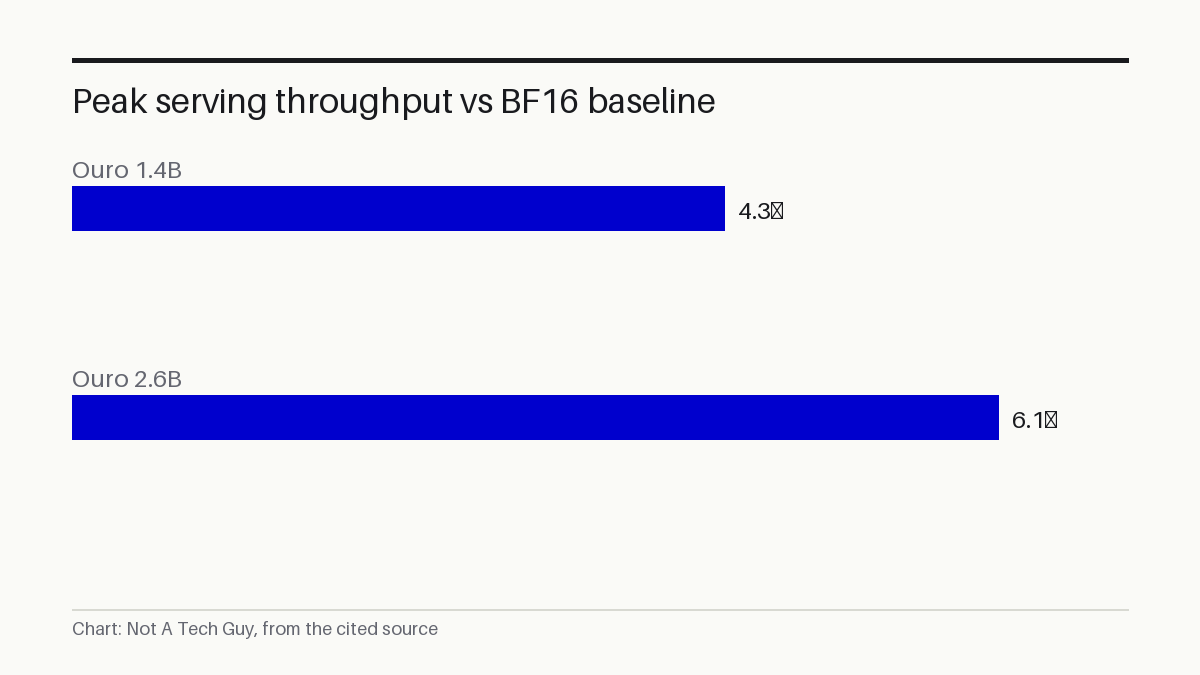
The authors implemented LoopVQ in SGLang, an open-source inference engine, and measured serving performance S¹. At a 32,000-token context, decode latency, the time to generate each new token, nearly halves compared to the BF16 baseline S¹. Peak serving throughput rises by up to 4.3× on the 1.4B Ouro model and up to 6.1× on the 2.6B Ouro, both against the BF16 baseline S¹.
What no one has checked
The preprint has not been peer-reviewed S¹. All performance figures are author-reported. The evaluation covers only three models, Ouro at 1.4B and 2.6B parameters and Huginn, and whether the redundancy assumption holds across other looped architectures is unproven. The throughput and latency figures come from an SGLang implementation and may not transfer to other serving frameworks. The paper reports no error bars on the accuracy claims.
Related work is still early. ResidualQuant, a separate preprint from Heejun Kim at KAIST and colleagues at Yonsei University and Seoul National University, tackles the same looped-transformer cache problem with 2-bit residual quantization P³. LoopQuant, from Zhixiong Zhao at Peking University and Houmo AI, takes a post-training approach P⁵. For standard, non-looped LLMs, KIVI, which appeared at ICML 2024, offers tuning-free 2-bit KV cache quantization P⁴. LoopVQ's contribution is specific to the loop axis that those methods do not address.
Who feels this first
A team serving looped models like Ouro or Huginn in production at long contexts would feel the cache pressure most directly. For them, the practical first step is to check whether their serving stack is SGLang-compatible, since every reported speed gain comes from that framework. The 0.5-bit configuration has the strongest comparative evidence. The 0.25-bit result depends on combining LoopVQ with TaSQ, and the paper does not specify how much accuracy is lost at that level.
The preprint is available on arXiv; no code release is confirmed in the paper.
Sources: S1 — LoopVQ: Sub 1-bit KV Cache Quantization for Looped Transformers · P2 — simplescaling/s1 · P3 — ResidualQuant: KV Cache Quantization for Looped Transformers with 2-Bi · P4 — jy-yuan/KIVI · P5 — LoopQuant: Accurate and Efficient Post-Training Quantization for Loope
Written from 5 sourced items, 4 of them primary.