A new AI framework called MAR-12 reaches 80.3% accuracy detecting humor in internet memes and 75.9% for detecting hate, according to a paper published on arXiv on 20 July 2026 [S1]. Spotting a joke is easy. Telling when a joke is also a weapon, and explaining why, is the problem. That distinction is what content moderation systems at every major platform still get wrong, and the gap costs real money, real reputations, and real harm.
Why memes break AI classifiers
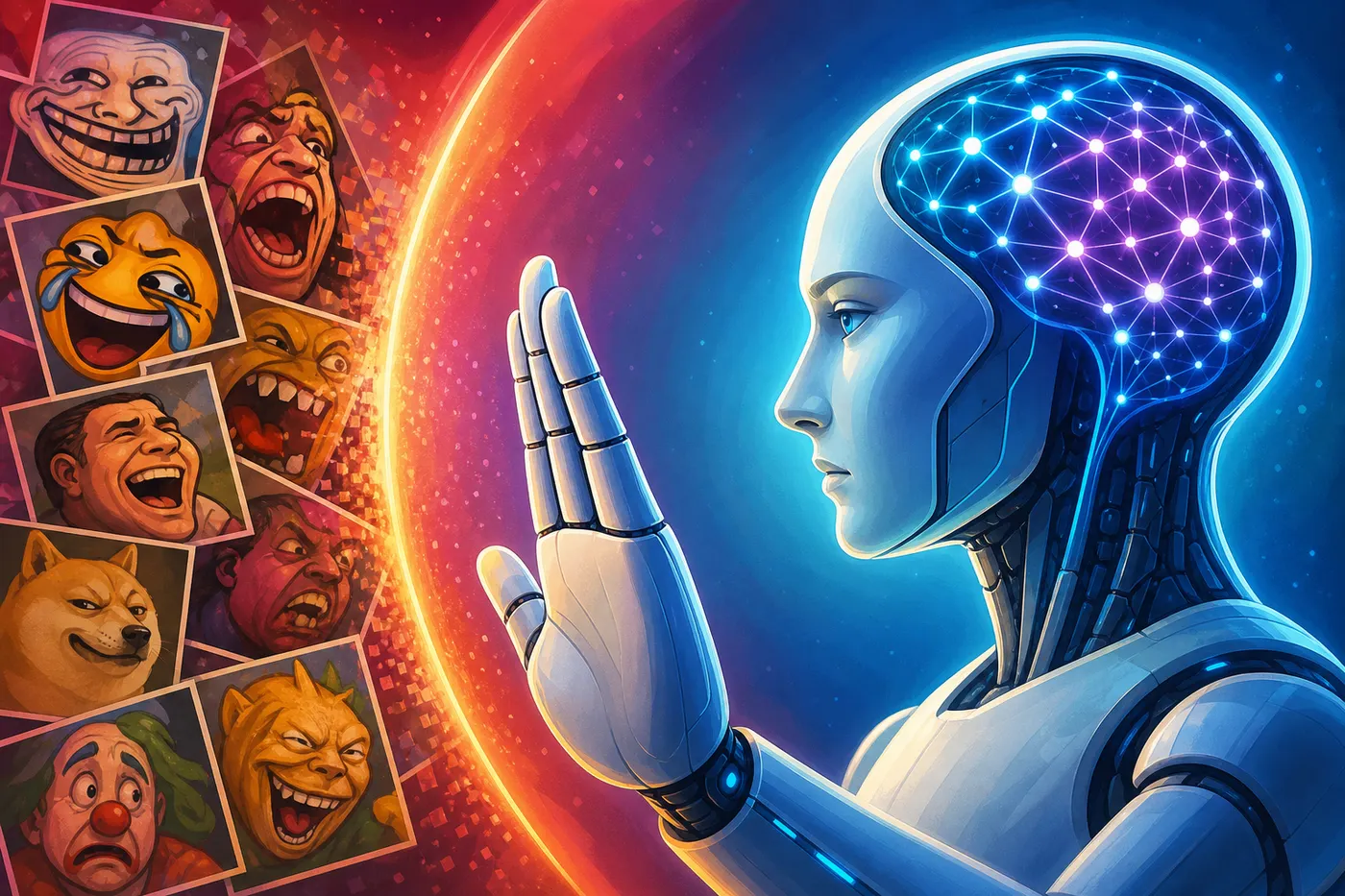
Internet memes are a nightmare for automated moderation. They mix visual cues, text, and cultural references into a single image, and the same elements that make a meme funny can make it hateful [S1]. A photo of a cat with a caption about Mondays is harmless. The same photo with a caption targeting a specific group is not. The image hasn't changed. The context has.
Existing multimodal classifiers, the paper notes, either miss the connections between these layers or offer little explanation for their decisions [S1]. A system that flags a meme as harmful but can't say why is useless to a human moderator reviewing thousands of posts per shift. It's also useless to the person whose post was wrongly removed.
This isn't a new problem. A related preprint from earlier in 2026, "They Said Memes Were Harmless, We Found the Ones That Hurt," tackled the same challenge of decoding jokes, symbols, and cultural references in memes [P2]. Another line of work explored using multiple large language models to debate whether a meme is harmful, pushing toward explainability through argumentation [P4]. MAR-12 takes a different route: structured reasoning from the start.
Twelve angles on a single image
MAR-12, which stands for Multi-Angle Reasoning with twelve perspectives, uses Vision Language Models to read both the image and the text in a meme [S1]. Vision Language Models are AI systems that process images and text together, the same family of technology behind tools like GPT-4V.
The framework doesn't just look at a meme once. It interprets each one through twelve structured perspectives drawn from humor theory and hate speech theory [S1]. Think of it as twelve different analysts, each trained to look for a specific pattern: one checks for sarcasm, another for stereotyping, another for the gap between literal meaning and intent, and so on.
A role-aware soft-gated attention mechanism then learns how much weight each perspective should carry for a given meme [S1]. Not every angle matters equally for every image. A meme that relies on visual distortion might need the image-analysis perspective more than the text-analysis one. The attention mechanism figures that out during training.
Finally, a prototype-based classifier makes the call: is this meme harmful, humorous, or both [S1]? Prototype-based classifiers compare each input to learned representative examples rather than drawing a single boundary through the data, which helps when categories overlap, as they do in memes where humor and hate coexist.
The explanations are where MAR-12 tries to separate itself. It synthesises them from the perspective-specific reasoning and the learned attention weights [S1], so a human moderator can see which angles drove the decision. MAR-12 applies a clear principle: don't let the model jump to a conclusion, make it work through the angles first.
The paper reports that human evaluators and GPT-4-based evaluations both found the explanations coherent and persuasive, particularly for memes where humorous and harmful cues appear at the same time [S1].
What it means
For a regular person scrolling through a feed, this research points to a future where the AI flagging your post can tell you why. Right now, moderation is a black box. A meme gets removed, and the user gets a generic notice about "community guidelines." MAR-12's approach, if it holds up, could produce specific explanations: this meme was flagged because the text uses a derogatory term common in anti-immigrant discourse, and the image depicts the target group in a dehumanising way.
That matters for two reasons. First, it gives users a way to understand and potentially appeal decisions. Second, it gives moderators a tool that explains itself rather than one they have to trust blindly. The 80.3% humor detection and 75.9% hate detection figures [S1] are not perfect, but they suggest the twelve-angle approach captures something single-pass classifiers miss.
The core insight is that harmful humor is not a single signal. It's a stack: a joke layer, a target layer, a cultural-reference layer, and an intent layer. MAR-12's contribution is trying to read all of them and show its work.
What it means for business
A two-person social media agency managing brand accounts knows the meme problem firsthand. A client shares a meme that seems funny to the team, but the cultural reference is offensive in a market they don't know. The agency needs a tool that can catch that before it goes live and explain the risk in plain terms.
MAR-12 is not that tool yet. It's a research framework on a preprint server. But the architecture points toward what such a tool would look like: a system that checks a meme from multiple angles, weights the risks, and produces a readable explanation rather than a binary flag.
For trust and safety teams at larger platforms, the appeal is cost. Human moderators review thousands of items per shift. A system that can pre-filter memes and attach a reasoning chain to each flag could let moderators focus on the borderline cases, where human judgment matters most. The prototype-based classifier also means the system can learn from new examples without a full retrain, which matters in a space where the vocabulary of harmful memes shifts weekly.
For smaller operators, the practical takeaway is to watch the Vision Language Model space. The models that power MAR-12 are getting cheaper and more capable. A suburban marketing firm that already uses AI for copywriting could, within a year or two, run a meme through a multi-angle safety check before posting, the way they currently run text through a spell checker.
What we don't know yet
The paper is an arXiv preprint. It has not been peer-reviewed, and the findings should be treated as provisional [S1].
Several questions remain open:
- The abstract doesn't specify whether the 80.3% humor detection and 75.9% hate detection figures were achieved on the same dataset or split across PrideMM and Memotion [S1]. Without knowing which benchmark produced which number, it's hard to compare against other systems fairly.
- The claim that MAR-12 outperforms state-of-the-art approaches is self-reported by the authors [S1]. Independent verification on the same benchmarks hasn't happened yet.
- Using GPT-4 to evaluate the quality of explanations introduces a potential circularity problem [S1]. GPT-4 is itself a large language model, and its judgments about what constitutes a coherent explanation may favour outputs that resemble its own reasoning style.
- The accuracy figures come from two specific datasets, PrideMM and Memotion [S1]. Real-world meme content is messier, more diverse, and evolves faster than any benchmark can capture. A meme format that emerged last week won't be in either dataset.
The next concrete event to watch is whether this paper gets accepted at a peer-reviewed venue, which would bring independent validation of the benchmark results. Until then, the twelve-angle approach is a promising idea, not a proven system.
If this kind of deep-dive into AI reasoning research is useful to you, subscribe to keep reading. We track the papers, the benchmarks, and the numbers that actually change what's possible.
Sources
- [S1] Beyond a Joke: Multi-Angle Reasoning for Detecting and Explaining Harmful Humor in Memes — arXiv cs.AI new (official RSS) (attributed)
- [P2] They Said Memes Were Harmless-We Found the Ones That Hurt: Decoding Jokes, Symbols, and Cultural References — They Said Memes Were Harmless-We Found the Ones That Hurt: Decoding Jokes, Symbols, and Cultural References (attributed)
- [P3] LTH14/mar — LTH14/mar (attributed)
- [P4] Towards Explainable Harmful Meme Detection through Multimodal Debate between Large Language Models — Towards Explainable Harmful Meme Detection through Multimodal Debate between Large Language Models (attributed)
- [P5] Chenyu-Wang567/All-Angles-Bench — Chenyu-Wang567/All-Angles-Bench (attributed)
More from Not A Tech Guy
- LLMs hold stable risk attitudes across tasks, study finds
- Text-to-video jailbreak gains 18.6% over closest rival
- OpenAI launches ChatGPT small business program
Generated from an audited evidence pack with primary-source research. Social-media items are discussion signals, not verified facts. Nothing here is financial, legal or medical advice.