
An arXiv preprint posted on 4 September 2026 describes Speculative Macro Commit, a runtime mechanism that cut tool-using agent wall time by 44.9% on the AppWorld benchmark while matching baseline accuracy on a second test S¹. The method pairs a small, fast model with a large, slow one, letting the small model guess what tools the big model will call next and pre-run them in an isolated copy of the environment. Whether that gamble pays off consistently, or whether the speed gain silently costs you completed tasks, is the question the paper opens but leaves half-answered.
My read: This is the most interesting agent-speedup idea I have seen this year. It takes the logic behind speculative decoding, a technique that already works for token generation, and applies it to the part of agent latency that actually hurts: the dead time between a model deciding to call a tool and the tool returning a result. I am skeptical of the AppWorld trade-off, where faster execution came with what the authors call a "small reduction in task completion" S¹ without putting a number on it. That gap matters. If you ship this and your agent finishes faster but solves fewer problems, you have not saved time. You have wasted it.
How the two-model gamble works
Think of a tool-using agent as a loop. The model decides to call a tool, waits for the result, reads it, decides on the next tool call, waits again. Each round trip is dead time. The model is not thinking during the tool execution. It is waiting.
SMC breaks that wait into parallel work. A large "actor" model, in this case Qwen3.5-27B INT4, produces the official record of what the agent did S¹. A smaller, faster "drafter" model, Qwen3.5-4B, runs ahead on an isolated snapshot of the environment, predicting and executing the next several tool calls before the actor has finished its current step S¹.
Here is the clever part. Before any of this happens, SMC mines training traces for recurring patterns of multi-action sequences, what the authors call "skeletons", and stores them in a macro library S¹. At runtime, the drafter checks its predicted action chains against that library. When the actor's next tool call matches the first action the drafter predicted, SMC commits the entire pre-executed chain, observations included, to the official trajectory S¹. The actor skips ahead. If the prediction is wrong, the draft is discarded and the actor proceeds normally.
Microsoft Research explored a related idea in March 2026 with "Act While Thinking," a paper on pattern-aware speculative tool execution for agents P². SMC extends that thread by adding the macro library. The library gives the drafter a structured set of known action patterns to match against rather than predicting from scratch each time.
Where the numbers land
The researchers tested SMC on two benchmarks. On the τ²-Bench Telecom subset, SMC matched the sequential agent's accuracy while cutting latency by 10.23% compared to the Speculative Actions baseline and 18.59% compared to plain sequential execution S¹.
On AppWorld, the gains were larger but came with a cost. Wall time dropped 7.7% over the SA baseline and 44.9% over sequential execution S¹. Task completion rates took a small hit, which the authors acknowledge without quantifying S¹.
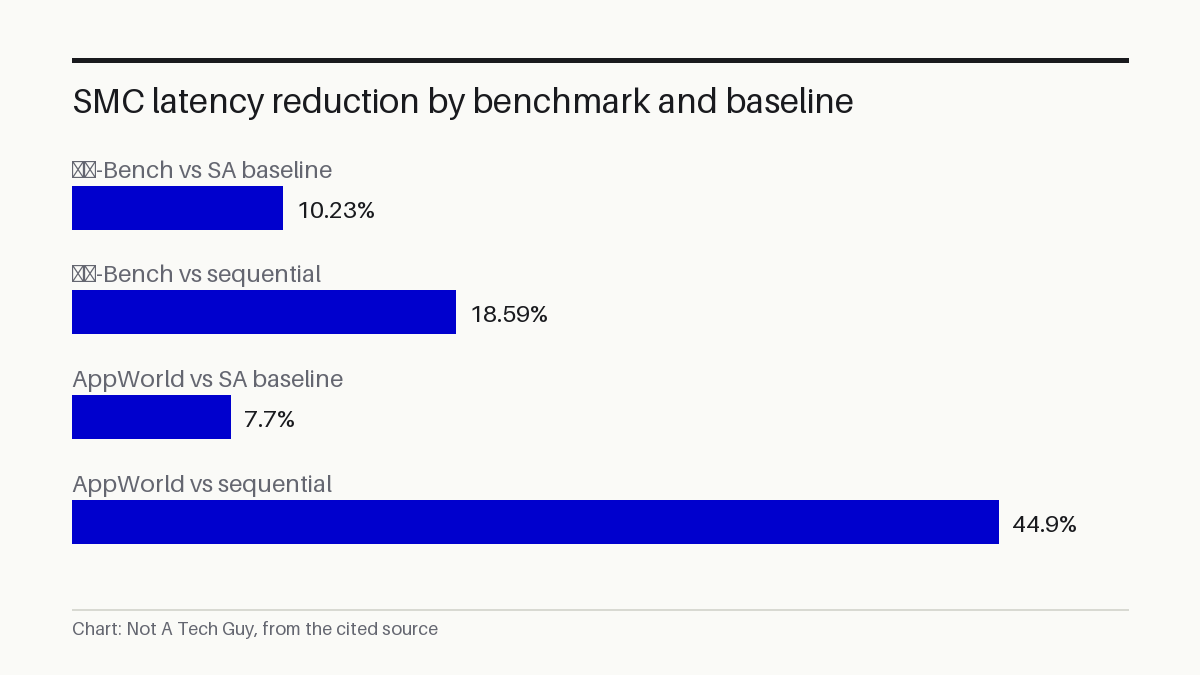
The spread between benchmarks is wide. A 7.7% improvement over the existing SA baseline on AppWorld is modest. The 44.9% figure looks dramatic, but it compares against sequential execution, the slowest possible baseline, not against the current best method. The accuracy-preserving result on τ²-Bench is the stronger claim.
What to do about it
If you build agents that call external tools in repeated sequences, this paper points to a concrete optimisation path. Consider a DevOps automation team whose agent queries a monitoring API, reads the response, checks a runbook database, then files a ticket. That four-step pattern repeats hundreds of times a day. SMC's macro library would mine that pattern from past traces, and the drafter model could pre-execute steps two through four while the actor is still processing step one.
The practical move this week: audit your agent's tool-call traces for repeated multi-step patterns. If you see the same three or four action sequences showing up across sessions, your workload is a candidate for this kind of speculative execution. The code is public on GitHub S¹, and the model pairing tested uses Alibaba's open-weight Qwen3 series P⁵, so you can reproduce the setup without licensing a proprietary model.
SMC is a useful addition to the agent-speedup toolkit, but it carries a known edge: it trades accuracy for speed in some settings, and you need to measure which side of that trade your workload falls on.
What we don't know yet
The paper leaves several gaps. The "small reduction in task completion" on AppWorld has no number attached to it S¹. Without a figure, you cannot tell whether the trade-off is a rounding error or a real degradation. The results come from exactly one model pairing, Qwen3.5-27B INT4 and Qwen3.5-4B S¹, so claims about broader applicability to other model sizes or families are untested. The two benchmarks cover specific domains. Whether SMC helps with code-generation agents or web-browsing agents is unknown. And this is an arXiv preprint, not a peer-reviewed publication. Every performance figure is self-reported.
The next signal: peer review and community reproduction. If independent teams can match the 44.9% wall-time reduction on AppWorld with a different model pairing and quantify the accuracy trade-off, this moves from interesting idea to deployable technique. We will check the GitHub repository for reproduction results and any follow-up paper that puts a number on the task-completion gap. If you want to know what happens when other researchers get their hands on this, subscribe and we will bring you the answer.
Sources: S1 — Speculative Macro Commit for Faster Tool-Using Agents · P2 — Act While Thinking: Accelerating LLM Agents via Pattern-Aware Speculat · P3 — smart-lty/LogitSpec · P4 — README.md · P5 — QwenLM/Qwen3
More from Not A Tech Guy
- GPT-6 Astra crosses OpenAI's Critical cybersecurity threshold
- Hermes Agent: 240k GitHub stars for self-improving AI
- Gilbert + Tobin deploys ChatGPT Enterprise firm-wide
Generated from an audited evidence pack with primary-source research. Social-media items are discussion signals, not verified facts. Nothing here is financial, legal or medical advice.